eBook - ePub
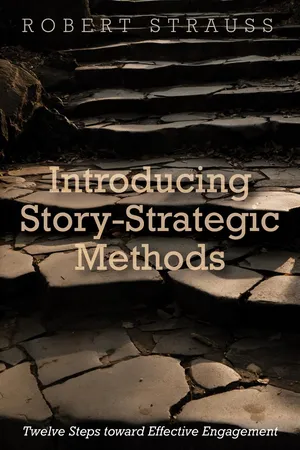
Introducing Story-Strategic Methods
Twelve Steps toward Effective Engagement
- 212 pages
- English
- ePUB (mobile friendly)
- Available on iOS & Android
eBook - ePub
About this book
The purpose of Introducing Story-Strategic Methods is to awaken us in the cross-cultural context. Our natural tendency is to be asleep to our own cultural values and core worldview assumptions. This tendency applies as well to our expectations in the cross-cultural context. For example, in what ways would a "justice" pattern of culture orient our speech and behavior? To what degree is a "justice" pattern of culture different from an "honor" pattern of culture? The book asserts that culture matters in effective communication. Going further, to what degree does a story told from the Bible nullify the power of culture? Often we assume that the biblical story trumps culture. It does not. The book affirms rigorously that culture is much more powerful than we first suppose. If in fact, culture trumps the biblical story. Therefore, understanding and skills are required for effective engagement across cultures. Strategic storytelling is a twelve-step methodology that addresses the problems of miscommunication and syncretism that plague the cross-cultural context. It offers a step-by-step solution that promises success. Insights are firmly rooted in Scripture and equally grounded in empirical research from the social sciences. The stories told throughout the book are true. The answers are compelling.
Information
Part One
Acknowledging Ambiguity
1
Describing the Context
There is More to the Story
In Reza Aslan’s book, There is no god, but God, the story is told on pages xviii-xxi of a conductor confronting a young American couple on a train bound to the interior city of Marrakesh from Casa Blanca on the Atlantic coast. In the story the conductor is upset and speaking loudly in Arabic, impacted by his Berber dialect. An economic center in West Africa, Marrakesh is a city dating from the Berber Empire with a population of about one million people.
Living now in California, but from the country of Iran, Aslan tells the story from his own perspective as a visitor in Morocco for several months. He is awakened from a rumbling slumber by a burst of conversation that he describes as a clap of thunder. It is coming from the adjacent compartment, loud enough to be heard over the roar of the train. Aslan says it sounded like a Moroccan authority was reprimanding someone and asking for passports.
The story goes something like this, but here it is retold fictitiously from the point of view of the conductor. However, the essence of the story is true.
The conductor had seen the young couple enter the First-Class compartment of Car 2 just after 8 PM in the evening. Departure from the train station in Casa Voys was at 20:50 with a normal arrival into the city of Marrakesh at midnight, three hours later. The train would make four stops along the way. Most passengers slept on this last run of the day from Casa Blanca. He did not know for sure at first, but assumed they were Americans from their appearance. Both were tall with long hair. The woman wore a thin long skirt and tank top. Her shoulders were bared and hair uncovered. It was blond and disheveled. They had backpacks but the man also carried a medium size box.
As soon as they were settled into their seats, the man opened the box and retrieved several books. The conductor immediately recognized what they were—Christian Bibles. His fury was abrupt, not only at the proselytizing but also the nightclub style apparel. The foreigner handed a book to each compartment companion who graciously accepted it. The conductor knew what to do but waited until the train was fully boarded. Mostly businessmen filled Car 2. Another man caught the conductors eye. He appeared Persian but seemed to carry himself comfortably. Maybe he also spoke Arabic, the conductor wondered.
Shortly after departing from Casa Blanca, the conductor confronted the couple. The man and woman had nestled together in the corner of a seat near the window. Even though he could speak some French and a few words in English, the conductor spoke to the foreigner in Moroccan Arabic. He understood he must be forceful and uninterrupted.
Flushed, the foreigner responded in French at first, but quickly reverted to American English. The conductor knew it! They were Americans! He paid no attention to the foreigner’s responses. He fervently urged him to stop distributing material offensive to Allah. As he admonished the man, the man responded in defensive anger. The conductor demanded to see their passports.
The conductor had not noticed his flank, but promptly the Persian businessman was at his side, speaking Arabic softly. The Persian begged the conductor to understand. The foreign man and woman were married, he said. They were Americans. The Persian said that the man was attempting to tell the conductor that they were simply sleeping and meant no mischief. The conductor indignantly countered, “This is not a nightclub!”.
Again, the American nervously beseeched the businessman, “Will you please tell this man we were sleeping (xix)?” The young woman cried out in panic, and the American began taking out money to pay off the conductor so he would leave them be.
The Persian intervened once more and quietly shared with the conductor that he would stay with the American couple to make sure they did no further harm. With extreme reluctance, the conductor complied. In disgust, he departed and spat in English, “Christian!”, his voice brimming with contempt.
He saw from a distance that the Persian businessman did move into the compartment. He spoke with the American couple. They seemed to be sharing some explanation with him. What he could not hear was that they told the Persian they were missionaries enroute to the country of Western Sahara through Marrakesh. The box they brought was filled with New Testaments translated into Arabic. They were distributing them as a means of sharing their faith with the people of Morocco as they traveled through the country. They did not speak Arabic and only a few words of French. They intended to share the Gospel in Western Sahara, also a Muslim nation where Arabic and Berber were spoken.
The conductor turned away in revulsion.
The young American couple was unaware, but there is more to the story. In the Prologue to No god but God: The Origins, Evolution, and Future of Islam, Reza Aslan (2011) describes the more complete story, including a bitter history of the region that not all understand, especially those coming in from the outside. Malcolm and Jennifer, the American couple on the train, had no lingering memory of the colonial endeavor, the “civilizing mission” that went hand-in-hand with the Christianizing efforts in the past.1
Most of the time locals do know and do remember the complete story, with fervency. Muslims resent the West and are suspicious of its people. In the Muslim world, many believe that there is a collision between the United States (and Israel) and Islam.2
So, one would not abruptly go into Morocco from the West. If one did enter the country, one would want to (re)build relationships, learn language, and (re)earn trust. Gifting the Christian New Testament in a local language would not be the first step.
The Same Plot but Different Characters and Settings
The story that Reza tells in his Prologue I have only heard once. It is in his book about Islam. But the plot we have heard countless times all over the world. In many ways Reza’s plot crystalizes the context of modern Christian expansion. And, that context is the catalyst for this book.
A New Story but . . .
Yes, the story of the Gospel of the Lord Jesus may be new in some locales, but to what degree do we realize that a rival story already exists in those locales, indeed in every locale? There is no place we go or group of people whom we approach where a story does not already exist. It is there and has been perhaps for centuries. The local and region...
Table of contents
- Title Page
- Acknowledgments
- Introduction
- Part One: Acknowledging Ambiguity
- Part Two: Aiming for Clarity
- Appendix A: Essential Steps of Field Research
- Appendix B: Four Overarching Patterns of Culture
- Appendix C: An Adaptation of the Developmental Model of Intercultural Sensitivity
- Appendix D: The Four Capabilities of Cultural Intelligence (CQ)
- Appendix E: Etic and Emic Perspectives of Culture
- Appendix F: Value Dimensions of Culture
- Appendix G: Max Weber
- Appendix H: Edwards-Strauss-Steiner Model of Cultural Context Awareness of Self and Others
- Bibliography
Trusted by 375,005 students
Access to over 1.5 million titles for a fair monthly price.
Study more efficiently using our study tools.
Frequently asked questions
Yes, you can cancel anytime from the Subscription tab in your account settings on the Perlego website. Your subscription will stay active until the end of your current billing period. Learn how to cancel your subscription
No, books cannot be downloaded as external files, such as PDFs, for use outside of Perlego. However, you can download books within the Perlego app for offline reading on mobile or tablet. Learn how to download books offline
Perlego offers two plans: Essential and Complete
- Essential is ideal for learners and professionals who enjoy exploring a wide range of subjects. Access the Essential Library with 800,000+ trusted titles and best-sellers across business, personal growth, and the humanities. Includes unlimited reading time and Standard Read Aloud voice.
- Complete: Perfect for advanced learners and researchers needing full, unrestricted access. Unlock 1.5M+ books across hundreds of subjects, including academic and specialized titles. The Complete Plan also includes advanced features like Premium Read Aloud and Research Assistant.
We are an online textbook subscription service, where you can get access to an entire online library for less than the price of a single book per month. With over 1.5 million books across 990+ topics, we’ve got you covered! Learn about our mission
Look out for the read-aloud symbol on your next book to see if you can listen to it. The read-aloud tool reads text aloud for you, highlighting the text as it is being read. You can pause it, speed it up and slow it down. Learn more about Read Aloud
Yes! You can use the Perlego app on both iOS and Android devices to read anytime, anywhere — even offline. Perfect for commutes or when you’re on the go.
Please note we cannot support devices running on iOS 13 and Android 7 or earlier. Learn more about using the app
Please note we cannot support devices running on iOS 13 and Android 7 or earlier. Learn more about using the app
Yes, you can access Introducing Story-Strategic Methods by Robert Strauss in PDF and/or ePUB format, as well as other popular books in Social Sciences & Sociology. We have over 1.5 million books available in our catalogue for you to explore.