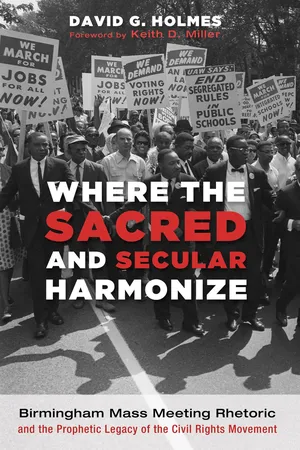
eBook - ePub
Where the Sacred and Secular Harmonize
Birmingham Mass Meeting Rhetoric and the Prophetic Legacy of the Civil Rights Movement
- 212 pages
- English
- ePUB (mobile friendly)
- Available on iOS & Android
eBook - ePub
Where the Sacred and Secular Harmonize
Birmingham Mass Meeting Rhetoric and the Prophetic Legacy of the Civil Rights Movement
About this book
Among pivotal historical moments in the United States, the civil rights movement stands out. In Where the Sacred and Secular Harmonize: Birmingham Mass Meeting Rhetoric and the Prophetic Legacy of the Civil Rights Movement, David G. Holmes offers an original rhetorical analysis of six speeches delivered during the 1963 civil rights campaign in Birmingham, Alabama. Holmes frames his analysis within the biblical concept of prophecy. However, he stresses the idea of prophecy as sociopolitical forth-telling, rather than mystical foretelling. Based on his own transcriptions from rare recordings, Holmes examines how these orations, which clergy and laypeople delivered, address enduring themes such as the role of religion and politics, black leadership and black activism, and the political and popular legacies of the civil rights movement.
Drawing upon American history, politics, hermeneutics, homiletics, and rhetoric, Holmes's discussion ranges from civil rights prophets to contemporary politicians, including Martin Luther King Jr. and Barack Obama. Where the Sacred and Secular Harmonize illustrates how the Birmingham mass meeting oratory of 1963 represented a quality of democratic discourse desperately needed today.
Information
Topic
Theology & ReligionSubtopic
Christian Theology1
Framing the Fragments
Remembering the Civil Rights Movement and Recovering Mass Meeting Prophetic Rhetoric
“Well, it [mass meeting] was similar to the church service, because we saw ourselves as doing God’s work. King saw himself as being an instrument in God’s hands. And our civil rights anthem marching song was ‘We Shall Overcome.’ We are not afraid. Black and white together.’ Sometimes we said, ‘The Lord is on our side, and the Lord will see us through.’ So the meetings were shot through with our Christian faith. I don’t think we could have had any without that. We had old-fashioned prayer meetings, old-fashioned warriors, singing in the choir.”1
—Abraham Woods, Alabama Christian Movement for Human Rights
“In terms of the mass meetings, particularly, I guess one thing you see definitely is how worship can be used as a tool for liberation, because that’s what the mass meetings were about. It was a place where people came to affirm their faith, affirm their hope . . . The mass meetings concretized the black experience particularly through worship.”2
—Wilson F. Fallin Jr., Baptist preacher and historian
Now, beyond the one-half-century mark, the civil rights movement continues to captivate our national and global imagination. Much of this sustained attention has to do with how we remember or romanticize certain people, places, and events. Martin Luther King Jr. and Rosa Parks have long since become icons; we tend to remember Montgomery, Selma, the March on Washington, King’s assassination in Memphis, as well as the passage of the Civil Rights and Voting Rights Acts of 1964 and 1965. To some extent what we don’t remember nevertheless remains sacrosanct, insolated, preserved, and sanctified by the selective memories of a grand movement that changed the course of the world and that most everyone (now in retrospect) believes was a good idea. Countless numbers of people, regardless of political stripe, recall marching with Martin Luther King Jr., intending to, or knowing someone who did. For most, including many academics who should know better, the civil rights movement is a moment that American society has moved on from, like the Civil War or slavery.
Those who teach and research about the civil rights movement, while searching for contemporary links, implications, and resonances, represent a broad swath of disciplines: African American studies, history, religion, theology, literary studies, philosophy, politics, law, communication, and composition. The cataloged and emergent scholarly treatments of the civil rights movement are legion. Given that much of civil rights rhetoric focuses on oratory, the work done on this subject is more than abundant. Scholars include, but are not excluded to, Keith D. Miller, Kirt Wilson, Eric King Watts, John Hatch, Mark Lawrence McPhail, John Louis Lucaites, and David Zarefsky. While remarkable studies continue to emerge on King, scholars such as Maegan Parker Brooks, Davis W. Houck, and David Dixon have produced substantive work on lesser known civil rights orators.
I pitch my tent in relatively unknown territory as well, rhetorically speaking. This book focuses on Birmingham mass meeting rhetoric of 1963. The history of the Birmingham campaign has been sufficiently covered in broader historical studies of the civil rights movement by the likes of Taylor Branch, Clayborne Carson, and David Garrow, as well as in specific treatments of this city in works by Jonathan Bass, Glenn T. Eskew, Andrew Manis, J. Mills Thornton, and Diane McWhorter, to name a few. When one turns to those scholars who mention or focus on the persuasive oratory and writing produced during the Birmingham campaign, the list shrinks considerably. Gary Selby, Richard Lischer, Davis W. Houck, and Jonathan Riedar have given rich and, in some cases, robust attention to Birmingham rhetors, most prominently, and, understandably, concentrating on Martin Luther King Jr.
Because King remains a practically incomparable figure in fathoming not only the Birmingham campaign but also the larger civil rights movement and its reverberating global impact, one should expect close readings of his rhetorical feats wherever they might be found. However, what abiding rhetorical and cultural relevance might be derived from a study of other Birmingham orators? Most historians agree that thirty-eight days in Birmingham saved the civil rights movement. How did other Birmingham orators help to facilitate this grand rhetorical experiment? What can be learned from them about the sources of African American preaching and its relationship to African American expressive culture, American political rhetoric, community-level civic engagement, and, by extension, public pedagogy, and popular culture? In short, do the Birmingham mass meeting rhetors—pastors and other visiting orators who were not clergy—have something salient to reveal about this pivotal moment in the civil rights movement and, by extension, to our politically charged culture?
Obviously, I believe they do, or I wouldn’t have written this book. The speeches that have been recovered from the Birmingham campaign are few. While my transcriptions cover several of these mass meetings in their entirety, I have chosen to examine the speeches of six speakers, including King. The others speakers are Fred Shuttlesworth, James Bevel, Ralph Abernathy, James Farmer, and Roy Wilkins. My examination of their speeches could hardly afford readers of this book with a full picture of the form, function, and force of these sociopolitical rallies steeped in the African American revivalist, worship tradition. So much has been written on the use of religious music in the black struggle for freedom for example. For better or worse, this book assumes a basic knowledge of the political history of black religious music—that the spirituals, anthems, gospel, and other genres of religious music inspired blacks to fight for equality for over three hundred years by redefining the terms of human struggle. These speeches I examine hail from the same rich cultural tradition, and though examining them alone does not afford readers with an understanding of the whole drama enacted during the Birmingham mass meetings, this book, nevertheless, opens up new scenes that might invoke richer insights.
Even with this relatively modest sampling, a full-on engagement of Birmingham mass meeting oratory, not to mention other rhetorical strategies, would require several books and spates of articles. As a result, I have opted to frame my analysis primarily through the concept of prophecy. When I use the word prophecy, I am not referring to supernatural foretelling. By prophecy, I mean a spiritual, moral, conceptual, and pragmatic orientation to speak truth to power, point out injustices, and defend the marginalized. Among the several reasons for choosing this term, I here note three principal ones. First, prophecy foregrounds the rhetorical strategies to be discussed within their most immediate and pertinent contexts. The oratory practiced during the civil rights mass meetings in general grew out of the African American preaching tradition and, for the most part, was done by black preachers. While there were mass meeting orators who were not preachers, that rhetorical tradition was the overriding standard by which they were judged to some degree. Second, as a number of scholars of religion, homiletics, communication, and composition-rhetoric have noted, prophecy or the prophetic is one of the most fruitful ways to describe civil rights discourse. Third, thinkers across disciplines have shown how prophetic discourses, while rooted in religion, possess sociopolitical and communicative potential beyond the walls of institutional or organized religion. Writers ranging from Cornel West and David L. Chappell to Sharon Crowley and George Shulman have argued that prophecy divorced from dogma can constitute a set of fertile resources for democratic deliberations as well as social critique of status quo injustices, including those perpetuated by religious institutions.
In this chapter, I will undertake two tasks. First, I consider the religious and ceremonial sources of Birmingham mass meeting rhetoric. Second, I introduce how prophecy, as one viable frame for analyzing mass meeting oratory, suggests productive rhetorical and ideological tensions that will be explored throughout the rest of the book. These tensions include the expressive and epistemic, literacy and orality, hierarchal and grassroots leadership, the political and subversive, and the sectarian and the secular.
Mass Meeting Sources
As used today, the phrase mass meetings likely conjures up images of public events such as concerts and political conventions. Obviously, this is not the sense in which I use the term here. While Martin Luther King Jr. eventually consulted Billy Graham and tried to model the mass meetings after the famous evangelist’s mass crusades,3 the idea of black religionists assembling in houses of worship for sociopolitical purposes predates both men. In terms of the modern civil rights movement, most scholars will trace the words “mass meeting” back to the assembly at the Holt Street Baptist Church in December 1955. Prompted by the arrest of Rosa Parks for refusing to give up her seat to a white man and the subsequent plans made for a bus boycott, a twenty-six-year-old Martin Luther King Jr. preached at a mass meeting that, according to Kirt Wilson, was “part political rally, part religious revival, and part business meeting.”4 For all intents and purposes, given the African American sociocultural proclivity to draw little if any distinction between spiritual and political liberation, Wilson’s description rings as historically sound. Sociologist Aldon Morris’s now classic description of the mass meetings likewise remains pertinent:
The new movement organizations inherited a vibrant church culture, with its tradition of bringing whole congregations into community activities, a guarantee of mass participation. When the masses assembled at the meetings, everyone sang the black spirituals they knew so well. They all bowed their heads when the traditional prayers of the church were offered. When the leaders addressed the meetings their style of presentation was rooted in the tradition of the church sermon, which elicited the mass response of “amen.” Indeed, mass participation at the meetings was usually guaranteed because scripture reading, prayer, and hymns were built directly into the program.5
Richard Lischer, renowned professor of homiletics and author of the critical acclaimed The Preacher King: Martin Luther King Jr. and the Word that Moved America, echoes Morris’s assessment, specifically focusing on Birmingham:
From the beginning, observers and participants noticed that the mass meetings resembled evangelistic church services. Like the typical week-long revival, these assemblies tested the endurance of the faithful; the mass meetings in Birmingham, for example, began in January and ended in May 1963, and at one stretch ran an astonishing fifty consecutive nights. All preaching and exhorting was borne along by the lively and sometimes haunting music of the movement . . . Also like revivals, the meetings closed with an appeal to members of the audience to make a decision to participate in the Movement and to signal their commitment by coming forward.6
Lischer...
Table of contents
- Title Page
- Foreword
- Preface
- Acknowledgments
- Abbreviations
- Chapter 1: Framing the Fragments
- Chapter 2: Prophecy, Poetry, and Hermeneutics
- Chapter 3: “Do You Want to Be Free?”
- Chapter 4: Between Prophecy and Pedagogy
- Chapter 5: Minor Prophets and Major Politics
- Chapter 6: Between Prophecy and the Presidency
- Chapter 7: Birmingham on My Mind
- Appendix: Ralph Abernathy’s May 3rd, 1963, Mass Meeting Speech
- Bibliography
Trusted by 375,005 students
Access to over 1.5 million titles for a fair monthly price.
Study more efficiently using our study tools.
Frequently asked questions
Yes, you can cancel anytime from the Subscription tab in your account settings on the Perlego website. Your subscription will stay active until the end of your current billing period. Learn how to cancel your subscription
No, books cannot be downloaded as external files, such as PDFs, for use outside of Perlego. However, you can download books within the Perlego app for offline reading on mobile or tablet. Learn how to download books offline
Perlego offers two plans: Essential and Complete
- Essential is ideal for learners and professionals who enjoy exploring a wide range of subjects. Access the Essential Library with 800,000+ trusted titles and best-sellers across business, personal growth, and the humanities. Includes unlimited reading time and Standard Read Aloud voice.
- Complete: Perfect for advanced learners and researchers needing full, unrestricted access. Unlock 1.5M+ books across hundreds of subjects, including academic and specialized titles. The Complete Plan also includes advanced features like Premium Read Aloud and Research Assistant.
We are an online textbook subscription service, where you can get access to an entire online library for less than the price of a single book per month. With over 1.5 million books across 990+ topics, we’ve got you covered! Learn about our mission
Look out for the read-aloud symbol on your next book to see if you can listen to it. The read-aloud tool reads text aloud for you, highlighting the text as it is being read. You can pause it, speed it up and slow it down. Learn more about Read Aloud
Yes! You can use the Perlego app on both iOS and Android devices to read anytime, anywhere — even offline. Perfect for commutes or when you’re on the go.
Please note we cannot support devices running on iOS 13 and Android 7 or earlier. Learn more about using the app
Please note we cannot support devices running on iOS 13 and Android 7 or earlier. Learn more about using the app
Yes, you can access Where the Sacred and Secular Harmonize by David G. Holmes in PDF and/or ePUB format, as well as other popular books in Theology & Religion & Christian Theology. We have over 1.5 million books available in our catalogue for you to explore.