- 368 pages
- English
- ePUB (mobile friendly)
- Available on iOS & Android
eBook - ePub
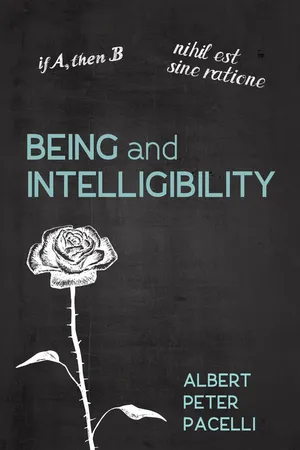
Being and Intelligibility
About this book
What do we mean when we say that something is? What is the meaning of human experience? These two most elementary philosophical questions have perplexed thinkers for thousands of years. Being and Intelligibility explores them from the simple premise that all entities are essentially logical in their being. The book develops its three central theses: that the beingness of beings, called "Being," and the intelligibility of Being are one and the same; that nothingness (i.e., absolute not-Being) is self-contradictory and unintelligible and, therefore, Being is logically necessary; and that the fullness of human rational experience cannot be explained in materially reducible terms and requires recognition of the existence of transcendent reality, which includes God (as self-grounding good will), moral obligation and freedom, and the souls of men. Being and Intelligibility thoroughly investigates the implications of the essential logicality of Being, including that human Being shows itself to itself from within itself as a substantive, persistent, morally obligated unity among the ordered manifold of its life experiences, whose essential Being is orientation toward God.
Information
Topic
PhilosophySubtopic
Philosophical Metaphysics1
Introduction
The Why Question
Anthropologists tell us that human beings are distinguishable from all of the other beings on the earth in many interesting ways. Human beings are the only animals who walk upright in normal locomotion, who require clothing to survive in most of the locations in which they live, who possess opposable thumbs that can reach all the way across their fingers and fingers that can reach to the base of their thumbs, who cook their meals, who often belie their true feelings by blushing, who require parental care well into their teenage years, who live long after the end of fertility, whose mental capacities are by far the greatest of the animals, and who can communicate in oral and written speech. From an anthropological standpoint, these are profoundly important characteristics and together they make man what he is: Homo sapiens, the wise human. From a philosophical standpoint, however, with the exception of speech (which is important in and of itself as a mode of communication and socialization but equally because of the cognitive activity that renders it possible), none of these characteristics, not even human brain capacity, is particularly notable. In contrast, the list of human characteristics that achieve philosophical importance is substantially different and much shorter and, as far as the philosophy presented in these pages is concerned, is strictly limited to consciousness of self as a persistent entity, objective propositional thinking and speaking, unremitting angst about being in the world, and an abiding sense of moral obligation.
The respective nature of the two lists makes manifest the fundamental difference between science and philosophy. The anthropological list treats man as a species of animal and comprises his unique biological characteristics. It considers him objectively, as science does any other entity in the world that is of interest to it. It deliberately refuses to take into account that the scientist who studies man is himself the object of his study, and the fact that man studies and classifies himself and other animals is in itself unique. By contrast, the philosophical list treats man in the full sense of his beingness and identifies those characteristics which are most relevant to how he thinks about himself and engages with the world in which he finds himself and, as we will see in a moment, it takes as especially important (via self-consciousness and propositional thinking) that not only are the items in the list descriptive of man but the list itself is made by and for him.
Of all the beings in the world, only man both knows and knows that he knows and recognizes himself as a persistent entity in a manifold of empirical and conceptual experience. This capability and perspective ground all of the other characteristics which we have listed as philosophically important. Because man is self-conscious he can distinguish other entities in an objective manner and he can label them, consider them critically, and formulate, communicate, and test propositions about them. Man not only takes the world as it presents itself to him but his intellect demands that the world disclose the reasons for that which it presents. Man’s reason does this on two levels. The first is imbedded in the very act of cognition; as Immanuel Kant teaches in his masterwork, Critique of Pure Reason, man organizes the material presented to his reason in space and time under the principle of causality. A world which presented itself to human reason helter skelter and not as a sequence of causes and effects would be incoherent and uncognizable. The second is a conscious act of thinking man. It occurs every time a child asks his parent why something is the way it is, or a scientist investigates empirical reality considered as a world of mind-independent objects, or a philosopher asks, as we will in these pages: Why is there something instead of nothing? This last question is one that we will call, following Martin Heidegger (in his Introduction to Metaphysics), the Why question. Indeed, thinking itself is the identification of the relations within and among its objects and their grounds.
It is also man’s self-consciousness which enables him to consider himself and the world objectively; he can consider himself as part of the world in which he dwells or he can conceptually set himself over and against the world as if he does not belong in and to it. This is both a natural instinct and a cornerstone of philosophical inquiry. Man can appreciate and enjoy the world as the nurturing entity out of which he arises, but because he is self-conscious and finite, he can also see himself as alien to the very same world, as an unwitting warrior against it and his own physical nature, as the fighter of an inevitably losing battle with natural death. Indeed, of all the beings in the world, only man is fundamentally anxious about his place in the world and compelled by his own nature to live his life in the face of a pervading sense that it is fated to be short-lived and that after all is said and done it may very well amount to nothing objectively meaningful.
Yet man’s brooding is also a great blessing to him because it impels him to be circumspect about how he makes use of his time on earth. Although all organisms have needs, only man is conscious of his in a way that allows him to formulate and prioritize his ends and to be aware that he is doing so; as a result, man can take the world and other men into account as both means and ends in themselves and he can measure his actions against other options available to him. Each decision that man makes at any moment to pursue a particular end is also a decision not to pursue a multitude of other ends open to him at the same moment. And the fact that such decisions by their very nature are made in the context of a world of other entities makes manifest what is perhaps the most interesting human characteristic of all: in acting and refraining from acting, in thought, word, and deed, man operates under an existential sense of moral obligation, that is, a perceived duty to comport himself in a certain way regardless of his own personal desires. Kant calls this the “fact of morality” and it is a characteristic about which we will have much to say in this work.
So ecce homo (behold the man): a self-concerned and anxious asker of the Why question, who is confronted until the day he dies with the question of how he ought to comport himself in and toward the world into which he is thrown. So far, so good. But what about the Why question itself, the one that is so profoundly important to man, and what is its relation to the beingness of man? On its face, the question seems simple enough—it appears to ask about the cause or ground of the beingness of beings (meaning all objects that can be perceived or conceived), which (again following Heidegger) we will call “Being.” But immediately, a difficulty appears: What sort of thing can the answer to the Why question be? Is the ground of Being itself a being? If it is not a being, then either the Why question is unanswerable or it requires knowledge of the existence of at least one non-being that serves to explain all the beings that there are. But it seems that we cannot even inquire what sort of thing a non-being might be without hopelessly involving ourselves with incoherency and self-contradiction. How can a non-being be? And even if that were possible, how could we have any knowledge about it? Is Being therefore itself a being? If so, what is the ground of that being, which itself is a ground? If Being is an ungrounded being we must again ask how we might have any knowledge of it—doesn’t knowledge of a thing mean knowledge of its ground? Must Being therefore ground itself? If so, that would make Being unique among all beings and, as such, one the knowledge of which would demark, if not exceed, the limits of our understanding.
The fact that we even ask the Why question seems to tell us something important because its asking presupposes that we already know something about the objects as to which we seek understanding. Certainly, it seems that we can only ask the Why question if we already have some knowledge of what beings are, which is to say that, at the very least, in the figurative sense, we seem to know beings when we see them. But, even taking that as true, we are only pushed deeper into the complexities of our inquiry, because we must then assess what it means to have that kind of knowledge. Saying, for example, that “(I know) there is a coffee cup on my desk,” reduced to its essence, appears to be nothing more than an acknowledgment of a particular state of affairs, namely, of the Being of the coffee cup (a being) and the Being of the desk (a being), the relation of the two beings to one another, and their relation to me, as the one who has knowledge of their Being. The profound relationship between Being and intelligibility thus becomes conspicuous but in a way that seems hopelessly circular: Being seems to characterize that which is (i.e., said to be) in such a way that any attempt to explicate Being must be had in terms of Being itself and the explication of Being appears to represent an attempt at knowledge of the state of affairs that is the state of all affairs, including itself. So, once again, the Why question appears to float in the air in a way that belies that the ground of things must ultimately either be groundless or self-grounding. Ironically enough, if this is the case, the only two possible answers to the Why question seem to be, in the first case, “For no reason at all!” and in the second case, the one given universally by parents to children who ask “Why?” one time too many times, is, of course, simply, “Because!”
But is the question of Being so hopelessly intractable? Oddly enough, modern mainstream philosophy recognizes the circularity of the question of Being but in an utterly dismissive way, first, by acknowledging that knowledge of Being is both philosophically inaccessible and presupposed by all else and, then, by denying that this is a major difficulty or that its implications must be taken into account in its other investigations. This position may be fine for scientists who endeavor to account for beings, but, from a philosophical standpoint, it is patently unacceptable and its debunking occupies a substantial portion the excellent life work of Heidegger. Indeed, one of Heidegger’s major themes is that philosophy unwittingly lost track of the question of Being as long ago as Plato and, instead, over the ensuing millennia, increasingly shifted its focus from the investigation of Being to the investigation of beings as such. In so doing, Heidegger argues, philosophy supplanted itself with empirical science and man increasingly came to define himself not in terms of his potentiality for Being but instead in terms of his own technology with the horrifying result that man’s tools became his ends and man’s historical Being was thereby obliterated. Heidegger asserts, quite rightly, that the failure of modern philosophy, in the first instance, and modern Western culture, consequentially, to take Being into account has led both philosophy and modern society to its current nihilistic mooring. Of course, Heidegger’s indictment of mainstream philosophy would have limited value were it not accompanied by a viable alternative, which in the case of the apparently fundamental circularity of the Why question, requires a means of access to Being itself, which Heidegger provides by pointing out that man himself is the one being whose Being is not presupposed by man but instead is disclosed to him in his asking of the Why question. So, Heidegger tells us, the answer to the Why question must be had, if it can be had at all, by commencing with the interrogation of man as to his own Being.
Heidegger’s superb methodological observation promises the possibility of yielding a presuppositionless philosophy, a goal which had been abandoned in the modern philosophical era until Edmund Husserl, Heidegger’s mentor and the inventor of the philosophy of phenomenology, took it up at the beginning of the twentieth century. Husserl attempts to avoid all philosophical presuppositions by considering things simply in the way that they appear to consciousness, which is an approach that Husserl adopts from Franz Brentano, Husserl’s mentor. Although Brentano describes his own work as the science of psychology, it is highly epistemological in its exposition and, from a historical perspective, Husserl’s development of Brentano’s methodology into a fully worked-out philosophical system represents an unsurprising step given Husserl’s gifted mind and interest in philosophical investigations. But, as Heidegger quickly realized, taking things in their “giveness” (as the phenomenologists aptly characterize their methodology), although methodologically valuable, does not avoid the presupposition of the Being of the things so given, which remains uninvestigated by the phenomenologists. To achieve a presuppositionless philosophy, Heidegger demotes phenomenology from substantive philosophy to mere methodology and adopts it as such for his ontological investigations, including, especially, his interrogation of man as to his own Being. Heidegger calls man “Dasein” (literally, “Being-there” or “Being-open”) because Heidegger understands him to be the ontological point at which the world discloses itself in its Being. It is difficult to imagine that anyone could ever characterize man more succinctly: for Heidegger, man is the being for whom his own Being is an issue. Given Heidegger’s understanding of Dasein, it is easy to see why he would lament so vigorously the loss of man’s historical Being that is implied in the confounding of Dasein’s means with its ends.
The phenomenological method is distinguished, quite brightly, from the traditional methods of philosophy which consider the objects of philosophical investigation as independent of the mind and the Being of the one who studies them and which, as a result, are heavily imbued with presuppositions about Being, cognition, and underlying reality. Although I am not an acolyte of Heidegger and will offer in these pages a profoundly different understanding of the nature of things, Heidegger’s claim, that cognition is a unified experience to which man brings his own Being in his grasping of what is disclosed to him and that science, which attempts to remove the cognizing “I” in order to understand entities objectively, presupposes without understanding the very Being of the entities it treats, seems unassailable. We can also agree with Heidegger that the result is that the scientific pseudo-philosophy that constitutes the contemporary mainstream, together with its analytical handmaiden, is not philosophy at all; that it fails to address, because it does not possess the scope or tools to do so, the most fundamental and important philosophical questions, and that in so doing Dasein, as the scientist-philosopher, completely loses sight of itself, the being to whom the world is disclosed.
Even so, the conclusion that a scientific approach to philosophical inquiry is by its very nature doomed to failure seems itself to presuppose that the Being of beings cannot be found by examining beings. This is a position with which we are in strong disagreement. Although our discussion has begun from a more or less phenomenological perspective with our depiction of man, the philosophy in these pages gives philosophical credence to both approaches, with the caveat that the philosopher must take into account at all times the perspective from which he or she conducts his or her investigations in order to avoid tripping over his or her own presuppositions, and we will u...
Table of contents
- Title Page
- Acknowledgments
- Chapter 1: Introduction
- Chapter 2: The Death and Resurrection of Metaphysics
- Chapter 3: The Reach of Reason
- Chapter 4: The Possibility of Objective Knowledge
- Chapter 5: The Homogeneity of Reason
- Chapter 6: Empirical Judgment
- Chapter 7: Infinity, Countability, And Self-Reference
- Chapter 8: Propaedeutic to Ontology
- Chapter 9: Being and Intelligibility
- Chapter 10: Duty and Desire
- Chapter 11: Moral Freedom
- Chapter 12: The Supreme Principle of Being and Intelligibility
- Chapter 13: Agape (Αγάπη)
- Bibliography
Trusted by 375,005 students
Access to over 1.5 million titles for a fair monthly price.
Study more efficiently using our study tools.
Frequently asked questions
Yes, you can cancel anytime from the Subscription tab in your account settings on the Perlego website. Your subscription will stay active until the end of your current billing period. Learn how to cancel your subscription
No, books cannot be downloaded as external files, such as PDFs, for use outside of Perlego. However, you can download books within the Perlego app for offline reading on mobile or tablet. Learn how to download books offline
Perlego offers two plans: Essential and Complete
- Essential is ideal for learners and professionals who enjoy exploring a wide range of subjects. Access the Essential Library with 800,000+ trusted titles and best-sellers across business, personal growth, and the humanities. Includes unlimited reading time and Standard Read Aloud voice.
- Complete: Perfect for advanced learners and researchers needing full, unrestricted access. Unlock 1.5M+ books across hundreds of subjects, including academic and specialized titles. The Complete Plan also includes advanced features like Premium Read Aloud and Research Assistant.
We are an online textbook subscription service, where you can get access to an entire online library for less than the price of a single book per month. With over 1.5 million books across 990+ topics, we’ve got you covered! Learn about our mission
Look out for the read-aloud symbol on your next book to see if you can listen to it. The read-aloud tool reads text aloud for you, highlighting the text as it is being read. You can pause it, speed it up and slow it down. Learn more about Read Aloud
Yes! You can use the Perlego app on both iOS and Android devices to read anytime, anywhere — even offline. Perfect for commutes or when you’re on the go.
Please note we cannot support devices running on iOS 13 and Android 7 or earlier. Learn more about using the app
Please note we cannot support devices running on iOS 13 and Android 7 or earlier. Learn more about using the app
Yes, you can access Being and Intelligibility by Albert Peter Pacelli in PDF and/or ePUB format, as well as other popular books in Philosophy & Philosophical Metaphysics. We have over 1.5 million books available in our catalogue for you to explore.