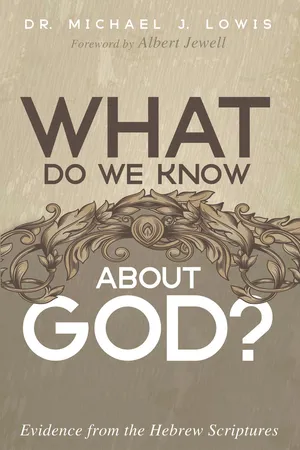
God has been around for a long time--in fact from the very beginning--but what do we actually know about him? Perhaps this is a silly question, because many people will regard the God of Judaism, Christianity, and Islam as unknowable. Nevertheless, this book explores the Hebrew Scriptures (Old Testament) to unearth just what is revealed about the nature and persona of the Deity. Early chapters discuss the first signs of religious beliefs, and the origins of the major religions. Ten chapters are devoted to what the Scriptures reveal about God's origin, attributes, and activities. These include miracles, making laws, punishing, rewarding, answering prayers, and predicting a future Messiah. A final chapter summarizes and draws conclusions. The sheer number of details gleaned from the biblical texts helps the reader to see God as an entity, with a personality who has attributes, likes, and dislikes. He rejoices, but also laments; he has a presence, he is available, he hears our prayers. Those who were a little unsure about the authenticity of God should have their confidence in him strengthened by the amount of information presented. They can then explore this further for themselves.
It is of course impossible to be certain when religious beliefs originated, or anything approaching religious practices were first enacted, but they could date from the very beginnings of hominid life on earth. Perhaps it all began with the veneration of the sun or moon or various aspects of nature that were held to be important in the cycle of birth, death and the food chain. G. van der Leeuw and C. J. Bleeker (1955),1 speculated that primitive human beings had a mentality that did not involve logical thinking, but instead regarded everything as a potential object of religious veneration. He suggested that the concept of religion developed over time in three phases.
Firstly there was dynamism, the belief in powers or natural forces that control the world, and the desire to manipulate them. Although this capacity could be attached to objects such as a meteorite, or ceremonial staff, people could also bear special powers, for example priests, medicine men, or shamans. Secondly there was animism, a theory developed by E. B. Tylor in 1871.2 He suggested that the early stages of religion stemmed from the concept of soul and spirits. Primitive man’s explanation of dreams, breathing, and other mental and physical experiences convinced him of the existence of a soul that leaves the body after death. This idea was then projected onto plants and animals, and even inanimate objects in the environment, so that everything was thought to have a soul. According to Tylor, a belief in the existence of independent spirits then led to the notion that there were gods.
The third phase in the development of religion is the start of a belief in a creator—a supreme being. Heiler3 refers to “causal god-concepts”—the theory that a deity was conceived to account for events and phenomena seen in the natural world. An example would be the appearance of comets in the sky, and the belief that these were sent by a god as signs to humanity. It was only a small step to see this deity as the creator, father, mother, or maker of the world, including of humankind.
An alternative explanation is known as the Way of Pre-eminence, meaning that the concept of a god was arrived at by adding together everything that is good and right, and attributing this to a deity.4 Heiler suggests yet another possibility, called the Way of Denial. This idea holds that the divinity is so great that it is beyond human understanding, and can only be spoken about in a negative way. For example, he (or she) is invisible, inaudible, intangible, or a non-being.5
Whilst these three phases suggest the possible evolution of individual beliefs and the idea of a supreme being, the next developmental step would involve communal activities. Those persons who were thought to possess special powers, as mentioned in the dynamism phase, might lead the community in specific rituals. These could include making use of idols or objects considered sacred, or even conducting sacrifices to appease the gods of nature.
Probably the oldest object yet found that may have had some mystical significance is known as the Makapansgat Pebble from South Africa. It is about three million years old, and was discovered in a cave associated with the bones of the early hominid Australopithacus africanus. It is not fabricated, but natural wear has created patterns on it that resemble a face (see Figure 1). It is believed that the stone was picked up some distance away and carried to where it was subsequently found. Thus it must have been held in some regard, although it is not known if it was kept just for the novelty of its facial appearance, or because it was believed to hold some mysterious powers.
Figure 1. The Makapansgat pebble (Image in public domain)
The evidence from early burial practices may provide firmer grounds for the existence of religious or spiritual beliefs. For example, taking care to bury the dead in a ritualistic way, perhaps one that suggested preparing them for a passage to another realm or afterlife, may indicate belief in a transcendent power.
In an article published in 2009, Joshua Mark6 stated that, in cultures such as Mesopotamia, tombs and graves were cut into the ground in the expectation that souls of the departed would more easily reach the afterlife, thought to exist underground. He added that such practices can be traced back to over 100,000 years ago. The earliest confirmed example of this is the Grave of Qafzeh in Israel, which is a group tomb of 15 people buried in a cave, along with their tools and other ritual artifacts.
Neanderthals existed alongside Homo sapiens for a time, until the former died out about 40,000 years ago. Although there may be even earlier evidence, Ker Than (2013)7 gives details of a Neanderthal skeleton dating from about 50,000 BC, that was unearthed in southwestern France. Excavations indicated that the companions of the deceased took great care to dig the grave so as to protect the body from scavengers. Subsequently, 20 or so other sites have so far been uncovered throughout Western Europe, confirming similar burial practices. Ker Than concluded that such behavior shows that the Neanderthals were capable of symbolic thought. This links with other findings that indicate they probably decorated themselves with colored pigments, and jewelry made of feathers and shells.
Evidence of an early belief in some sort of transcendent dimension is not restricted to gravesites. John Roach (2003)8 describes how, in 1939, a statue was discovered in Hohle Fels Cave in southwestern Germany. Known as the Lowenmensch (Lion-man) figurine, it is carved out of woolly mammoth ivory and measures nearly a foot in length. It is believed to have been fabricated about 30,000 years ago. What makes this object so interesting is that it is anthropomorphic, meaning that it gives human characteristics to an animal. Could this little statue have played a significant role in the mythology of early humans, perhaps even having religious connotations? Roach cites experts who think it may either represent admiration for the powerful, fast and aggressive lion, or provide evidence of shamanism—a device to help interaction with the spirit world.
What may be one of the oldest human-made sites of religious worship—the world’s first temple—was discovered a few miles from the city of Sanliurfa, in the southeast of Turkey. According to the official website,9 it is known as Gobeklitepe, and is believed to be about 12,000 years old. This date places the time of construction in the Neolithic A period, a time before pottery, metallurgy, writing, or the wheel. The site comprises a series of mainly circular and oval-shaped structures set on top of a hill. Within the temple there is a series of T-shaped stone pillars, many of which are decorated with carvings of abstract symbols, along with depictions of animals including foxes, snakes, and lion. Some of the stone structures weigh as much as 20 tons, and the only tools available for dressing and carving them were pointed flints. It is speculated that a priestly cast oversaw the construction of the temple, and that it was a place of pilgrimage and worship.
It would be difficult to deny that the ancient Egyptians brought a level of sophistication to tomb building and burial practices that it would be hard to beat even today. Joshua Mark (2016)10 states that depictions of gods and the afterlife first appeared on the walls of Egyptian tombs, about 6,000 years ago. The Step Pyramid o...
Table of contents
Title Page
Foreword
Preface
Acknowledgments
Introduction
Chapter 1: First Signs of Religious Beliefs
Chapter 2: Origins of the Major Religions
Chapter 3: Reliability of the Hebrew Scriptures
Chapter 4: History of the Books Consulted
Chapter 5: God’s Origin, and Name
Chapter 6: God’s Attributes
Chapter 7: What God Does—Creation
Chapter 8: Nature Miracles
Chapter 9: Healing Miracles
Chapter 10: God’s Laws
Chapter 11: Judgment and Punishment
Chapter 12: Rewards for the Faithful
Chapter 13: Messianic Prophesies
Chapter 14: God Answers Prayers
Chapter 15: So What Do Know about God?
Bibliography
Trusted by 375,005 students
Access to over 1.5 million titles for a fair monthly price.
Study more efficiently using our study tools.
Frequently asked questions
Yes, you can cancel anytime from the Subscription tab in your account settings on the Perlego website. Your subscription will stay active until the end of your current billing period. Learn how to cancel your subscription
No, books cannot be downloaded as external files, such as PDFs, for use outside of Perlego. However, you can download books within the Perlego app for offline reading on mobile or tablet. Learn how to download books offline
We are an online textbook subscription service, where you can get access to an entire online library for less than the price of a single book per month. With over 1.5 million books across 990+ topics, we’ve got you covered! Learn about our mission
Look out for the read-aloud symbol on your next book to see if you can listen to it. The read-aloud tool reads text aloud for you, highlighting the text as it is being read. You can pause it, speed it up and slow it down. Learn more about Read Aloud
Yes! You can use the Perlego app on both iOS and Android devices to read anytime, anywhere — even offline. Perfect for commutes or when you’re on the go. Please note we cannot support devices running on iOS 13 and Android 7 or earlier. Learn more about using the app
Yes, you can access What Do We Know about God? by Michael J. Lowis in PDF and/or ePUB format, as well as other popular books in Theology & Religion & Biblical Studies. We have over 1.5 million books available in our catalogue for you to explore.