- 226 pages
- English
- ePUB (mobile friendly)
- Available on iOS & Android
eBook - ePub
About this book
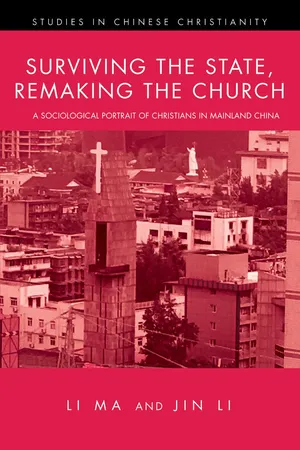
This sociological portrait presents how Chinese Christians have coped with life under a hostile regime over a span of different historical periods, and how Christian churches as collective entities have been reshaped by ripples of social change. China's change from a centrally planned economy to a market economy, or from an agrarian society to an urbanizing society, are admittedly significant phenomena worthy of scholarly attention, but real changes are about values and beliefs that give rise to social structures over time. The growth of Christianity has become interwoven with the disintegration or emergence of Chinese cultural beliefs, political ideologies, and commercial values.
Relying mainly on an oral history method for data collection, the authors allow the narratives of Chinese Christians to speak for themselves. Identifying the formative cultural elements, a sociohistorical analysis also helps to lay out a coherent understanding of the complexity of religious experiences for Christians in the Chinese world. This book also serves to bring back scholarly discussions on the habits of the heart as the condition that helps form identities and nurture social morality, whether individuals engage in private or public affairs.
Information
Subtopic
Histoire du Christianisme1
Captives
A prison cell, in which one waits, hopes—and is completely dependent on the fact that the door of freedom has to be opened from the outside, is not a bad picture of Advent.
—Dietrich Bonhoeffer1
Since 1949, China’s communist regime has considered Christianity an opponent to its ideology. Through banning and cooptation, it has sought to eradicate this religion, as well as other faiths that rivaled communism, from Chinese society. Foreign Christians were evicted from the country, while indigenous leaders were executed or imprisoned. However, these measures did not choke out the seeds of Christianity; they led to its more resilient transformation into a fast-growing religion during the next thirty years. Although Christians believe that the way in which persecution spreads the gospel is a theme attested in the Bible and in church history, such a mystery still needs to be unfolded in China.
In his autobiography Captive Spirits, Xiaokai Yang narrates his first encounter with a Chinese Christian in a prison cell in the 1960s.2 The 16-year-old Red Guard Yang was sentenced to a ten-year imprisonment after publishing a political treatise titled “Whither China?” This decade of experience in captivity turned out to be his “university education,” where he befriended various intellectuals imprisoned by the communist regime. Through his cellmate, a mathematics Professor Yu, Yang learned English and Calculus. Another Roman Catholic adherent Li was jailed because he refused to worship Mao. Yang was surprised to find that Li acted like a gentleman even in prison. “I marvel over the fact that anyone can be so consistently selfless,” writes Yang. It was a time when prison became the only place one could meet genuine Christians.
After his release in 1978, Yang entered graduate school without a bachelor’s degree due to his imprisonment. Later, he won a scholarship to study for a doctoral degree in Economics at Princeton University. Afterwards, he held a postdoctoral position at Yale University. By 2002, Yang had become a world-renowned economist who was twice nominated for the Nobel Prize. This was also the same year when Yang finally embraced the Christian faith after being diagnosed with cancer. In the last two years of his life, Yang published some important articles that campaigned for democracy from a Christian perspective.3 For example, his treatise My Second Testimony centered on how his biblical worldview called into question his professional views on the value of modernization. This article was very instrumental to bring many educated Chinese into Christianity in the mid 2000s.4 In our fieldwork, we heard many young people mentioning Yang’s testimony as a contributing factor in their conversions.
Another widely spread prison cell Christian testimony that brought about many conversions is the story of Zhao Lin, a famous female activist and martyr. Like Yang, she was also born into a family of the privileged “revolutionary” political elite. Nineteen-year-old Lin was a devout follower of Mao who wrote letters calling him her “father” even during her earlier years of imprisonment. The authorities intentionally put her in the same cell with a Christian, with the intent that her thoughts be straightened out when debating with her stubborn, believing cellmate. Before her execution, Lin used her own blood as ink to write letters, with words of lament from a believing heart:
Why would I still hold a humane hope for you [China]? What is this compassion in my heart? At its root, it is nothing but mercy and conscience given by my Heavenly Father. . . . I cry for you because you are burdened with sin and evil, which are drowning you in the swamp of destruction. Sirs, you who enslave others! Know that you are not free yourselves!5
The stories of imprisoned Christians under the first two decades of China’s communist regime were seldom told: they were forbidden and became forgotten. These rare stories we read today portray the amazing resilience and freeing power of the Christian faith in the most dreadful human situations. Even prison cells created by communists became a training ground for new converts.
We tried to interview some Christians who had prison experiences when starting our research, because we are convinced that a project like this would be incomplete without their stories. However, many of these people are advanced in age or have already passed away. Therefore, we can provide only one direct account of an eighty-four-year-old medical doctor, Yuan, who had spent ten years in communist prison as well as two short accounts from those whose family members suffered imprisonment. We use these narratives to show the complexity of what really happened to most Chinese Christians between the 1950s and 1970s. There is no need to further explain that Christians had a marginalized and even criminalized status in new communist China, for they belonged to the lowest social class because of their religious ideology and affiliation with the West. But how the communist regime attempted to staunch the growing church at that time is a topic worth studying. To some extent, the Communist Revolution from 1949 to 1979 was a success, because never in China’s history had the country been penetrated with an ideology so absolutely as it was under communism and Maoism.
Seeds of Faith before 1949
The two decades prior to 1949 in China were years of religious tolerance. They were also times of growth for home-grown Protestant movements in China. Many government and military officials were baptized Christians.6 Evangelism and church-planting were allowed, as were the ministries of influential figures such as John Sung, Wang Mingdao and Watchman Nee, etc. Although variant in their theological backgrounds, these founders of different sects came out of missionary-run churches. Protestant missionary work in the 1920s left a comprehensive social impact on the Chinese society by establishing schools, universities and hospitals.7 For example, by the late 1920s, various missionary groups had founded fourteen universities, while China at that time had only three state-run universities.8 These were the primary means of expanding the influence and of training modern personnel for Christian churches. As historian Jonathan Spence notes, “Through their texts, their presses, their schools, and their hospitals, the efforts of foreign Christians affected Chinese thought and practice. The strength of that influence is impossible to calculate . . . they protested foot-binding, commiserated over opium addiction, offered religion and education as sources of solace and change, and a new perspective on social hierarchies and sexual subordination.”9
After 1949, civil space was compressed to a minimum through the wave of violent communist revolution. The communists sought to destroy the “old China” and rebuild a new social order through the nationalization of key resources, such as land, capital and labor allocation. The hukou system was installed to forbid residential mobility even during famine years. Communists also eradicated free market enterprises such as commercial guilds and private businesses. In the countryside, the gentry class which used to be a pillar of its civil society was completely wiped out through violent executions. The communist rule directly penetrated into rural villages by installing the most politically loyal cadres as watchdogs for any social activity outside of their direct control. From the 1950s to the 1970s, self-governance in urban and rural communities was not permitted. Most importantly, social trust and interpersonal networks were undermined after a series of political movements. This period also nurtured a political culture that rewarded betrayal and impersonal political loyalty to the Chinese Communist Party (CCP).
The communist rulers also utilized the involvement of the US in the Korean War to propagate nationalist fervor against “imperialist infiltration.” As Spence says, “Given momentum by the anger and excitement of the Korean War, a second mass campaign was directed at domestic ‘counterrevolutionaries.’ Millions of Chinese who had worked for KMT or foreign organizations were closely investigated. In the summer of 1951, the CCP leadership launched a series of mass rallies in large cities to publicize this new campaign against domestic subversion. This campaign later grew in brutality, intensity and thoroughness, leaving lasting trauma for almost every Chinese person.10 Urban authorities also used this campaign of terror to attack religious groups, including the most widespread sect of Yi Guan Dao (‘Way of Basic Unity Society’).”11 Spence notes that public media were used to disintegrate the old social order: “Propaganda networks were also developed, consisting of trained experts who could work through the media and through small discussion groups to encourage compliance with the government policies. One function of these cadres and propagandists was to break down the often tight personal, emotional, and family bonds.”12 It was also during the Maoist reforms in the 1950s when Christian groups became the targets of suppression due to their connections with foreigners.
A Never-arriving Verdict
The son of a family of medical practice, Yuan (pseudonym) was converted in his twenties and received an excellent education in a Christian-founded medical school in Beijing in the 1920s. His parents served with foreign Christians from the China Inland Mission in the 1940s. When Yuan was twenty years old, he entered into a pre-med program at Shanghai’s St John’s University. It was a campus dotted with western Gothic architecture and alive with Christian evangelism. One day he saw a Christian fellowship event flyer posted on the campus bulletin board. Such flyers were seen everywhere on the university campus. During this special gathering, a student preacher passionately spoke about God’s love and called people to accept that love. Yuan’s new life started from that day as a true follower of Christ. His heart longed for the path of sacrifice and glory, as his favorite hymn “The Path of the Cross is Sacrifice” illustrated.
The group with which Yuan later affiliated was the “Little Flock” (xiaoqun), also known as the Chinese Local Assembly (juhuichu) founded by Watchman Nee. It is a Protestant sect whose pietist theology has left the most far-reaching impact on Chinese Protestantism to this day. It is characterized by a pessimistic and separatist view of end-time Christian living centered around the “truth of the cross.”
After graduation, Yuan was appointed to a job in Beijing. Yuan recalls the way religious space in Beijing wa...
Table of contents
- Title Page
- Acknowledgments
- Introduction
- Chapter 1: Captives
- Chapter 2: Worldview
- Chapter 3: Censored
- Chapter 4: Orphans
- Chapter 5: Two Cities
- Chapter 6: CCP
- Chapter 7: Nationalism
- Chapter 8: Charity
- Chapter 9: Calvinism
- Chapter 10: Marriage
- Chapter 11: Education
- Chapter 12: Crosses
- Conclusion
- Appendix 1
- Appendix 2
- Appendix 3
- Bibliography
Trusted by 375,005 students
Access to over 1.5 million titles for a fair monthly price.
Study more efficiently using our study tools.
Frequently asked questions
Yes, you can cancel anytime from the Subscription tab in your account settings on the Perlego website. Your subscription will stay active until the end of your current billing period. Learn how to cancel your subscription
No, books cannot be downloaded as external files, such as PDFs, for use outside of Perlego. However, you can download books within the Perlego app for offline reading on mobile or tablet. Learn how to download books offline
Perlego offers two plans: Essential and Complete
- Essential is ideal for learners and professionals who enjoy exploring a wide range of subjects. Access the Essential Library with 800,000+ trusted titles and best-sellers across business, personal growth, and the humanities. Includes unlimited reading time and Standard Read Aloud voice.
- Complete: Perfect for advanced learners and researchers needing full, unrestricted access. Unlock 1.5M+ books across hundreds of subjects, including academic and specialized titles. The Complete Plan also includes advanced features like Premium Read Aloud and Research Assistant.
We are an online textbook subscription service, where you can get access to an entire online library for less than the price of a single book per month. With over 1.5 million books across 990+ topics, we’ve got you covered! Learn about our mission
Look out for the read-aloud symbol on your next book to see if you can listen to it. The read-aloud tool reads text aloud for you, highlighting the text as it is being read. You can pause it, speed it up and slow it down. Learn more about Read Aloud
Yes! You can use the Perlego app on both iOS and Android devices to read anytime, anywhere — even offline. Perfect for commutes or when you’re on the go.
Please note we cannot support devices running on iOS 13 and Android 7 or earlier. Learn more about using the app
Please note we cannot support devices running on iOS 13 and Android 7 or earlier. Learn more about using the app
Yes, you can access Surviving the State, Remaking the Church by Li Ma,Jin Li in PDF and/or ePUB format, as well as other popular books in Théologie et religion & Histoire du Christianisme. We have over 1.5 million books available in our catalogue for you to explore.