This book is available to read until 23rd December, 2025
- 170 pages
- English
- ePUB (mobile friendly)
- Available on iOS & Android
eBook - ePub
Available until 23 Dec |Learn more
About this book
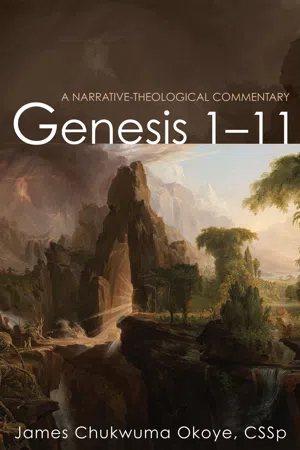
Genesis 1-11: A Narrative Theological Commentary combines critical acumen with concern for the theological message of Scripture. It is a commentary in two stages. First, the text is allowed to speak for itself, using a narrative approach. Then, specific Jewish and Christian traditions flowing from the text are identified, and the underlying hermeneutical moves analyzed.
Frequently asked questions
Yes, you can cancel anytime from the Subscription tab in your account settings on the Perlego website. Your subscription will stay active until the end of your current billing period. Learn how to cancel your subscription.
No, books cannot be downloaded as external files, such as PDFs, for use outside of Perlego. However, you can download books within the Perlego app for offline reading on mobile or tablet. Learn more here.
Perlego offers two plans: Essential and Complete
- Essential is ideal for learners and professionals who enjoy exploring a wide range of subjects. Access the Essential Library with 800,000+ trusted titles and best-sellers across business, personal growth, and the humanities. Includes unlimited reading time and Standard Read Aloud voice.
- Complete: Perfect for advanced learners and researchers needing full, unrestricted access. Unlock 1.4M+ books across hundreds of subjects, including academic and specialized titles. The Complete Plan also includes advanced features like Premium Read Aloud and Research Assistant.
We are an online textbook subscription service, where you can get access to an entire online library for less than the price of a single book per month. With over 1 million books across 1000+ topics, we’ve got you covered! Learn more here.
Look out for the read-aloud symbol on your next book to see if you can listen to it. The read-aloud tool reads text aloud for you, highlighting the text as it is being read. You can pause it, speed it up and slow it down. Learn more here.
Yes! You can use the Perlego app on both iOS or Android devices to read anytime, anywhere — even offline. Perfect for commutes or when you’re on the go.
Please note we cannot support devices running on iOS 13 and Android 7 or earlier. Learn more about using the app.
Please note we cannot support devices running on iOS 13 and Android 7 or earlier. Learn more about using the app.
Yes, you can access Genesis 1–11 by James Chukwuma Okoye in PDF and/or ePUB format, as well as other popular books in Theology & Religion & Biblical Commentary. We have over one million books available in our catalogue for you to explore.
Information
Chapter 1
A Narrative Theology of the Book of Genesis
And so people supported by faith, hope and charity, and retaining a firm grip on them, have no need of the Scriptures except for instructing others. And so there are many who live by these three even in the desert without books. This leads me to think that the text has already been fulfilled in them.
—Augustine, De Doctrina Christiana, I, 431
A Narrative Approach
Methods chosen are usually relevant to goals sought; each commentator brings a certain perspective to the text. He or she approaches the text with certain presuppositions, questions, and concerns or is already convinced of the effectiveness of some method for the exegetical task at hand.
Most commentators on the book of Genesis use some form of the historical-critical approach—form criticism or tradition criticism, social science criticism, or some other. In the historical approach, meaning derives from the author and is generally sought in the author’s intentions and historical context and time. Many of such commentators have recourse to the documentary hypothesis2 or some recent adaptation or replacement of it, for example, the Yahwist as postexilic, the entire material as divided into Priestly and non-Priestly, D-Komposition and P-Komposition. For current trends in this area, the advanced reader may consult The Pentateuch, edited by Thomas Dozeman, et al.
Some commentators apply reader-response approaches which privilege the reader. The reader consciously brings his or her convictions and points of view to bear; the meaning of the text is “meaning for me.” Strands of this approach are ideological criticism, liberation and feminist criticism, postcolonial criticism, and so on.
An increasing number of commentators have recourse to literary approaches. These derive meaning from the structure of the text itself and how it intends to mean. They pay full attention to how it does things with words, both with the form (the how) and the content (the what). Strands of this approach are structuralism, rhetorical criticism, and narrative criticism.
Meaning Is Never Divorced from the Participation of the Reader
Left to its own devices by the maker, the text goes in search of a competent reader . . . [What is essential is] that which the text itself provides, the world it evokes and the values it embodies, and then, the confrontation, the interplay, the friction and sometimes the clash between all this and the reader’s world and values.3
Nor is text ever divorced from context. To begin with, the text of Genesis is in ancient Hebrew and this has built-in conventions and patterns of meaning.4 The text itself has had a history and there may be textual riddles to be deciphered and apparent contradictions to be resolved. A synchronic reading thus cannot dispense with all historical or source-oriented inquiries. For this reason, I sometimes call upon the so-called Pentateuchal “sources,” for example, in Genesis 1 (Priestly Theology) or the flood story (Yahwist and Priestly Theologies)—the diachronic in service of the synchronic. For the nonspecialist, some concepts used by narrative criticism may need brief explanation.
The Narrator
The voice telling the story is called the narrator, to be distinguished from the writer of the story. The narrator is also to be distinguished from the characters of the story. Sometimes the narrator’s voice merges with that of the characters, sometimes it diverges or stands in opposition to it. Sometimes indeterminacy may result from irony, the implied author undermining the narrator.5 In any case, the narrator wants to bring the reader to his point of view (in the context of Genesis, the writer was most probably male). The narrator knows everything, even the future, and what is in the mind of God and not just of people, and so scholars apply the term “omniscient narrator.” Such omniscience is, in the first place, to be understood in a literary, not a theological sense: “It is not necessary to consider such a statement ‘historically reliable’ and assume a prior phone call from the Holy Ghost to the writer.”6
God as a Character
In narrative theory, “God” within the narrative is a character created by the narrator. As such, one may distinguish the character of God and the manner in which he functions in different parts of the Bible. Fokkelman writes:
The God of the books of Samuel is not exactly the same as the God of Moses . . . and something else entirely than the God of Ecclesiastes. Add to this the fact that the God of a devout Jew or Christian will always be different and greater than the image that anyone has of God. So let us . . . not immediately lock the narrator of the Hebrew story inside our assumption that he, the maker of the character God, entertains the same values.7
Yet, the biblical narrator presents God as omniscient and omnipotent, always trustworthy. Jewish and Christian faith equates the God of the Bible with the Creator; Christian faith further presents him as the Father of our Lord Jesus Christ. The literary and theological points of view can be in some tension: “God” as character in the story versus the God of faith. For how this commentary navigates this conundrum, see “The Approach of This Commentary” below.
Characters
The writer propels the story forward through characters who speak, act, and interact with one another—Cain and Abel, Lamech, Abraham . . . Characters are generally round (complex, with many traits, developing one way o...
Table of contents
- Title Page
- Preface
- Abbreviations
- Chapter 1: A Narrative Theology of the Book of Genesis
- Chapter 2: Genesis 1:1—2:4a
- Chapter 3: Genesis 2:4b—3:24
- Chapter 4: Genesis 4:1–26
- Chapter 5: Genesis 5:1—6:4
- Chapter 6: Genesis 6:5—8:22
- Chapter 7: Genesis 9
- Chapter 8: Genesis 10–11
- Conclusion
- Bibliography