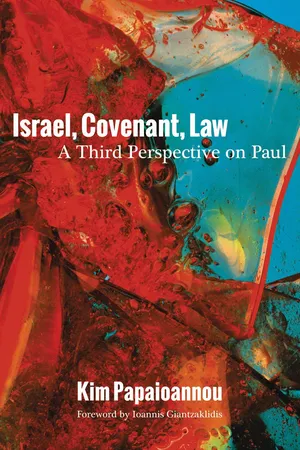
Pauline studies are in a conundrum. The Reformation perspectives championed by great men like Martin Luther and John Calvin have been challenged recently by the rise of the new perspective on Paul. The main point of contention seems to be the place of biblical law in salvation. While the Reformation perspectives, based in part on Paul’s apparent attacks on law, assert that salvation is a free gift unmerited by human works, the new perspective suggests the law is an integral part of the work of salvation. It holds that Paul’s attacks on the law were focused only on specific aspects of law, the so-called boundary markers. This book, while having points of contact with both outlooks, takes a different view on Paul and the law. Building on Paul’s self-identification as a Christian, and Christian views on the covenant, it endeavors to give biblical law its due place in the plan of salvation and the life of the believer.
- 168 pages
- English
- ePUB (mobile friendly)
- Available on iOS & Android
eBook - ePub
About this book
Information
1
Reformation Perspectives and New Perspectives
The Current Impasse
Thesis Statement—Both the Reformation Perspective on Paul and the New Perspective have gaps and fail to fully make sense of Paul. A new paradigm is needed and proposed.
Paul’s Apparent Self-Contradictions
Pauline studies are in a conundrum in a number of ways. This study will focus on one of them, Paul’s relation to law. Part of it has to do with Paul’s own sometimes convoluted way of thinking. Commenting on this, 2 Pet 3:15–16 writes, “And count the patience of our Lord as salvation, just as our beloved brother Paul also wrote to you according to the wisdom given him, as he does in all his letters when he speaks in them of these matters. There are some things in them that are hard to understand, which the ignorant and unstable twist to their own destruction, as they do the other Scriptures.”1 If Peter found Paul’s writings “hard to understand,” we are excused to feel the same way.
Consider some of Paul’s seemingly contradictory statements concerning the law (emphasis added): “But now we are released from the law, having died to that which held us captive, so that we serve not under the old written code but in the new life of the Spirit” (Rom 7:6).
“For he himself is our peace, who has made us both one and has broken down in his flesh the dividing wall of hostility by abolishing the law of commandments and ordinances, that he might create in himself one new man in place of the two, so making peace” (Eph 2:14–15).
“Now if the ministry of death, carved in letters on stone, came with such glory that the Israelites could not gaze at Moses’ face because of its glory, which was being brought to an end, will not the ministry of the Spirit have even more glory? (2 Cor 3:7–8).
“Let me ask you only this: Did you receive the Spirit by works of the law or by hearing with faith? Are you so foolish?” (Gal 3:2–3).
“For all who rely on works of the law are under a curse; for it is written, ‘Cursed be everyone who does not abide by all things written in the Book of the Law, and do them’” (Gal 3:10).
“Now before faith came, we were held captive under the law, imprisoned until the coming faith would be revealed. So then, the law was our guardian until Christ came, in order that we might be justified by faith. But now that faith has come, we are no longer under a guardian” (Gal 3:23–25).
“And you, who were dead in your trespasses and the uncircumcision of your flesh, God made alive together with him, having forgiven us all our trespasses, by canceling the record of debt that stood against us with its legal demands. This he set aside, nailing it to the cross” (Col 2:13–14).
Texts like the above appear to, and have been understood to, abolish the legal codes of the OT. Had these been the only relevant texts in relation to law, we would have been excused in thinking that Paul was an antinomian. However, Paul has numerous other texts that appear to suggest the exact opposite, namely, the OT law is binging. Consider a few examples.
“Do we then overthrow the law by this faith? By no means! On the contrary, we uphold the law” (Rom 3:31).
“So the law is holy, and the commandment is holy and righteous and good” (Rom 7:12).
“For we know that the law is spiritual, but I am of the flesh, sold under sin” (Rom 7:14).
“For I delight in the law of God, in my inner being” (Rom 7:22).
“The commandments, ‘You shall not commit adultery, You shall not murder, You shall not steal, You shall not covet,’ and any other commandment, are summed up in this word: ‘You shall love your neighbor as yourself’” (Rom 13:9).
“For neither circumcision counts for anything nor uncircumcision, but keeping the commandments of God” (1 Cor 7:19).
“‘Honor your father and mother’ (this is the first commandment with a promise)” (Eph 6:2).
Reading the above texts and a number of others, one might reasonably be tempted to conclude that Paul was confused.
Reformation Perspectives on Paul and the Law
Beyond apparent contradictions in the Pauline writings, there is the question of theological outlook. Theological outlooks are like a pair of glasses with which we read the text. Every NT scholar wears them. For some, the glasses are of higher diopter and for some of lower, but we all wear them. The type of glasses, the theological outlook, an exegete has will determine to some extent the way a particular text is read and interpreted. The higher the diopter the more inclined is the exegete to read texts in a way that suits a given theological outlook.
In the Protestant world, for close to five centuries, theological thinking has been shaped by the Reformation and its great teachers, chief among Martin Luther. The son of a German miner, Luther was prompted by his father towards a career in law, and to this effect he entered the University of Erfurt, graduating eventually with a Master of Arts degree. His life changed dramatically during one night in 1505 when while in a forest during a severe thunderstorm, he became so scared that he thought he would not survive the experience. In fear and trembling, he prayed that if he were to survive, he would become a monk.
Survive he did, and faithful to his promise he became a monk in the Augustinian order. There is some debate whether this was a decision of the moment or, more likely, something Luther had been contemplating for a while. His intense fear of hell and the wrath of God caused him to think that perhaps in the monastery, he could find peace and assurance of salvation. A person of continual inner reflection, once in the monastery Luther devoted himself to long hours of prayer, fasting, pilgrimages, and frequent confessions. But none of these allayed his conscience or brought peace of mind. Luther later referred to this time in the cloister as one of deep spiritual despair. After a trip to Rome that filled him with more disillusionment, he enrolled in the University of Wittenberg, excelled in his studies, and graduated as a doctor of theology, becoming in turn a professor of theology at the university.
It was while lecturing from the Epistle of Romans, around 1515, that Luther began to understand salvation as a gift from God that cannot be attained by good works or human merit. Luther projected his own troubled conscience onto Paul before the Damascus experience. His previous religious experience of prolonged prayer, fasting, pilgrimages, and activities that failed to bring him inner peace he projected upon first century Judaism with its manifold laws, traditions, and regulations that, likewise, in Luther’s mind, could not bring peace. And now that he had at last understood that salvation is a free gift, he became a type of new Paul combating the “works” perversions of the gospel around him.
A w...
Table of contents
- Title Page
- Foreword
- Introduction
- Chapter 1: Reformation Perspectives and New Perspectives
- Chapter 2: Paul and Israel
- Chapter 3: Paul and the Covenant
- Chapter 4: Paul and the Law—Part I
- Chapter 5: Paul and the Law—Part II
- Synopsis and Synthesis
- Bibliography
Trusted by 375,005 students
Access to over 1.5 million titles for a fair monthly price.
Study more efficiently using our study tools.
Frequently asked questions
Yes, you can cancel anytime from the Subscription tab in your account settings on the Perlego website. Your subscription will stay active until the end of your current billing period. Learn how to cancel your subscription
No, books cannot be downloaded as external files, such as PDFs, for use outside of Perlego. However, you can download books within the Perlego app for offline reading on mobile or tablet. Learn how to download books offline
Perlego offers two plans: Essential and Complete
- Essential is ideal for learners and professionals who enjoy exploring a wide range of subjects. Access the Essential Library with 800,000+ trusted titles and best-sellers across business, personal growth, and the humanities. Includes unlimited reading time and Standard Read Aloud voice.
- Complete: Perfect for advanced learners and researchers needing full, unrestricted access. Unlock 1.5M+ books across hundreds of subjects, including academic and specialized titles. The Complete Plan also includes advanced features like Premium Read Aloud and Research Assistant.
We are an online textbook subscription service, where you can get access to an entire online library for less than the price of a single book per month. With over 1.5 million books across 990+ topics, we’ve got you covered! Learn about our mission
Look out for the read-aloud symbol on your next book to see if you can listen to it. The read-aloud tool reads text aloud for you, highlighting the text as it is being read. You can pause it, speed it up and slow it down. Learn more about Read Aloud
Yes! You can use the Perlego app on both iOS and Android devices to read anytime, anywhere — even offline. Perfect for commutes or when you’re on the go.
Please note we cannot support devices running on iOS 13 and Android 7 or earlier. Learn more about using the app
Please note we cannot support devices running on iOS 13 and Android 7 or earlier. Learn more about using the app
Yes, you can access Israel, Covenant, Law by Kim Papaioannou in PDF and/or ePUB format, as well as other popular books in Theology & Religion & Biblical Criticism & Interpretation. We have over 1.5 million books available in our catalogue for you to explore.