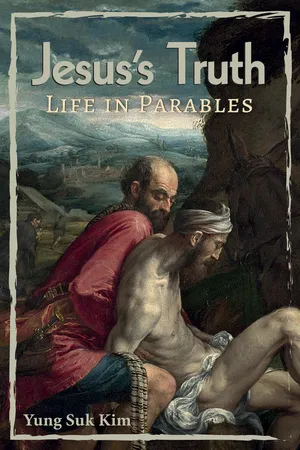
Parables of Jesus are stories about everyday life, ranging from a person’s worldview to economic justice in society. This book examines most parables of Jesus from a critical literary perspective. Twenty-three narrative parables in the Synoptic Gospels are rearranged by their source: Markan parables, Q parables, Matthean unique parables, Lukan unique parables. Each parable invites readers to reengage Jesus’s stories in the contemporary world.
- 124 pages
- English
- ePUB (mobile friendly)
- Available on iOS & Android
eBook - ePub
About this book
Information
1
Introduction
Allegorical interpretation deprives us of the true meaning of a parable by spiritualizing it. Allegory, derived from allegorein (meaning “to speak differently”), is a way of reading the text by focusing not on the internal story but the hidden spiritual meaning. In doing so, what readers do typically is to make a one-to-one correspondence between story and particular outside the story. This allegorical interpretation has been popular with the Alexandrian School (Clement, Origen, and Augustine). In the parable of Samaritan (Luke 10:25-37), the allegorical matchings go like this: Jerusalem as Paradise; Jericho as world; a robbed person as Adam; robbers as evil; priest as the law; Levite as prophets; the good Samaritan as Jesus; injury as disobedience; donkey as Jesus’s body; inn as church; the innkeeper as bishop of the church; and the promise of return as the second coming of Jesus. We can hardly think that Jesus applied himself to a Samaritan as in allegorical interpretation. Rather, we can read this parable as a story and wonder why first two religious leaders pass by without helping the needy person. They also have to think about the third person, who is not an ordinary Jewish person but a despised foreigner who need not respond to the needy person from the perspective of Jews. He could pass by without looking at this man robbed, but he stopped by and did everything he could to help him. Hearers must grapple to understand the act of this man from Samaria, a district of contempt by Jews. Who is this guy? He was not considered a neighbor by Jews. But he became a neighbor to them. This mysterious act and presence of the Samaritan raise a metaphorical imagination to hearers.1 How can a Samaritan become a neighbor? From a traditional perspective of Jews, the neighbor is found among themselves. But the Samaritan became a neighbor to a person in need.
Another famous parable of Jesus, “the father and two sons” (Luke 15:11-34), also has been read allegorically. Namely, the older son/brother represents Jews, the younger son/brother represents newly converted Gentile sinners, and the father represents the compassionate God. So much so, the older brother/son is blamed for his narrow mindset, and his father welcomes the younger brother/son because of his repentance. But inside the parable, there is no such clue that this story is understood with such “representative” interpretation. Rather, this story is taken from e...
Table of contents
- Title Page
- Acknowledgements
- Chapter 1: Introduction
- Chapter 2: Markan Parables
- Chapter 3: Q Parables in Matthew and Luke
- Chapter 4: Matthean Unique Parables
- Chapter 5: Lukan Unique Parables (I)
- Chapter 6: Lukan Unique Parables (II)
- Bibliography
Trusted by 375,005 students
Access to over 1.5 million titles for a fair monthly price.
Study more efficiently using our study tools.
Frequently asked questions
Yes, you can cancel anytime from the Subscription tab in your account settings on the Perlego website. Your subscription will stay active until the end of your current billing period. Learn how to cancel your subscription
No, books cannot be downloaded as external files, such as PDFs, for use outside of Perlego. However, you can download books within the Perlego app for offline reading on mobile or tablet. Learn how to download books offline
Perlego offers two plans: Essential and Complete
- Essential is ideal for learners and professionals who enjoy exploring a wide range of subjects. Access the Essential Library with 800,000+ trusted titles and best-sellers across business, personal growth, and the humanities. Includes unlimited reading time and Standard Read Aloud voice.
- Complete: Perfect for advanced learners and researchers needing full, unrestricted access. Unlock 1.5M+ books across hundreds of subjects, including academic and specialized titles. The Complete Plan also includes advanced features like Premium Read Aloud and Research Assistant.
We are an online textbook subscription service, where you can get access to an entire online library for less than the price of a single book per month. With over 1.5 million books across 990+ topics, we’ve got you covered! Learn about our mission
Look out for the read-aloud symbol on your next book to see if you can listen to it. The read-aloud tool reads text aloud for you, highlighting the text as it is being read. You can pause it, speed it up and slow it down. Learn more about Read Aloud
Yes! You can use the Perlego app on both iOS and Android devices to read anytime, anywhere — even offline. Perfect for commutes or when you’re on the go.
Please note we cannot support devices running on iOS 13 and Android 7 or earlier. Learn more about using the app
Please note we cannot support devices running on iOS 13 and Android 7 or earlier. Learn more about using the app
Yes, you can access Jesus’s Truth by Yung Suk Kim in PDF and/or ePUB format, as well as other popular books in Theology & Religion & Biblical Criticism & Interpretation. We have over 1.5 million books available in our catalogue for you to explore.