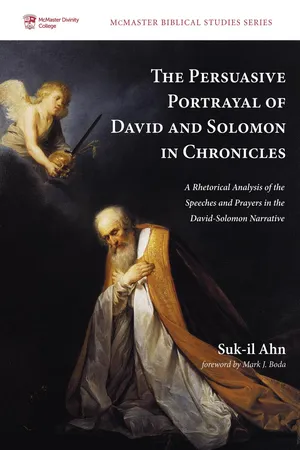
eBook - ePub
The Persuasive Portrayal of David and Solomon in Chronicles
A Rhetorical Analysis of the Speeches and Prayers in the David-Solomon Narrative
- 334 pages
- English
- ePUB (mobile friendly)
- Available on iOS & Android
eBook - ePub
The Persuasive Portrayal of David and Solomon in Chronicles
A Rhetorical Analysis of the Speeches and Prayers in the David-Solomon Narrative
About this book
This study examines the speeches and prayers in the David-Solomon narrative in Chronicles and seeks to demonstrate that the Chronicler's portrayal of David and Solomon attempts to establish the Yehudite community's identity. Is the covenantal relationship still valid in the Persian period? The author asserts that as a commitment to YHWH involving the worship of YHWH through the Jerusalem temple, the covenantal relationship between YHWH and Israel continues even into the Persian period. This study employs Kennedy's rhetorical method with the new categories of the narrative situation and the Chronicler's situation being used to further delineate his concept of the narrative situation. The Chronicler's portrayal of David and Solomon through speeches and prayers serves to persuade his audience of the significance of the Jerusalem temple, reformulating the Yehudite community identity as a cultic community in the Persian period.
Information
1
Introduction
The present study attempts to examine the persuasive portrayal of David and Solomon in Chronicles and its contribution to the Chronicler’s purpose. In particular, the speeches and prayers in Chronicles are seen as the Chronicler’s key strategy for presenting the early history of Israel to those who were living in the Persian era. In fact, speeches and prayers occupy a large portion of Chronicles. Thus, the persuasive portrayal of David and Solomon will be explored in terms of the speeches and prayers in the David-Solomon narrative.
Many scholars have claimed that the Chronicler portrays David and Solomon as idealized kings in the narrative of the temple building.1 However, if they were idealized in Chronicles, why does the Chronicler include David’s census and his initial failure to bring the ark to Jerusalem? It seems that the Chronicler’s purpose in portraying David and Solomon does not simply lie in idealizing the reign of David and Solomon in order to glorify YHWH.
How then does the Chronicler depict David and Solomon? What is the primary purpose of the Chronicler in portraying David and Solomon? What do David and Solomon say about themselves in their speeches and prayers, and what do others say about David and Solomon? What roles do they play in the persuasive purpose of the Chronicler? Previous studies on David and Solomon in Chronicles took into account David as the founder of the cultic system and the one who prepared for the building of the temple and Solomon as one who completed the establishment of the cult and the building of the temple.2 However, the Chronicler’s portrayal of David and Solomon goes beyond these themes.
In this study, I will examine the persuasive portrayal of David and Solomon, based on speeches and prayers in the narrative framework with the assumption that the David-Solomon narrative is a sub-rhetorical unit within the whole book of Chronicles. I will argue that the Chronicler’s persuasive portrayal of David and Solomon is designed to help reconstruct the identity of the Yehudite community as a cultic community through the Jerusalem temple, revealing the continuity of the covenantal relationship between YHWH and the Judahites in the Persian era. Even if the images of David and Solomon are as the preparer of the temple building and builder of the temple, their primary roles in the Chronicler’s presentation are to re-establish the identity of the Yehudite community in Persian Yehud on the basis of the Jerusalem temple, pointing to the continuity of the covenantal relationship in the Persian period,3 which was expressed by the Davidic covenant regarding temple building. In this study, the covenant relationship in the Persian era is defined as a commitment to YHWH through the Jerusalem temple with a dedication to the worship of YHWH.4
In effect, the rhetorical situation is an identity crisis in the Persian era. The identity of Israel as God’s people was challenged by the destruction of Jerusalem (587/86 BCE) since their identity markers such as king, temple, and worship disappeared.5 However, Cyrus’s edict changed the deportees’ situation in Babylon, leading to their return to their homeland. As part of the reformation of their identity in the Persian era, some groups of the returnees from Babylon to Jerusalem, including those who remained in Yehud later, would feel the need to reformulate their identity as God’s people in the Persian period and to confirm their covenantal relationship with YHWH, since the relationship seems to have been broken during the exile. In their eyes, it would be doubtful whether or not YHWH’s covenants with Israel were still valid in the Persian era. Thus, the Chronicler’s persuasive portrayal of David and Solomon serves to reconstruct the community identity through the Jerusalem temple, revealing the continuity of the covenantal relationship between YHWH and Israel in the Persian period.
History of Research
Until the nineteenth century Chronicles was regarded as a reliable historical source of pre-exilic Israel. However, this was challenged with the advent of the historical-critical method, so that Chronicles was seen as a tendentious alteration, and its historical reliability was underlin...
Table of contents
- Title Page
- Foreword
- Preface
- Abbreviations
- Chapter 1: Introduction
- Chapter 2: Rhetorical Situation
- Chapter 3: Rhetorical Unit
- Chapter 4: Speeches and Prayers in David’s Narrative
- Chapter 5: Speeches and Prayers in Solomon’s Narrative
- Chapter 6: Conclusion
- Bibliography
Trusted by 375,005 students
Access to over 1.5 million titles for a fair monthly price.
Study more efficiently using our study tools.
Frequently asked questions
Yes, you can cancel anytime from the Subscription tab in your account settings on the Perlego website. Your subscription will stay active until the end of your current billing period. Learn how to cancel your subscription
No, books cannot be downloaded as external files, such as PDFs, for use outside of Perlego. However, you can download books within the Perlego app for offline reading on mobile or tablet. Learn how to download books offline
Perlego offers two plans: Essential and Complete
- Essential is ideal for learners and professionals who enjoy exploring a wide range of subjects. Access the Essential Library with 800,000+ trusted titles and best-sellers across business, personal growth, and the humanities. Includes unlimited reading time and Standard Read Aloud voice.
- Complete: Perfect for advanced learners and researchers needing full, unrestricted access. Unlock 1.5M+ books across hundreds of subjects, including academic and specialized titles. The Complete Plan also includes advanced features like Premium Read Aloud and Research Assistant.
We are an online textbook subscription service, where you can get access to an entire online library for less than the price of a single book per month. With over 1.5 million books across 990+ topics, we’ve got you covered! Learn about our mission
Look out for the read-aloud symbol on your next book to see if you can listen to it. The read-aloud tool reads text aloud for you, highlighting the text as it is being read. You can pause it, speed it up and slow it down. Learn more about Read Aloud
Yes! You can use the Perlego app on both iOS and Android devices to read anytime, anywhere — even offline. Perfect for commutes or when you’re on the go.
Please note we cannot support devices running on iOS 13 and Android 7 or earlier. Learn more about using the app
Please note we cannot support devices running on iOS 13 and Android 7 or earlier. Learn more about using the app
Yes, you can access The Persuasive Portrayal of David and Solomon in Chronicles by Suk-Il Ahn in PDF and/or ePUB format, as well as other popular books in Theology & Religion & Biblical Criticism & Interpretation. We have over 1.5 million books available in our catalogue for you to explore.