- 194 pages
- English
- ePUB (mobile friendly)
- Available on iOS & Android
eBook - ePub
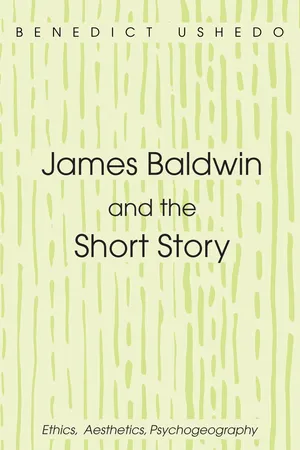
About this book
This book examines the range of issues that echo in James Baldwin's short stories. It articulates and defends the claim that the stories in the collection Going to Meet the Man are driven by the autobiographical memory of the author. To support this line of thought and the related proposition that the stories feed into themes relevant to self-knowledge, vicarious suffering, love, and forgiveness, their effectiveness as transformative and "revelatory texts" is highlighted. By drawing on contemporary studies and challenging the view that short stories are no more than miniature pieces merely echoing "major" works of their authors, this book demonstrates that the short story genre can be profoundly forceful and effective in the articulation of complex human issues. This study shows also that the humanistic import of the Baldwin stories is amplified by their ability to accumulate moral tension as they elicit the participation of the reader in an imaginative quest for a better world.
Information
1
Ethics, Selfhood, and Textuality
. . . my own interests led me to see literary situations as cultural situations, and cultural situations as great elaborate fights about moral issues . . .
—Lionel Trilling, Beyond Culture
The Functioning of Literature
I will focus on the themes which are specifically highlighted in the short stories of James Baldwin in the collection Going to Meet the Man.1 The discussion will be undertaken within the wider context of the writer’s novels and non-fictional writings in appreciation of the autobiographical as well as the ethical and theological dimensions in the stories. It will be demonstrated that his art grew from his early exposure to the Bible through the religious, cultural values and images of America as he knew and understood the country.
The study goes against the grain of many critics who unduly emphasize Baldwin as a political author thereby coming to much narrower conclusions about his vision. It is inspired by the conviction that there is a symbiotic relationship between literature, theology, and the arts given that the relevance of any narrative is determined by the extent to which the “facts” of the story as evocations of human experience are organized to inform, edify or challenge its audience. A work of fiction can also be entertaining and even deconstructive as it transmits its messages. It is the nature of fiction to operate in a universe of the author’s own making. As we shall discover, Baldwin wrote directly from autobiographical experiences which gave him the raw materials for his art. Like many writers of fiction, he used language with regard to what he knew, felt, and believed about the world in which he lived and he did not conform to the restrictions of any specific literary paradigm.2 This framework provides ample opportunities for creativity on the parts of both reader and writer, including both the advantages and disadvantages of their backgrounds.3
Baldwin was very much aware that works of fiction are transformative; they help people to think clearly and feel more deeply as well as judge—for good or ill. Their transforming and revelatory powers are evident in the capacity of fiction persuasively to invite imaginative participation as well as to draw attention to alternative visions of life. What is remarkable about these alternative visions is that they “are less equivocal and easier to see than they are within the drudgery and pain of our own ordinary lives.”4 Literature functions also by facilitating a sympathetic understanding of other people, and the motivations behind their actions and reactions as well as the choices they make. This makes it particularly useful for Christian religious discourse in as much as Christian Scriptures deal also with the human condition.5
In its relationship with theological ethics, literature tends to break down barriers and establishes a plurality that rejects the distinction between “sacred” and “secular.” It is concerned with issues of freedom, the liberation of values, and the endless, democratic exercise of reading. As David Jasper has suggested, the fear of relativism cannot be ruled out in theological criticism, but the approach only amounts to a shift from the authority of the text to the authority of the interpreting community where communication occurs. The shift depends neither on the privileging of text, nor on the particular texts as the final arbiter on matters of faith. On the contrary, theological criticism is idealistic, fragile, and open to change since “literary value is not the property of an object or of a subject but, rather, the product of the dynamic of a system.”6 Hence, the interaction of literature with Scripture responds to the immediacy of human creativity.7 Equally characteristic of theological criticism is the fact that literature is used to maintain the vitality of the biblical text, its narrative and its lyrics, while resisting conclusion or dogma defined by the endless search for a final word on the Bible. The outlook allows for the assumption that the text is always more than we can say about it. In this regard, the metaphorical quality of texts provide platforms for new adventures of understanding and imagination—giving energy to that which theology and its orthodoxy tend to ossify.
The vitality that is embodied in this approach to texts and contexts inspires artists and creative writers to respond to “sacred texts” like the Bible in an acknowledgment of dissimilar sociopolitical agendas, and to explore the complexities in the human condition. In this regard, works that fictionalize biblical characters and narratives often succeed in articulating the timelessness of human experience. Revitalized by the notion of intertextuality, works of fiction echo, rewrite, or are otherwise intertwined with biblical texts or other non-biblical co-texts in acknowledgment of the fact that theology entertains open-ended narratives.8 The dynamics of intertextuality ensure also that stories and images trigger insights which move beyond existing theological frameworks.
This state of affairs engenders a plurality of interpretation given that at no point can one claim to have arrived at the final conclusion. Thus, the power of the images in art and fiction reside in endless resistance to definition and refusal to be pigeonholed.9 Carried to its conclusion, creative reading through literature and the arts has the capacity to disturb the narrative order in biblical stories and challenge the institutions and the theology which govern orthodox interpretations of canonical texts. It equally means that the “shepherd” image of the theologian, supposedly best positioned to dispense true knowledge to the “sheep” of his flock, will become suspect since such conception of an all-knowing guru of the Christian “tradition” often degenerates into an idealisation of the past, a situation which the postmodern condition resists.10
The Challenge of the Baldwin Short Stories
The challenge of this study does not lie in a search for theological and/or ethical propositions since the stories are neither prescriptive nor do they necessarily aim at providing answers. Yet the themes embedded in them will be studied with a view to finding out the questions they stimulate. Moreover, even though it can be argued, as biographers tend to do, that Baldwin abandoned formal religion (at least intellectually) in the course of his life, the stories will be researched to determine how they draw upon the master narratives of biblical literature and generate refreshing vocabularies that “reread” and transform personal and societal problems into a spiritual autobiography. It is equally of paramount interest to explore how the stories elicit creative thinking as well as facilitate an appreciation of the practical implications of the clash of values implicit or explicit in them. It is against this background that we shall understand how the stories, read in terms of Baldwin’s priorities, are able to blend ethics and aesthetics such that they not only function as “revelatory text” but also constitute, in some sense, a bridge toward the transcendent. Attempts will be made to examine how each of the stories through its literary form and religious connotations, enhances the possible choice of one ethica...
Table of contents
- Title Page
- Preface
- Chapter 1: Ethics, Selfhood, and Textuality
- Chapter 2: Myth and the Scapegoat Rhetoric
- Chapter 3: Tragedy
- Chapter 4: Contrast Experience
- Chapter 5: Music and Revelation
- Chapter 6: Conclusion
- Works and Interview by James Baldwin
- General Bibliography
- Index
Trusted by 375,005 students
Access to over 1.5 million titles for a fair monthly price.
Study more efficiently using our study tools.
Frequently asked questions
Yes, you can cancel anytime from the Subscription tab in your account settings on the Perlego website. Your subscription will stay active until the end of your current billing period. Learn how to cancel your subscription
No, books cannot be downloaded as external files, such as PDFs, for use outside of Perlego. However, you can download books within the Perlego app for offline reading on mobile or tablet. Learn how to download books offline
Perlego offers two plans: Essential and Complete
- Essential is ideal for learners and professionals who enjoy exploring a wide range of subjects. Access the Essential Library with 800,000+ trusted titles and best-sellers across business, personal growth, and the humanities. Includes unlimited reading time and Standard Read Aloud voice.
- Complete: Perfect for advanced learners and researchers needing full, unrestricted access. Unlock 1.5M+ books across hundreds of subjects, including academic and specialized titles. The Complete Plan also includes advanced features like Premium Read Aloud and Research Assistant.
We are an online textbook subscription service, where you can get access to an entire online library for less than the price of a single book per month. With over 1.5 million books across 990+ topics, we’ve got you covered! Learn about our mission
Look out for the read-aloud symbol on your next book to see if you can listen to it. The read-aloud tool reads text aloud for you, highlighting the text as it is being read. You can pause it, speed it up and slow it down. Learn more about Read Aloud
Yes! You can use the Perlego app on both iOS and Android devices to read anytime, anywhere — even offline. Perfect for commutes or when you’re on the go.
Please note we cannot support devices running on iOS 13 and Android 7 or earlier. Learn more about using the app
Please note we cannot support devices running on iOS 13 and Android 7 or earlier. Learn more about using the app
Yes, you can access James Baldwin and the Short Story by Benedict Ushedo in PDF and/or ePUB format, as well as other popular books in Literature & Literary Criticism. We have over 1.5 million books available in our catalogue for you to explore.