eBook - ePub
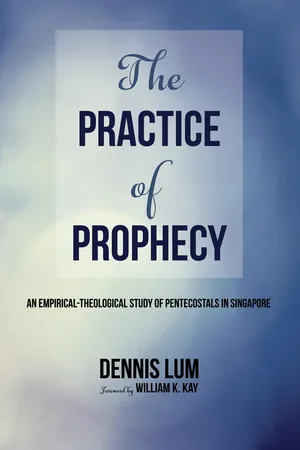
The Practice of Prophecy
An Empirical-Theological Study of Pentecostals in Singapore
- 278 pages
- English
- ePUB (mobile friendly)
- Available on iOS & Android
eBook - ePub
The Practice of Prophecy
An Empirical-Theological Study of Pentecostals in Singapore
About this book
The charisma of prophecy is found throughout the history of the global Pentecostal movement. Within the movement, prophecy is seen as the communication of an inspired, spontaneous revelation, bringing edification to the faith community. Despite its prevalence, academic research has mostly focused on the biblical-theological aspect, neglecting the actual contemporary practice. This book addresses this gap with a study on the practice of prophecy within the Assemblies of God of Singapore. The book investigates the nature, purpose, and significance of the phenomenon. It also identifies theological variables that are correlated with its practice and explicates these relationships. The investigation employs the empirical-theological method of Johannes van der Ven, utilizing both a qualitative and a quantitative study. The results provide a rich description of the actual reception, delivery, and judging of prophecy. Significant findings include relationships between prophecy and courage, love, personality types, prayer types, and evangelism.
Information
Topic
Theology & ReligionSubtopic
Christian Denominations1
Introduction and Background
1.1 Introduction
The phenomenon of prophecy is widely observed throughout the history of the Pentecostal movement.1 A survey conducted by the Pew Research Center showed that prophecy remains common among contemporary Pentecostal congregations worldwide.2 The report revealed that prophecy is extensively practiced within Asia, with 29 percent in the Philippines, 41 percent in India, and 43 percent in South Korea responding to say they had given or interpreted prophecy. It would be reasonable to infer that an even greater percentage of believers have heard or received a prophecy in these congregations. Similarly, a survey of Pentecostals in Singapore, Malaysia, and Hong Kong showed that 60 percent of the respondents were engaged in prophesying.3 This widespread occurrence of the phenomenon highlights its important place within the Pentecostal movement. The great value of prophecy is highlighted by early Pentecostal statesman Donald Gee when he writes: “It [prophecy] can sweep the assembly up into heights of glory and enthusiasm, melt with tenderness, and make to tremble with awe. It truly ministers to the believer ‘exhortation, edification and comfort’ (1 Corinthians 14:3); and in the unbeliever can produce deep conviction (verse 24).”4
Prophecy is one of the spiritual gifts or charismata listed by Paul in 1 Corinthians 12:8–10. Pentecostals generally consider prophecy to be the reception and communication of a spontaneous revelation through a divinely inspired human intermediary.5 This is often described as comprising of either forth-telling or fore-telling.6 Forth-telling consists of communicating a message believed to originate from God whereas fore-telling comprises the prediction of future events; the former function being more common of the two. The prophetic message is usually directed to a congregation though it may also be directed specifically at individuals.
The purpose of prophecy is understood to be primarily for the strengthening, encouragement, and comfort of the community of faith (1 Cor 14:3).7 The literature review will later demonstrate that prophecy is widely discussed within Pentecostal literature at both the popular level as well as in academic discourse. However, most discussions examine prophecy from a historical or biblical-theological perspective. While there are popular handbooks on how Pentecostal prophecy should be practiced in the church today, there is a somewhat surprising dearth of academic studies on the practice of contemporary prophecy within the Pentecostal movement, particularly from the empirical perspective.8 A significantly larger number of studies have focused on the phenomenon of glossolalia.9 Furthermore, Pentecostal literature is strongly dominated by Western scholarship and studies on prophecy are mostly focused on the Western context.10 This is despite the fact that the majority of Pentecostals reside in Asia, Africa, and Latin America.11 There is thus a lack of studies on the contemporary practice of prophecy in the Pentecostal movement, particularly in the majority world. This study hopes to fill this lacuna in the literature through an empirical-theological investigation of prophecy in the Asian city-state of Singapore.
1.2 Purpose of the Study
The purpose of this study is to investigate the contemporary practice of prophecy within the Pentecostal church. Specifically, the study hopes to answer the following research questions: What is the nature, purpose, significance, and characteristics of contemporary prophecy? How does contemporary prophecy compare with literature on this subject? What variables are correlated with the practice of prophecy and what is their relationship? What practical-theological understanding can be gained from this study and what are its implications? The study will conduct an empirical-theological examination of the practice of prophecy within the Assemblies of God of Singapore (AGS) to address these questions.
1.3 Context of the Study
The beginning of the Pentecostal movement is usually traced back to the revivals that took place globally at the beginning of the twentieth century.12 Perhaps the most prominent and significant of these revivals were those that occurred at Topeka, Kansas and at Azusa Street in the United States.13 These revivals were marked by believers seeking a spiritual experience, subsequent to conversion, termed as the Baptism of the Holy Spirit. This experience was marked by the utterance of tongues or glossolalia.14 The revivals were also characterized by the fervent activity of charismata such as prophecy and divine healing. These supernatural phenomena were, in fact, exhibited throughout the New Testament and much of church history.15 However, the Pentecostal movement has placed far greater emphasis on the activity of the charismata than other modern Christian movements.
The Pentecostal movement is commonly categorized into three groups within the literature.16 Classical Pentecostal churches form the first group and this consists of denominations and churches that originated from the revivals mentioned above at the start of the twentieth century and the subsequent missionary endeavors of these churches. The second group comprises of Charismatic churches within the older, historical denominations which have been impacted by Pentecostal teaching and experience. These churches hold to the Pentecostal emphases of the supernatural activity of the Holy Spirit and the charismata while incorporating them into their traditional doctrinal positions. Neo-charismatic churches form the third and largest group. This group includes a wide variety of churches that are independent, indigenous, or part of post-denominational networks. These churches likewise stress the activity of spiritual gifts while placing greater emphasis on “signs and wonders,” deliverance, and power encounters. The practice of glossolalia is much less emphasized within this last group.
This present study is limited to examining the practice of prophecy within the A...
Table of contents
- Title Page
- Foreword
- Acknowledgements
- Abbreviations
- Chapter 1: Introduction and Background
- Chapter 2: An Empirical Approach to Practical Theology
- Chapter 3: A Qualitative Study on Prophecy
- Chapter 4: The Nature and Purpose of Prophecy
- Chapter 5: The Practice of Prophecy
- Chapter 6: A Quantitative Study on Prophecy
- Chapter 7: Theological Reflection and Conclusion
- Appendix A: Qualitative Interview Questions
- Appendix B: Survey Instruments
- Bibliography
Trusted by 375,005 students
Access to over 1.5 million titles for a fair monthly price.
Study more efficiently using our study tools.
Frequently asked questions
Yes, you can cancel anytime from the Subscription tab in your account settings on the Perlego website. Your subscription will stay active until the end of your current billing period. Learn how to cancel your subscription
No, books cannot be downloaded as external files, such as PDFs, for use outside of Perlego. However, you can download books within the Perlego app for offline reading on mobile or tablet. Learn how to download books offline
Perlego offers two plans: Essential and Complete
- Essential is ideal for learners and professionals who enjoy exploring a wide range of subjects. Access the Essential Library with 800,000+ trusted titles and best-sellers across business, personal growth, and the humanities. Includes unlimited reading time and Standard Read Aloud voice.
- Complete: Perfect for advanced learners and researchers needing full, unrestricted access. Unlock 1.5M+ books across hundreds of subjects, including academic and specialized titles. The Complete Plan also includes advanced features like Premium Read Aloud and Research Assistant.
We are an online textbook subscription service, where you can get access to an entire online library for less than the price of a single book per month. With over 1.5 million books across 990+ topics, we’ve got you covered! Learn about our mission
Look out for the read-aloud symbol on your next book to see if you can listen to it. The read-aloud tool reads text aloud for you, highlighting the text as it is being read. You can pause it, speed it up and slow it down. Learn more about Read Aloud
Yes! You can use the Perlego app on both iOS and Android devices to read anytime, anywhere — even offline. Perfect for commutes or when you’re on the go.
Please note we cannot support devices running on iOS 13 and Android 7 or earlier. Learn more about using the app
Please note we cannot support devices running on iOS 13 and Android 7 or earlier. Learn more about using the app
Yes, you can access The Practice of Prophecy by Li Ming Dennis Lum in PDF and/or ePUB format, as well as other popular books in Theology & Religion & Christian Denominations. We have over 1.5 million books available in our catalogue for you to explore.