eBook - ePub
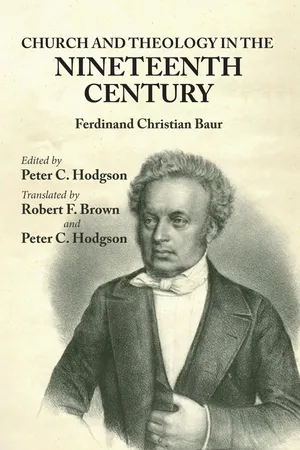
Church and Theology in the Nineteenth Century
- 544 pages
- English
- ePUB (mobile friendly)
- Available on iOS & Android
eBook - ePub
Church and Theology in the Nineteenth Century
About this book
The last volume of Baur's church history, based on lectures delivered during the 1850s, covers the nineteenth century. They were edited and published by Eduard Zeller after Baur's death. Since the lectures devote equal attention to theological and ecclesiastical matters, the title in English is Church and Theology in the Nineteenth Century. Baur provides critical analyses of the philosophers and theologians of the nineteenth century (Herder, Schiller, Goethe, Kant, Fichte, Schelling, Jacobi, Schleiermacher, Marheineke, Neander, Mohler, Hegel, Strauss, Feuerbach, and many others), as well as details about European Catholic and Protestant church history from 1800 to 1860. What he produces is a "participant history," written by a scholar very much engaged in the issues of his time. Ferdinand Christian Baur was a professor of theology at the University of Tubingen from 1826 to 1860. He is known for his path-breaking studies in New Testament literature and historical theology. Recent translations of his work by Brown and Hodgson include History of Christian Dogma and Lectures on New Testament Theology.
Information
Topic
Theology & ReligionSubtopic
Christian TheologyPart One
From the Beginning of the Nineteenth Century to 1815
1
Introduction
Survey of Political Events
The beginning of Part One takes us back to the turbulent times during which the French Revolution completed its course. Since from its beginning it was a world-shattering event, it was the center of gravity of all political movements of the European states. The torrent, which had powerfully and perilously swollen the stream of revolutionary sentiment, had begun to recede, and more fixed points in the newly forming order of things already had begun to emerge amid the widespread destruction and confusion of the previously existing order. By the first days of the new century, a man stood at the pinnacle of power in France. This was a man who managed to forge the chaotically confused elements in France together and to amplify the power delivered into his hands from the revolution, which he would use to determine the fate of Europe for years to come. After he became the First Consul of the French Republic, in 1799, Napoleon Bonaparte (1769–1821) demonstrated the great organizing talent that set him apart. Because of him France became a newly organized state, rejuvenated with powers nourished by the revolution. Thus he now exerted the greatest influence on the whole of a Europe crumbling as the result of the revolution, and he effected the most important changes in political affairs and all related matters. The entire period of Napoleonic domination involves a series of events that, to an ever greater extent, caused everything to be torn loose from its old footings and the foundations of a new structure to be laid on the wreckage of the old.
The first important event of this period was the peace concluded between the French Republic and the German emperor at Lunéville in February 1801, as a result of the victory of the French at the Battle of Marengo.1 This treaty separated the left bank of the Rhine from Germany and joined it to France, and this brought about a series of changes that were of great importance in the ecclesiastical realm as well. This was the beginning of the dissolution of the German imperial regime as it had existed since early times. Its complete dissolution came about a few years later.2 While France became a united monarchy by the transformation of the Republic into a hereditary empire,3 as seemed to befit the needs of the nation, everything that happened in Germany since the Peace of Lunéville showed ever more clearly how little the decaying and collapsing system of the old aristocracy and monarchy had aroused resistance to itself, whereas resistance seemed ever more necessary the more power the new rulers seized. The new coalition formed against France in 1805 came to an end, following the Battle of Austerlitz, with the Peace of Pressburg concluded in December of that year. That treaty considerably diminished the power of Austria and also cut loose from German imperial authority a number of German imperial princes—the electors of Bavaria, Württemberg, and Baden, who were elevated to being kings. Thus at the beginning of 1806 the German emperor saw that it was necessary for him to dissolve the empire and relinquish the German throne.
What happened to Austria in 1805 with the Battle of Austerlitz, happened to Prussia in 1806 with the Battle of Jena. Prussia, so resplendent in its ancient glory as a significant state, all at once became a minor territory. Under the name of the Confederation of the Rhine, to which the Electorate of Saxony (elevated to a kingdom) and the newly erected Kingdom of Westphalia (ruled by a French prince) belonged, the greater part of Germany became a French province. The mighty French Empire, constantly and rapidly expanding, and utilizing all the instruments of power and politics, attained its long-sought goal of a universal European monarchy. The pressure on the general atmosphere at that time quickly became so great that Austria hoped to shake off the yoke of foreign domination by the great exertions it made in 1809. These efforts just served to entrench opinions about the omnipotence of its foreign domination. The peace newly concluded in Vienna, which joined the new French dynasty with the old Habsburg dynasty through family ties, just seemed to establish a new guarantee for the continuing existence of the French monarchy.4
The extent to which the peoples and states of Europe—with the exception of the English who were protected by their insular situation, and the tenacious resistance of the Spanish religious fanaticism—were under French control, and how little these apparently independent peoples were able to resist the force of necessity and so joined in campaigns of conquest, we see in 1812 when the French emperor turned against the emperor of Russia, with whom he previously had been on friendly terms, in order to expand his universal monarchy in this direction too. As he explained in his war manifesto, Napoleon supposed that, in the war for which he himself was responsible, Russia would simply be meeting its fate. But the menacing fate now fell upon the bold [would-be] conqueror himself. The burning of Moscow, and the deadly harshness of the Russian winter on the withdrawing army, brought a sudden reversal: the extraordinary events could be seen to herald the cry for liberation from the oppression of foreign domination.5 In Prussia there had long been a secret, calculated plan, relying on both moral energy and political shrewdness. Now it suddenly and powerfully came out into the open, and the heroic uprising of the entire people directly shows that now they faced an entirely different opponent than in the days of the catastrophe at Jena. To be sure, victory over a military power as well organized as the French required many bloody battles with varying outcomes; but by the end of 1813 things had gone so far that now the whole of Europe was allied against France, whereas the previous year it had taken the field with France. Despite the valiant resistance that the united armies met with in France, the empire could not endure. It collapsed to such a degree that Napoleon had to abdicate and withdraw from the stage.
What was scarcely thought possible now happened: the exiled Bourbons again mounted the French throne and claimed their hereditary rights to it. But in a short while the contrast between the new rule and the previous one was felt so deeply, and the sympathy of the French nation for the emperor who had elevated France to the highest level of its power and glory was so strong, that he only needed to reappear in order to topple the Bourbon throne once again. The whole of France fell to Napoleon with new enthusiasm when in 1815 he landed on the French coast with a few comrades from the island of Elba. While the monarchs assembled in Vienna, to divide the spoils of their conquests, were deeply involved in their diplomatic negotiations, which became ever more complex because of their discrepant interests, the destiny of Europe had to be decided once again by force of arms. The Battle of Waterloo finally put an end to Napoleon’s domination.6 The negotiations of the Second Treaty of Paris and the acts of the reopened Congress of Vienna lay the foundation of a new political system, which in particular established the internal circumstances of Germany as they still are today.7
Germany under Napoleon; The Wars of Liberation
If we survey this time frame, we can rightly say that there is no period of history with such a great reordering of circumstances as in this short span of fifteen years, and with one world-historical event following upon another. What the French Revolution meant for France, the revolution proceeding from Napoleonic rule meant for the lands to which it extended, especially for Germany. If the French Revolution was the most decisive break with the past and its traditions, with a system that had become outdated in all its forms, then the same thing was supposed to happen in other lands too. We see the old forms collapsing everywhere. It is as though a mighty storm blew across the whole of Europe, bringing down everything lacking the power to withstand it. Initially we can see in this entire period only the caprice and forceful dominion of a bold conqueror, who allowed nothing to stand in the way of pursuing his plans ever further. But it would be very one-sided just to stop at this point; rather things must be viewed from the standpoint of a historical process through which the states and peoples of Europe had to pass in order to enter a new period of their political and intellectual development. Progress does not always occur on the smooth and peaceful path of gradual inner development; there are also times of revolution when, once people recognize what the times call for, they must attain it, albeit only through struggle and force. When the whole system of the old aristocracy and monarchy became an unbearable weight, the French nation disburdened itself of it by means of a movement that merits the name of revolution, if any movement does.
Other lands too, especially Germany, found themselves in a similar condition. They plodded along in the most cumbersome way with forms that had become antiquated and that therefore maintained their coherence through longstanding convention, but lacked any inner vital power. The entire system of German imperial government was antiquated, decaying and withered. Just one example is that the relationship of the imperial leader to the imperial princes was lacking in any inner sense of purpose and stability. When we compare Germany with France, the great difference, however, is that in Germany people had not yet properly felt all the deficiencies and shortcomings from which they suffered. People deceived themselves about their own condition and hoped that a thorough remedy of the affliction might bring something better; but they believed that the old, worn-out diplomatic artifices of a dishonest, morally disreputable politics would provide the remedy. We can only imagine how deluded people were if they believed, not only in Prussia but also the other German lands, that a state such as Prussia, with its self-proud aristocracy, its rigid bureaucratic mechanisms, its outmoded traditions from a time on whose dead capital people drew without having the spark of its spirit within them, could take on an opponent such as Napoleon.8 People in Germany first had to come to a realization about themselves, to a clear awareness of what was lacking in all the circumstances of the life of the people and the state—of what could happen only through such experiences as had occurred in the most palpable way over a series of years. We can now look back on the entire period of French domination—during which Germany was not only robbed of its political and national independence, but also became inwardly alienated and torn apart—with the feeling of deepest shame and humility. But this was the necessary path by which Germany could emerge from the old unhealthy circumstances and rise up, inwardly strengthened with fresh moral energy.
Seen from without, the time of French domination was, for Germany and the lands on which the pressure weighed most heavily, simply a period of oppression; but viewed more closely, at bottom it was a conflict of the old and new, a conflict between two opposed principles, one of which had a national, popular origin, while the other rested on the system of ancient legitimacy and dynastic interests. The first of these principles was represented by the French nation. However one may judge the revolution in other respects, France attained a national strength and moral energy through the revolution that placed it far above other nations. By contrast, the other principle was represented by those states that were incapable of any vigorous resistance. From this we can see how completely the authority of the state had withered when it concentrated all its power in a monarchy based only on its absolute right and unconnected to any vital ties to the people. The result of the struggle between the two principles in the period before us shows very clearly the intrinsic tendency of the new age that began with the French Revolution: to replace the old traditional regime with a genuinely popular rule arising out of the self-consciousness of the people, and the extent to which this age has its distinctive center of gravity only where a people and state become aware of and assert their national interests. Nothing shows this more clearly than the final result of the struggle between these two principles during the period we are examining. Napoleonic domination, which far exceeded its natural limits, had to collapse as soon as it disowned the source from which it had emerged, and assumed a despotic character that was essentially no different than the old monarchy—as soon as what originally had been a purely national power believed it was able to maintain itself by destroying the national s...
Table of contents
- Title Page
- Editor’s Foreword
- Introduction
- Part One: From the Beginning of the Nineteenth Century to 1815
- Part Two: From 1815 to 1830
- Part Three: From 1830 to Most Recent Times
- Appendix
Trusted by 375,005 students
Access to over 1.5 million titles for a fair monthly price.
Study more efficiently using our study tools.
Frequently asked questions
Yes, you can cancel anytime from the Subscription tab in your account settings on the Perlego website. Your subscription will stay active until the end of your current billing period. Learn how to cancel your subscription
No, books cannot be downloaded as external files, such as PDFs, for use outside of Perlego. However, you can download books within the Perlego app for offline reading on mobile or tablet. Learn how to download books offline
Perlego offers two plans: Essential and Complete
- Essential is ideal for learners and professionals who enjoy exploring a wide range of subjects. Access the Essential Library with 800,000+ trusted titles and best-sellers across business, personal growth, and the humanities. Includes unlimited reading time and Standard Read Aloud voice.
- Complete: Perfect for advanced learners and researchers needing full, unrestricted access. Unlock 1.5M+ books across hundreds of subjects, including academic and specialized titles. The Complete Plan also includes advanced features like Premium Read Aloud and Research Assistant.
We are an online textbook subscription service, where you can get access to an entire online library for less than the price of a single book per month. With over 1.5 million books across 990+ topics, we’ve got you covered! Learn about our mission
Look out for the read-aloud symbol on your next book to see if you can listen to it. The read-aloud tool reads text aloud for you, highlighting the text as it is being read. You can pause it, speed it up and slow it down. Learn more about Read Aloud
Yes! You can use the Perlego app on both iOS and Android devices to read anytime, anywhere — even offline. Perfect for commutes or when you’re on the go.
Please note we cannot support devices running on iOS 13 and Android 7 or earlier. Learn more about using the app
Please note we cannot support devices running on iOS 13 and Android 7 or earlier. Learn more about using the app
Yes, you can access Church and Theology in the Nineteenth Century by Ferdinand Christian Baur, Peter C. Hodgson, Robert F. Brown in PDF and/or ePUB format, as well as other popular books in Theology & Religion & Christian Theology. We have over 1.5 million books available in our catalogue for you to explore.