- 198 pages
- English
- ePUB (mobile friendly)
- Available on iOS & Android
eBook - ePub
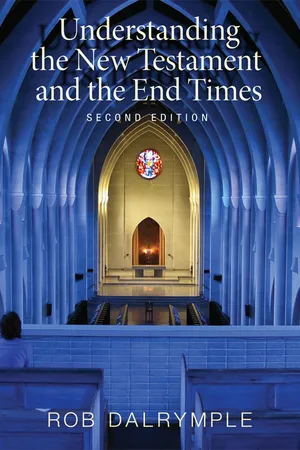
Understanding the New Testament and the End Times, Second Edition
About this book
Many evangelicals have come to embrace a populist eschatology that has neither the support of the historical church, nor of the scholarly world today. For some, this has led to a disillusionment with eschatological speculations. For others, the results are apathy and a failure to understand the mission of God's people. This is tragic! For when the entirety of the New Testament is read and understood from an eschatological perspective, the grand narrative of Scripture and its fulfillment in Jesus comes clearly into focus. A proper framework for understanding eschatology directly correlates to a proper understanding of the mission of God's people, who are themselves carrying forth the biblical story as we approach the New Jerusalem. To fail to comprehend eschatology is to fail to comprehend our mission.
This book has two objectives: First, to provide a proper hermeneutical framework from which we may discern a biblical eschatological worldview. Second, to demonstrate that a proper eschatological framework relates to the mission of God's people and the demand for holiness. Thus, eschatology matters!
Information
1
My Story
Introduction
In 1989, I had come to conclude that the end times and the book of Revelation were a mystery that would only be solved when everything was over. If anyone proposed that they knew what it meant, they were not to be trusted, for no one knows what it means. Now, you must understand that prior to this time I had been fascinated with the end times and all of the hype that went along with it.
After all, I was born in 666—honestly: June 1966. After coming to faith in Christ at a young age, I grew up in an evangelical, fundamentalist Christian tradition. I strived to live as a faithful Christian and, by God’s grace, my faith remained strong. Throughout my youth I read dozens of books on the end times and earnestly strove to determine the meaning of the book of Revelation and the end times according to the New Testament (NT). I even spent hours in the local library one day to determine the number of earthquakes and other such “signs” that had occurred in the last generation, with the conviction that this data would confirm that the return of Christ was indeed near.
As a product of a well-intentioned, evangelical, fundamentalist upbringing, I was taught that the Bible was to be interpreted in a particular manner—with a wooden literalism—and in accord with a well-delineated evangelical worldview. I was convinced that this was the only true way to interpret the Bible. In fact, I was confident that Jesus, Paul, and for that matter Moses, David, and the rest, must also have thought and reasoned like me. Furthermore, I was also convinced that all other interpretations were the result of liberal assertions, which were intended to undermine the truth of God, Christ, the Bible, and ultimately Christianity itself.
Now, in all of this I was very well intentioned. I was a sincere and genuine follower of Christ. I read the Bible as a moral guidebook. It told me what was right and what was wrong. It told me that if I believed in Jesus then I should do what was right. The Bible was merely a handbook of dos and don’ts, which I was attempting to follow. I worked hard at being a good Christian.
When it came to the study of the end times, I was taught that things were fairly well spelled out. We were to look for certain events that were precursors to the return of Jesus, including the rebuilding of the temple in Jerusalem and the rise of an anti-Christ, who will rise to power in a restored Roman Empire and will impose a one-world, end-times government.
Problems began to surface for me along two lines. First, I began to realize that there were tremendous disagreements in the popular literature over the meaning of Revelation and the end times. I became increasingly uneasy in my heart as I grappled with these things, not knowing whom to believe. Secondly, by the middle of the 1980s, I began to realize that many of the prophecies, which I had been told we were seeing fulfilled in our generation, never seemed to come to fruition. I had read many books that assured me that Jesus would return by the mid 1980s.1 By 1989, and the fall of the iron curtain, I was totally disillusioned. I had begun to realize that not only were the events not being fulfilled as these popular writers had assured me, but the things that I was told were “signs” of the imminent fulfillment were all moving in the opposite direction. The Russians were certainly not about to invade Israel; they seemed more concerned with how they might feed their own soldiers.
Now, the Lord has a way of being quite humorous. For, by the early 1990s, in the midst of my disillusionment with the book of Revelation and the study of the end times, I was blessed with the opportunity to teach New Testament studies at a Christian college. Immediately I was confronted with a problem. How could one teach an “Introduction to the New Testament” course and omit the book of Revelation? For I truly wanted to omit it. After all, I certainly did not know what it meant.
I decided to prepare by consulting some commentaries on the book of Revelation. Now, in my studies of the New Testament I had gained much insight from several series of standard evangelical commentaries. As I read through these standard, scholarly, evangelical commentaries on the book of Revelation, I began to realize several things. First, there was a significant amount of agreement among scholars as to what the book of Revelation was saying. Secondly, the book of Revelation made great sense when approached carefully through the lens of the Old Testament (OT) and Jesus’ fulfillment of it. Thirdly, the message of the book is incredible! As a result, I began to fall in love again with the book of Revelation and the study of the end times!
Over the next few years I immersed myself in the study of the end times and apocalyptic literature. I soon discovered that the message of the NT must be understood from within an eschatological (“end times”) context; and that God’s eschatological plan was not only fulfilled in Christ, but was continuing to unfold through his people, and that all of this climaxes in the New Jerusalem.
As I continued to examine the Scriptures I became aware that the message of the NT is that God has called us—his people—to participate now in the building of his kingdom! The kingdom that Jesus began is the same kingdom that God has prepared for us to build. Eschatology is missional! That is, understanding the end times, and that they have begun in Christ, provides us with the framework for understanding the work of God in the present: namely, his bringing about the New Creation!
This all came to a climax for me during the years of my graduate and doctoral work. For, it was then that I came to fully grasp that the manner of interpretation of the Scriptures that I had followed, and its accompanying worldview, was not the approach/worldview of Jesus, Paul, Moses, David, or anyone in the biblical world. When I initially came to an awareness of this fact, I was somewhat okay with it. For how and why should I suppose that anyone in the ancient world thought like me (even though I had been raised to think that they did!)? But, I was also uncertain how to proceed—for I knew that I could not go back. What I was learning was true. For Paul thought like a first-century Jew, Luke was well at home in the Roman world, and Moses’ writings make perfect sense when read from within an Ancient Near Eastern (ANE) perspective.
At the same time, I found myself in awe of the beauty and depth of the Scriptures as I was now beginning to see them. They were not merely a simplistic manual on right and wrong and how to be a good Christian until I go to heaven. The Scriptures were far grander, much richer, and more magnificent than I had ever thought! They exhibited a depth and beauty beyond anything I had ever imagined. I was beginning to see that God and his plan were far more majestic than I could possibly conceive! Throughout this time I was continuously stimulated by the new found riches revealed in Scripture.
But I was also fearful. On the one hand, I was beginning to see that Scripture contained so much more for me to discover. It was as though I had stumbled into Narnia and there before me was a whole new world to explore beyond the wardrobe! But, on the other hand, I was nervous. My prior convictions had been the bedrock of my faith. If this bedrock was nothing more than sand, then upon what would I now stand? If my preconceptions in all these areas were unfounded, then might my whole faith implode? For months, and even years, as I continued to grapple with this newfound understanding of God and Scripture, I struggled with these constantly mixed emotions: excitement over newly discovered riches, and concern over a quickly eroding foundation. For, if this foundation were removed, then with what would it be replaced? How was I now to read the Bible?
Then I found Jesus. Not in a personal sense—I already knew him in that regard. I mean that I found that Jesus was the answer! Jesus became my new foundation for understanding the Bible. That is, the Bible is about Jesus—the Jesus who transcends all comprehension: the God whose thoughts are not my thoughts and whose ways are not my ways.2 Jesus is the key to a proper understanding of the Bible. Christ himself became my new bedrock for interpreting the Scriptures. And I found that the centrality of Christ was a more sure foundation than any method of interpretation that I had previously employed. I discovered that if we come to fully understand the significance of the person and work of Jesus, that is, truly understand it without limitations, then the Scriptures and the mission of God all begin to fall into place.
This new perspective (new for me of course, but one that I soon found out was commonplace among most scholars today and the church historically) radically influenced my understanding of the overall nature and purpose of Scripture. Suddenly, the overall story of the Bible—the person, nature, and mission of God; the person of Christ and his fulfillment of God’s mission; and the calling of God on people to be the means by which he continues to build his kingdom—have all come into a much sharper focus. Now I see that Scripture relays for us a dynamic story in which God has guided and moved history in a tremendously fascinating and complex manner: the grand plan of God’s cosmic design unfolds throughout the narrative of Genesis to Revelation. God’s sovereign plan, in which he wills to dwell among his people, is disclosed through the pages of Scripture. That plan is about Jesus.
What I hope to share in the pages of this book are the implications of all this for understanding the end times, the mission of God’s people, and why it matters. Why is this important? After all, there is so much speculation about the end times, and much of it has proven to be false over the years, that one may well wonder if it even matters—let alone if anyone could possibly know what the end times hold. Well, it matters alright! It matters greatly. It matters because this plan is one in which God has called us to participate!
Reading This Book
As for the general presentation of this book: I am confident that, for the most part, much of the basic argumentation within each chapter, though perhaps new to many, will appear reasonable and stimulating. Most readers who have not ventured too far into this field of study will agree with the overall conclusions and find them exciting. At times, however, I will take some of these conclusions and draw inferences from them that, though widely acknowledged among the scholarly community, and well within the historical understanding of the church, will prove to be a challenge for many readers.
One of the reasons for this challenge is that much of contemporary Christianity has unknowingly been influenced by Western rationalism and modernism. This influence of Enlightenment and post-Enlightenment thinking is so deeply engrained in our psyche that many of us are unprepared and, perhaps, even unwilling to think differently. I know, for I too thought this way.
Unfortunately, the theological perspectives of twentieth-century popular Christianity have become such dogma that many find it impossible to think any other way. All other boxes are deemed a concession to liberalism, scientism, humanism, and many other -isms. The thought that Jesus, Paul, Moses, et al. did not think within the context of a modernistic worldview is unconscionable. Indeed, I am speaking from my own experience here. I remember distinctly thinking that Jesus must have thought like me because we, in the post-Enlightenment West, have learned how to think and to know in all fields with absolutes. Since this manner of thinking is deemed “correct” in an absolute sense, and since Jesus must have thought “correctly,” then he too must have thought like me. My worldview, in fact, was built on the edifice that this was the proper and only way to think and reason.3
I assure you that the conclusions presented in this work will serve to confirm the core of Christian theology. The primacy of Christ is a conviction that all Christians share. This book will not only affirm the primacy of Christ, but demonstrate that much of Christian theology has not emphasized enough the centrality of Christ’s person and work, especially when it comes to interpreting the Bible. At this point, most readers will not only find themselves in hearty agreement, but will sense a level of enthusiasm as the Scriptures come alive with far more force than previously imagined. The problems for some will arise when I extend these conclusions and the accompanying implications to their natural conclusions. For, the ramifications of a proper christological perspective in Scripture are grand—and at times convicting.
Another reason why some may struggle with the framew...
Table of contents
- Title Page
- Acknowledgments
- Preface
- Preface to the Second Edition
- Chapter 1: My Story
- Chapter 2: Introduction to Understanding The New Testament and the End Times
- Chapter 3: Jesus: Reading the Bible Christologically
- Chapter 4: Jesus, the End Times, and the Arrival of the Kingdom
- Chapter 5: Understanding Prophecy and the End Times
- Chapter 6: The End Times and the Temple
- Chapter 7: The End Times, the Temple, and the New Testament
- Chapter 8: The Tribulation and the People of God
- Chapter 9: Understanding the Second Coming of Christ
- Chapter 10: Understanding the “Signs of the Times”
- Chapter 11: The War of Armageddon
- Chapter 12: Understanding The New Testament and the End Times: Why It Matters!
- Bibliography
Trusted by 375,005 students
Access to over 1.5 million titles for a fair monthly price.
Study more efficiently using our study tools.
Frequently asked questions
Yes, you can cancel anytime from the Subscription tab in your account settings on the Perlego website. Your subscription will stay active until the end of your current billing period. Learn how to cancel your subscription
No, books cannot be downloaded as external files, such as PDFs, for use outside of Perlego. However, you can download books within the Perlego app for offline reading on mobile or tablet. Learn how to download books offline
Perlego offers two plans: Essential and Complete
- Essential is ideal for learners and professionals who enjoy exploring a wide range of subjects. Access the Essential Library with 800,000+ trusted titles and best-sellers across business, personal growth, and the humanities. Includes unlimited reading time and Standard Read Aloud voice.
- Complete: Perfect for advanced learners and researchers needing full, unrestricted access. Unlock 1.5M+ books across hundreds of subjects, including academic and specialized titles. The Complete Plan also includes advanced features like Premium Read Aloud and Research Assistant.
We are an online textbook subscription service, where you can get access to an entire online library for less than the price of a single book per month. With over 1.5 million books across 990+ topics, we’ve got you covered! Learn about our mission
Look out for the read-aloud symbol on your next book to see if you can listen to it. The read-aloud tool reads text aloud for you, highlighting the text as it is being read. You can pause it, speed it up and slow it down. Learn more about Read Aloud
Yes! You can use the Perlego app on both iOS and Android devices to read anytime, anywhere — even offline. Perfect for commutes or when you’re on the go.
Please note we cannot support devices running on iOS 13 and Android 7 or earlier. Learn more about using the app
Please note we cannot support devices running on iOS 13 and Android 7 or earlier. Learn more about using the app
Yes, you can access Understanding the New Testament and the End Times, Second Edition by Rob Dalrymple in PDF and/or ePUB format, as well as other popular books in Theology & Religion & Biblical Criticism & Interpretation. We have over 1.5 million books available in our catalogue for you to explore.