- 126 pages
- English
- ePUB (mobile friendly)
- Available on iOS & Android
eBook - ePub
About this book
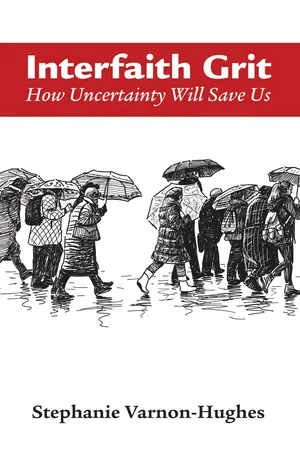
This book is meant for every family member, colleague, and airplane seatmate who has asked me a variation of the following question: "Why is the world like this? What can I do?"
Being human is a messy endeavor. We are made to be in relationship--built for community, craving to be known and seen and heard, better together. And yet, some flaw in us allows us to dwell on difference and allows diversity to become divisiveness. We fear the unknown. We resist the new. We turn strident and hateful when made to change. Why is this?
I believe that leaning into the unknown is a transformative skill. We can practice becoming okay with difference. We can become virtuosic at embracing the unknown. When we learn that diversity will indeed transform us--body, soul, and nation--we can systematically name, teach, and celebrate the practices that help us persevere in shaky places.
Information
Topic
Theology & ReligionSubtopic
Christian TheologyThe Problem
Our World Just Won’t Stay Still
Babies and toddlers are used to their worlds being upended. Depth perception, object permanence, new textures and foods—reality shifts, is added to and changed; new information transforms what they thought they knew, all day long.
Dissonance is uncomfortable. We are literally experiencing a shakiness which can feel like a threat to the world, and how we fit in it. And yet, disequilibrium precedes all real learning. It’s a necessary ingredient to learning. If we hope to learn, if we seek to mature, we must take the risk of being changed.
How do we cope with change? How do we cope with difference? Some of us avoid. Some flee. Some bargain, and some try to debate. Some experience a crisis of faith or become paralyzed by moral relativism. Some fear outsiders as a perceived threat. Some become energized by travel, new foods, new customs, and difference. Some meet great friends, roommates, coworkers, or fall in love with someone different. Some feel their own religious or ethical traditions illuminated or strengthened by exposure to and relationship with difference.
What divides these two groups of people? Or rather, what keeps us from being more open to difference? Are some of us more naturally inclined be okay with this dissonance? Are there practices or things we can learn to help us deal with disequilibrium? Can we teach those in our communities to encounter difference with a positive posture of openness?
This book operates on the idea that we can become more comfortable with difference. Further, if we are a teacher, parent, religious leader, or manager in a workplace or organization, it is our responsibility to help others grow in their ability to withstand dissonance. It takes a little courage, it takes a willingness to be occasionally uncomfortable—it takes interfaith grit.
Recently, there has been a bit of a backlash against the idea of “grit,” especially as applied to urban youth—the concept has been much in public discussion. But misconceptions about grit and resilience characterize those traits as somehow innate. In fact, resilience is a transferable skill. It is a practice, and leaders can help teach and foster strategies that lead to great resilience and, in turn, to more effective learning and lasting positive relationships.2
What do we know about resiliency, psychology, and the human brain? The work of Norman Garmezy has been instrumental in the development of the study of human resiliency as a field. The literature begins in child psychology and psychiatry in the 1960s and 1970s on “vulnerable children,” “social effectiveness,” “protective factors,” “temperament,” and “social competence,” including the work of Norman Garmezy, Edward Zigler, Ann Masten, Michael Rutter, and Leslie Phillips. Moving into the 1980s and 1990s, research covered such concepts as “stress resistant,” “risk,” “vulnerability,” “coping,” and “adjustment,” with the work of the authors mentioned above, as well as J. K. Felsman, Eric Dubow, A. L. Rabin, and J. Aronoff. Resiliency emerged as a concept that could be studied and applied in education.
As early as the 1970s, Garmezy and Masten were identifying examples of “at risk” children who succeeded despite their circumstances. Garmezy in particular sought to lead a shift in researching moving from how to protect children in troubled circumstances to trying to understand how children who thrived anyway did so. By 2006, developmental psychologists and educators had made that transition; the new perspective is exemplified with Steven J. Condly (summing the work of Garmezy, Masten, and their peers in “Resilience in Children: A Review of Literature with Implications for Education”) writes,
There is a clear class of children who defy the conventional wisdom and not only survive hostile environments but also actually thrive; these are the resilient . . . resilience is . . . perceived as a label that defines the interaction of a child with trauma or a toxic environment in which success . . . is achieved by virtue of the child’s abilities, motivations, and support systems.3
Over the course of shifting from looking at children who weren’t thriving, to seeking to understand the special capacities that thriving children had, terms such as “invulnerability,” “adaptation,” and “competence” were used by researchers.
The idea of “competence” as a positive attribute to be studied exemplifies the switch to studying positive capacities in children instead of keeping track of the trauma surrounding them. Ann Masten, herself a pioneer in this area, tracks the development of the field in “Resilience in Developmental Psychopathology: Contributions of the Project Competence Longitudinal Study,” written in 2012. Masten writes, “To investigate resilience, we defined and measured the quality of adaptive behavior . . . the nature and severity of adversity or risk encountered, and the individual or contextual differences that might account for the variable patterns of adaptation.”4 Note that current resilience research still focuses on the behaviors and capacities of individual children—developmental psychologists have made recommendations to parents and teachers, but teachers have not made links between what makes up resilience and what can be taught or fostered at school. A current scan of the field of resilience in education reveals studies for teachers about resilience and programs that can build resilience in at-risk youth, but there is no mention of how resilience and inter-religious education may be linked, or how they can benefit from one another. Currently we know a great deal about resilient children and even about the resources that sustain them. Next steps for widening the field will include broadening our understanding of resilience in adult populations, linking resilience to specific areas, like inter-religious education, and learning how such connections cause learning to flourish (or not).
In this section, we will briefly examine key features of resiliency as it has been applied in developmental psychology and education, with particular attention to the latter. This research seeks to explore if and how resiliency might be an essential ingredient for inter-religious education. To that end, we will connect aspects of resilience that are particularly integral to inter-religious learning.
In 1970, the father of resiliency research, Norman Garmezy, presented a paper entitled “Vulnerability Research and the Issue of Primary Prevention” at the annual meeting of the American Orthopsychiatric5 Association. By “primary prevention,” Garmezy means “coping,” and he sought to understand how some young people—even with few resources—coped with stress and trauma better than others. This was a puzzle; researchers were seeking to learn why some children succeeded against all odds. Could they learn from those “high risk” children? As Garmezy put it, “a simple declaration of physical, psychosocial or sociocultural resources cannot explain divergent paths to adaptation or to deviance.”6 This “variability in outcomes”7 led to Garmezy’s consideration of development from the end (either the traumatized and not flourishing, or traumatized and still flourishing) child, to try and determine what had justified that outcome. This was a new lens with which to consider the outcome—previously, researchers (including Garmezy) had begun with the starting situation or traumas (poverty, illness, sick mother, low IQ). Garmezy marks this new lens and the meaning for how researchers saw children within the context of his outcomes as he writes,
Provide us with a slum child who is forging a pattern of strength and we will cast about for environmental surrogates who must have served as inoculators against despair, for events that must have encouraged hope rather than hopelessness, for inner resources that must have proclaimed vitality rather than helplessness. However, were we to convert this same slum child into someone prone to violence or aberration, our focus would be turned with equal efficiency and perhaps even greater facility to alternate figures and facets that would buttress our perception of deviance.8
Note that even Garmezy’s verb “inoculate” suggests the idea that something external, when applied to a child, can foster healing and strength. Instead, what Garmezy and his peers find is that the strength is already present within some children...
Table of contents
- Title Page
- Introduction
- Fear, Curiosity, Change, and Growth
- The Problem
- Time for Pause
- Practice, Posture, and Possibility
- Imagination and Seeing with New Eyes
- In Conclusion
- Bibliography
Trusted by 375,005 students
Access to over 1.5 million titles for a fair monthly price.
Study more efficiently using our study tools.
Frequently asked questions
Yes, you can cancel anytime from the Subscription tab in your account settings on the Perlego website. Your subscription will stay active until the end of your current billing period. Learn how to cancel your subscription
No, books cannot be downloaded as external files, such as PDFs, for use outside of Perlego. However, you can download books within the Perlego app for offline reading on mobile or tablet. Learn how to download books offline
Perlego offers two plans: Essential and Complete
- Essential is ideal for learners and professionals who enjoy exploring a wide range of subjects. Access the Essential Library with 800,000+ trusted titles and best-sellers across business, personal growth, and the humanities. Includes unlimited reading time and Standard Read Aloud voice.
- Complete: Perfect for advanced learners and researchers needing full, unrestricted access. Unlock 1.5M+ books across hundreds of subjects, including academic and specialized titles. The Complete Plan also includes advanced features like Premium Read Aloud and Research Assistant.
We are an online textbook subscription service, where you can get access to an entire online library for less than the price of a single book per month. With over 1.5 million books across 990+ topics, we’ve got you covered! Learn about our mission
Look out for the read-aloud symbol on your next book to see if you can listen to it. The read-aloud tool reads text aloud for you, highlighting the text as it is being read. You can pause it, speed it up and slow it down. Learn more about Read Aloud
Yes! You can use the Perlego app on both iOS and Android devices to read anytime, anywhere — even offline. Perfect for commutes or when you’re on the go.
Please note we cannot support devices running on iOS 13 and Android 7 or earlier. Learn more about using the app
Please note we cannot support devices running on iOS 13 and Android 7 or earlier. Learn more about using the app
Yes, you can access Interfaith Grit by Stephanie L. Varnon-Hughes in PDF and/or ePUB format, as well as other popular books in Theology & Religion & Christian Theology. We have over 1.5 million books available in our catalogue for you to explore.