eBook - ePub
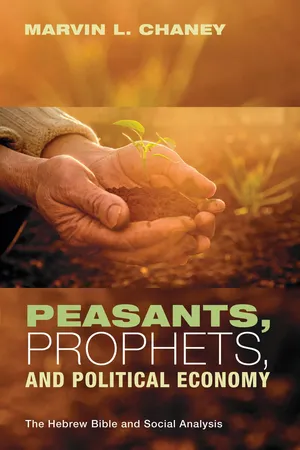
Peasants, Prophets, and Political Economy
The Hebrew Bible and Social Analysis
- 316 pages
- English
- ePUB (mobile friendly)
- Available on iOS & Android
eBook - ePub
About this book
Contents
1 Ancient Palestinian Peasant Movements and the Formation of Premonarchic Israel
2 Joshua
3 Coveting Your Neighbor's House in Social Context
4 Systemic Study of the Israelite Monarchy
5 Debt Easement in Israelite History and Tradition
6 The Political Economy of Peasant Poverty
7 Bitter Bounty: The Dynamics of Political Economy Critiqued by the Eighth-Century Prophets
8 Whose Sour Grapes? The Addressees of Isaiah 5:1-7
9 Accusing Whom of What? Hosea's Rhetoric of Promiscuity
10 Producing Peasant Poverty: Debt Instruments in Amos 2:6b-8, 13-16
11 Micah--Models Matter: Political Economy and Micah 6:9-15
12 Review of Roland Boer, The Sacred Economy
Information
1
Ancient Palestinian Peasant Movements and the Formation of Premonarchic Israel1
Introduction
Few biblical scholars would deny that ancient Israel, prior to its coalescence as a monarchic state at the tranisition from the second to the first millennium BCE, constituted for some time a recognizable society, resident in the hill country of Palestine. An equally broad consensus would probably agree that this premonarchic period proved normative for much in later Israel, but that its detailed, sequential history cannot be written from the information currently available. Although questions concerning the process by which Israel became established in the Palestinian uplands are too important to ignore, the data, of themselves compel no particular historical reconstruction. As a result, three contending gestalts are presently championed for the historical interpretation of these data.
No full rehearsal of the data is possible or intended here. This study will instead examine the adequacy of the paradigmatic—and frequently contolling—assumptions made by the proponents of each of the three models, while advocating a nuanced version of one. Since these assumptions frequently pertain to societal processes more fully attested in the history of other agrarian societies, a further modicum of control will be sought in the disciplined comparison of such societies by historical sociologists.
The latter expedient is not a methodological commonplace in biblical studies and hence deserves a word of explanation. To readers more familiar with the linguistic tools correctly regarded as indispensable to biblical research, the role granted here to the social sciences can be expressed by the following proportion: philology:comparative linguistics::history:historical sociology. The first and third of these fields are primarily concerned with the humanistic interpretation of delimited data—in this case, a given text or a given historical period and location. Utilizing a broader database, the second and fourth disciplines seek to analyze commonalities of structure, process, and causation. While a tendency to find patterns and make generalizations is thus inherent in the tasks of the two comparative fields, their more delimited counterparts partake of an equal and opposite proclivity for particularism. Only when the tension intrinsic to this division of labor occasions mutually corrective dialogue, rather than polarization, can any of the four disciplines remain healthy.
For example, a difficult form or vocable in the text of the Hebrew Bible routinely prompts a controlled comparison with related phenomena in the other Semitic languages, even though their attestation may be at a great chronological and/or geographical remove. Any study of comparative Semitics is, in turn, dependent upon the fullest possible philological description of Biblical Hebrew. Similarly, when a given event or process in ancient Israelite society is difficult to interpret historically because of sparse or ambiguous data, recourse is properly had to a disciplined comparison of related phenomena in other agrarian societies just as the comparative analysis of such societies should take account of the most nuanced histories of ancient Israel.
The time is particularly propitious for this dialogue. After a long period of neglect by both anthropology and sociology, agrarian societies—those whose primary means of subsistence is a cultivation of fields which utilizes the plow but not industrial technology—are once again receiving serious attention from social scientists, who, from their side, are expressing renewed interest in interdisciplinary cooperation with historians in the investigation of such societies (Lenski and Lenski 1978:30, 88–141, 177–210).
Before each of the three models is reviewed in light of this broader methodology, points of congruence among their respective reconstructions need to be sketched, for they are presupposed in the discussion of disputed areas. All would agree that Late Bronze Canaan comprised a miscellany of agrarian city-states, each with its own petty kinglet, but under the nominal suzerainty of Egypt. The power and control of the local dynasts were centered in walled cities which clustered near the steady water supplies of the piedmont springline and the rich, alluvial soils of the plains. Connecting these concentrations of population with each other and the world beyond were overland routes, also favored by the relatively level topography. While constituting only a small minority of the population, the ruling elite were able to dominate the other inhabitants of these plains because they alone could field chariots armed with composite bows. Conversely, premonarchic Israel’s poor and mostly unwalled towns and villages were concentrated where the control of the Canaanite kings had never been strong—in the rugged terrain and scrub woods of the hill country. Although this territory was less desirable economically because of its steep, brushy hillsides, thin soils, and relative lack of perennial water sources, it effectively neutralized the tactical advantage of the chariots and composite bows with which the ruling classes held sway on the plains.
With these elements of consensus2 as background, the conflicting models may be examined.
A Model of Nomadic Infiltration
Developed by such scholars as Alt (1966b:135–69), Noth (1960:66–84), and, more recently, Weippert (1971:1–146), what may be termed the nomadic infiltration model posits that the Israelites, prior to their founding of a monarchic state, were land-hungry nomads and semi-nomads in a process of gradual sedentarization in the sparsely inhabited hill country.
We may think of it as having proceeded rather in the way in which even today semi-nomadic breeders of small cattle from the adjoining steppes and deserts pass over into a settled way of life in the cultivated countryside . . . The Israelites were land-hungry semi-nomads of that kind before their occupation of the land: they probably first set foot on the land in the process of changing pastures and in the end they began to settle for good in the sparsely populated parts of the country and then extended their territory from their original domains as occasion offered, the whole process being carried through, to begin with, by peaceful means and without the use of force. (Noth 1960:69)
The latter point is linked by this school with a judgment that Joshua 1–12 is constituted mostly of traditions that were aetiologically generated and hence of little value to the modern historian regarding the events of which they purport to tell (Alt 1936:13–29; Noth 1953:7–13; 20–69; Weippert 1971:136–44). Archaeological evidence for the destruction of many of the cities named in Joshua 10–11 is denied relevance by the judgment that the time and agent(s) of the destruction cannot be ascertained accurately. With military conflict thus largely excluded, the tension between Canaanites and Israelites is understood essentially as that between farmers and nomads, respectively.
Although both past and present exponents of this view exhibit prodigious learning and exert broad influence, their synthesis and its assumptions now stand under heavy and—it would appear to this writer—decisive criticism. The essentials of that critique may he summarized in the following points:3
(1) Neither the tribalism of early Israelite society nor the itineracy of some of its members necessitates desert or pastoral origins. Tribal organization is well documented among various tillers of the soil, while tinkers, merchants, bandits, and caravaneers itinerate without being desert pastoralists.
(2) In a sharp break with nineteenth-century concepts which still dominate OT scholarship, modern prehistorians and anthropologists no longer regard pastoral nomadism as an evolutionary interval between hunting and gathering and plant cultivation. Instead, it is viewed as a marginal specialization from the animal husbandry that came to be associated with horticulture and agriculture. Thus, although some pastoral nomads might later sedentarize, the evolutionary flow was from the cultivated areas of the Near East “toward the steppe and desert, not out of the desert to the sown” (Luke 1965:24).
(3) So-called “full nomadism,” such as that associated with the Midianites or the modern Bedouin, depends upon extensive, mounted use of camels or horses, which alone allow significant penetration of the Syro-Arabian desert by a preindustrial society. Before the camel saddle made possible the first such penetration, the asses and flocks of “semi-nomads” clung of necessity to the fringes of the fertile crescent. Modern proponents of the nomadic infiltration model recognize that “full nomadism” appeared too late in antiquity to bear upon the discussion of Israelite origins, but their frequent appeal to such intentionally vague phrases as “nomads and semi-nomads” or “(semi-) nomads” endeavors to salvage a paradigm based upon the priority of a nomadism completely at home in the desert. This attempt to win a reprieve for long-cherished assumptions, however, only succeeds in confounding chronological periods, evolutionary sequences, and discrete ecosystems, which can and should be distinguished.
(4) Contrary to the dichotomy unsually drawn between nomad and farmer, the relationship between cereal cultivation and pastoralism, particularly in its “semi-nomadic” form, was symbiotic. Grain harvest in spring and early summer coincided with the drying up of winter pastures in the steppes. When wetter uplands such as Carmel also proved insufficient, the hungry flocks needed to graze upon the stubble of the harvested grainfields and drink from the perennial waters available where hill met plain. In return, they served as roving manure spreaders, fertilizing the fields for the autumn sowing. At the very least, then, herder and cultivator lived hard by one another several months of each year and were economically interdependent; at most, they were one and the same.
(5) Judging from technological parameters and evidence from later periods, the number of pastoral nomads in comparison to the sedentary population would have been quite small. Before the development of a satisfactory camel saddle—which occurred after the initial formation of Israel—the number of pastoralists lacking significant intercourse with cultivators may be regarded as historically negligible. The romantic image of the Syro-Arabian desert as a vast womb, producing wave upon wave of Proto-Semites, is as demographically fallacious as it is long-lived in historiography.
(6) Similarly, the portrait of pastoral nomads as the major agents of change in every agrarian society of the ancient Near East has been grossly overdrawn. “Their restiveness and conflict with the state was not due to their invading or infiltrating from the desert but rather to their rural-based resistance to the drafting and taxing powers of the state” (Gottwald 1976b:629).
(7) OT traditions view the desert as strange and hostile—a place where Israel required special assistance. The motif of “return to desert” has been shown to express a threat against covenant breakers rather than harking back to an idealized past. Other supposed vestiges of a nomadic ideal in the Hebrew Bible, such as the Rechabites, have been plausibly explained in other terms (Riemann 1963:passim; Talmon 1966:31–63; Frick 1971:279–87).
(8) The land hunger evinced in so many OT texts is far more characteristic of peasant...
Table of contents
- Title Page
- Preface
- Abbreviations
- Chapter 1: Ancient Palestinian Peasant Movements and the Formation of Premonarchic Israel
- Chapter 2: Joshua and the Deuteronomistic History
- Chapter 3: Coveting Your Neighbor’s House in Social Context
- Chapter 4: Systemic Study of the Israelite Monarchy
- Chapter 5: Debt Easement in Israelite History and Tradition
- Chapter 6: The Political Economy of Peasant Poverty
- Chapter 7: Bitter Bounty
- Chapter 8: Whose Sour Grapes?
- Chapter 9: Accusing Whom of What?
- Chapter 10: Producing Peasant Poverty
- Chapter 11: Micah—Models Matter
- Chapter 12: Korea and Israel
- Chapter 13: Some Choreographic Notes on the Dance of Theory with Data
- Acknowlegments
- Bibliography
Trusted by 375,005 students
Access to over 1.5 million titles for a fair monthly price.
Study more efficiently using our study tools.
Frequently asked questions
Yes, you can cancel anytime from the Subscription tab in your account settings on the Perlego website. Your subscription will stay active until the end of your current billing period. Learn how to cancel your subscription
No, books cannot be downloaded as external files, such as PDFs, for use outside of Perlego. However, you can download books within the Perlego app for offline reading on mobile or tablet. Learn how to download books offline
We are an online textbook subscription service, where you can get access to an entire online library for less than the price of a single book per month. With over 1.5 million books across 990+ topics, we’ve got you covered! Learn about our mission
Look out for the read-aloud symbol on your next book to see if you can listen to it. The read-aloud tool reads text aloud for you, highlighting the text as it is being read. You can pause it, speed it up and slow it down. Learn more about Read Aloud
Yes! You can use the Perlego app on both iOS and Android devices to read anytime, anywhere — even offline. Perfect for commutes or when you’re on the go.
Please note we cannot support devices running on iOS 13 and Android 7 or earlier. Learn more about using the app
Please note we cannot support devices running on iOS 13 and Android 7 or earlier. Learn more about using the app
Yes, you can access Peasants, Prophets, and Political Economy by Marvin L. Chaney in PDF and/or ePUB format, as well as other popular books in Theology & Religion & Biblical Criticism & Interpretation. We have over 1.5 million books available in our catalogue for you to explore.