eBook - ePub
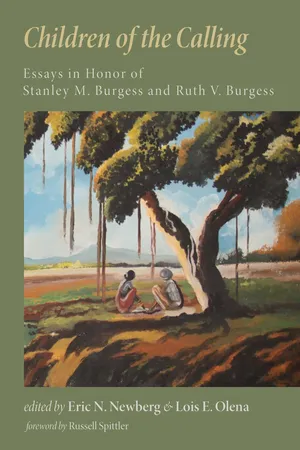
Children of the Calling
Essays in Honor of Stanley M. Burgess and Ruth V. Burgess
- 388 pages
- English
- ePUB (mobile friendly)
- Available on iOS & Android
eBook - ePub
Children of the Calling
Essays in Honor of Stanley M. Burgess and Ruth V. Burgess
About this book
This volume of essays, dedicated to Stan and Ruth Burgess, has been written by their colleagues and students to honor them as they retire after many years of distinguished service to Evangel University, Southwest Missouri State University, and Regent University.
Several meanings can be subsumed under the title Children of the Calling. Stan and Ruth grew up in India, children of Pentecostal missionaries who felt they had "divine callings." They were influenced not only by the religious callings of their parents, but also by the cultural milieu of India. Though they did not personally take on board the specific missionary calling of their parents, they charted life maps that benefitted from the cross-cultural proficiencies developed in their childhoods in India, which to a large extent colored the influence they would have on their children, academic colleagues, and students, some of whom have submitted essays for this Festschrift.
The diversity of subjects in this volume attests to the breadth of the scholarly work of Stan and Ruth Burgess. The first section narrates the major highlights of Stan and Ruth's academic biographies, the second presents pioneering studies of biblical studies and church history, and the third offers application-based research and personal reminiscences.
Information
Topic
Theology & ReligionSubtopic
Christian ChurchThe Quest to Understand beyond Boundaries
3
Written with the Finger of God
Divine and Human Writing in Exodus202
Introduction
Perhaps it is the modern obsession with communication technologies that has inspired a re-investigation of the Hebrew Bible as the product of not only the interplay between different types of communication in the ancient world (oral and written), but also the representation of writing in ancient literature. As Mogens Trolle Larsen aptly states,
In a situation where the general feeling seems to be that technological “progress” or “development” is rushing ahead like an express train into the night, propelled by its own internal logic and changing the world with irresistible force, it is obviously of vital interest to study other similar or parallel historical moments when new techniques for storing and disseminating knowledge, ideas and information were introduced.203
This search for the specifically written origins of a tradition, though stimulated by our own preoccupations, is not without warrant in the literary and historical depictions of writing in ancient cultures; in many languages and literatures, the act of writing is treated with a distinct sense of awe, or even dread. The knowledge of those who write is arcane, the writers are divinities or revered leaders, and their written product is a tool of creation and destruction.
The canonical and historical centrality of the book of Exodus for the religious traditions of ancient Israel only serves to emphasize the multiple and significant acts of writing perpetrated by both God and humans in that book. Indeed, arguably the central features of the Torah—the giving of the tablets of law to Moses, and the Sinai encounter in general—are surrounded by descriptions of writing. Despite the multiple examples of this important motif, there have been few concerted attempts to specifically discuss the role of writing in Exodus as a whole. Therefore my goals here are twofold:
(1) To make a detailed case for the significance of both divine and human writing in Exodus. By the end of this study, it will hopefully be clear that writing plays a decisive role in the narrative construction of Exodus and also that the memories of writing enshrined in Exodus serve to bolster the sense of power and awe attached to the Torah as a document.
(2) To explore the connection of writing and cultic acts, which are referenced together (or in close proximity to one another) in all of the critical passages (the battle with Amalek in 17:14–15, the vision of God on the mountain in 24:1–8; the “golden calf” episode in 31:18–32:35; the inscribing of cultic apparel in 28:9–12, 36–38, 39:14–30). I will suggest that writing and cult may have been more intimately connected during some periods of Israel’s religious activity, and that the act of writing and the products of writing are intimately involved in the search for God’s physical representation on earth.
To these ends, we must first make some preliminary comments on the nature of writing in the ancient world and the secondary literature which has arisen over the past few decades regarding the complex interplay of orality and literacy in traditional societies (including ancient Israel). An examination of passages in Exodus where writing occurs will follow; wherever appropriate, we must seek to integrate the discussion of the biblical text with some ancient Near Eastern materials and with the anthropological study of writing and religion.
Orality and the Power of Writing
The multitude of artistic representations of Moses and the written tablets of the Law produced since antiquity—ranging from the frescos of Dura Europas (third century CE; Syria), where Moses receives the Torah on a scroll instead of the traditional stone tablets, to Rembrandt van Rijn’s brooding portrait of the embattled leader on the verge of smashing the Law at the foot of the mountain (1659; Gemäldegalerie, Berlin)—bear witness to the role of writing in semi- or non-literate cultures; writing is viewed with awe and suspicion, even danger, and can act as a tangible link between humans, divinity, and the very nature of reality. The historical invention and development of writing in southern Mesopotamia sometime in the late fourth millennium was, of course, much more mundane than the account of Berossus in his third–century BCE Babyloniaca, where humans who had previously been living “without laws just as wild animals” are granted “the knowledge of letters and sciences and crafts of all types” by a “beast named Oannes . . . from the Erythraean Sea” [i.e. Persian Gulf].204
Nevertheless, Berossus’ description of Oannes highlights an attitude toward writing p...
Table of contents
- Title Page
- Foreword
- Preface
- Contributors
- Introduction
- From Mavelikara and Pune to Springfield and Jerusalem
- The Quest to Understand beyond Boundaries
- The Need to Expand, Preserve, and Restore Tradition
- Epilogue
Trusted by 375,005 students
Access to over 1.5 million titles for a fair monthly price.
Study more efficiently using our study tools.
Frequently asked questions
Yes, you can cancel anytime from the Subscription tab in your account settings on the Perlego website. Your subscription will stay active until the end of your current billing period. Learn how to cancel your subscription
No, books cannot be downloaded as external files, such as PDFs, for use outside of Perlego. However, you can download books within the Perlego app for offline reading on mobile or tablet. Learn how to download books offline
Perlego offers two plans: Essential and Complete
- Essential is ideal for learners and professionals who enjoy exploring a wide range of subjects. Access the Essential Library with 800,000+ trusted titles and best-sellers across business, personal growth, and the humanities. Includes unlimited reading time and Standard Read Aloud voice.
- Complete: Perfect for advanced learners and researchers needing full, unrestricted access. Unlock 1.5M+ books across hundreds of subjects, including academic and specialized titles. The Complete Plan also includes advanced features like Premium Read Aloud and Research Assistant.
We are an online textbook subscription service, where you can get access to an entire online library for less than the price of a single book per month. With over 1.5 million books across 990+ topics, we’ve got you covered! Learn about our mission
Look out for the read-aloud symbol on your next book to see if you can listen to it. The read-aloud tool reads text aloud for you, highlighting the text as it is being read. You can pause it, speed it up and slow it down. Learn more about Read Aloud
Yes! You can use the Perlego app on both iOS and Android devices to read anytime, anywhere — even offline. Perfect for commutes or when you’re on the go.
Please note we cannot support devices running on iOS 13 and Android 7 or earlier. Learn more about using the app
Please note we cannot support devices running on iOS 13 and Android 7 or earlier. Learn more about using the app
Yes, you can access Children of the Calling by Eric Nelson Newberg,Lois E. Olena, Newberg, Olena in PDF and/or ePUB format, as well as other popular books in Theology & Religion & Christian Church. We have over 1.5 million books available in our catalogue for you to explore.