- 212 pages
- English
- ePUB (mobile friendly)
- Available on iOS & Android
eBook - ePub
About this book
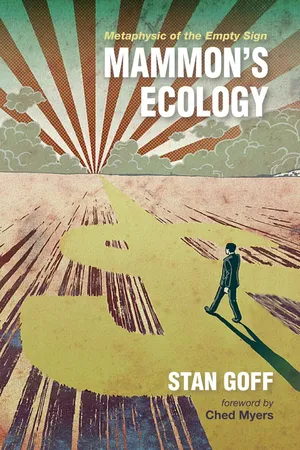
Proverbs 22:22 enjoins the reader, "Don't take advantage of the poor just because you can." Mammon's Ecology is a systematic investigation into the mysterious nature of modern money, which confronts us with the perplexing fact that, in the global economy as it is, we take advantage of the poor whether we want to or not. We destroy natural systems whether we want to or not.
Ched Myers describes Mammon's Ecology as a "workbook" about "the secret life of money." Where Prather and others have shown that money is one of the perverse Powers described in Ephesians 6, Mammon's Ecology details precisely how money exercises this peculiar power and outlines suggestions for Christians who feel trapped in this complicity--not just as individuals, but as church. Mammon's Ecology is not a book about economics (which the author calls "the world's best antidote to insomnia"), but rather a book about the "deep ecology" of (post)modern power and injustice. Read individually or as a group, Mammon's Ecology will leave you unable to think about money the same way again.
Information
Topic
Theology & ReligionSubtopic
Christian Theology1
Detectives
Don’t take advantage of the poor just because you can; don’t take advantage of those who stand helpless in court.
—Proverbs 22:22
Nodes and Flows
A node is a point of interchange.
Every hour a healthy adult casts off in the range of 30–40,000 dead skins cells from the stratum corneum, our outer layer of skin. The stuff is raining off of us all the time, drifting around us in little clouds, depositing itself in our clothes, making maps of itself on our beds. We breathe these in from ourselves and others, ingest it from our food, and massively exchange it during intimacy.
All day long, we exchange atmospheric oxygen for metabolically produced carbon dioxide and gaseous water, with an average tidal volume of 500 milliliters per breath. If you brightly backlight two people having a conversation, you will see whole sprays of breath, material otherwise invisible. The subjects, like all of us who have face-to-face discussions, are actually steaming and spitting—storming steam and spit—onto each other.
We drink around 2 liters of water each day, which is exchanged everywhere throughout our bodies for metabolic wastes. The water is then run through a couple of complicated filters called kidneys just underneath our inferior-posterior ribs, whereupon it is mixed with other filtrates, like urea, and passed back out of the body again at a rate generally corresponding to the fluid intake.
We take in fuel (energy) from the sun every day, which has been stored in plants, and from plants eaten by animals. We eat the fuel, or food, which is then converted into biological maintenance materials and useable energy. The parts unused for maintenance or energy are consolidated into feces, which is then passed out of the body and into the surround again, where it breaks down and is reincorporated into other materials. To aid in the digestion of that food, there is a megacity along the walls of your gut of around 100 trillion various bacteria, about three pounds worth of living things that are not you, making trillions of little exchanges per second, without which you would die.
The stuff coming off of you all the time is so uniquely mixed that for a good tracking dog it might as well be a fingerprint or a DNA sample. You leave behind molecular clues about your past whereabouts in such profusion that large hounds, the kind with three million scent receptors, can find you ten miles away and three days later if you are moving on foot.
A human being observed as a location is the hub, or node, of multiple exchanges; flows of materials in, and flows of changed materials out. We are mixed into our environment, a part of it and not apart from it. If we could simply see the invisible gases moving through a person, respiratory and otherwise, a crowd of people would appear to boil in front of us, each person another bubble rising from the bottom of the pan.
A family domicile is such an exchange node, too. Things flow in. Things flow out. Think of what happens when flows are disrupted. What an emergency when the electricity fails! When the sewer pipe becomes obstructed, or the water shuts off, or the trash haulers go on strike! Disrupted flows, many of those flows that we take for granted, are crises—times of difficulty, disorientation, and even danger. This is true of a cell, a body, a home, a community, a biome,1 a watershed,2 an ecosystem,3 or a nation.
This is also true of technologies. The car that supports the family and the family’s dwelling can also be seen as an exchange node. Gasoline fuel, other fluids, and lubricants go in; heat and work (movement of mass) come out. New parts replace old ones that flow into a trash bin, and from there into a landfill. New paint and epoxies are needed to fix damaged spots that have disappeared with rust. The machine is not a thing-in-itself any more than we are. In its own way, on its own timetable, it eats and excretes, or it will slowly dissolve.
The car gets you to a grocery store, where that most common of exchanges takes place, money for food, carried back to the car, and by car back into the input stream for the household, where the metabolic flows are maintained for all those warm bodies.
In this book, we are going to become detectives. Exchange detectives.
Let’s open that grocery bag.
Exchange Detection
What do we have here? Bread. Frozen fish. Cheese slices. Pasta noodles. Pasta sauce. Fresh cherries. Bell peppers. Olive oil. Canned soup. Breakfast cereal. Salad greens. Eggs. Milk. This will be a short list, or we’d have a whole book, an encyclopedia, on the nodes and flows of foods. What is the first question the exchange detective asks? Where did each item originate? Okay, the bread was made one state over, the frozen fish was packed in California, the cheese slices came from a factory in Illinois, the pasta noodles from a factory in Atlanta, the cherries from an orchard in Chile, the peppers from a farm in Texas, the olive oil (which is mixed with other oils to make it cheaper) was harvested in Spain and Iowa then mixed in Mexico, the breakfast cereal hails from a factory in Michigan, the soup was made in a factory in China, the salad greens were brought in from Mississippi, the eggs from a distributor 150 miles away (God knows where the actual egg factory is with the captive chickens), the milk from the same distributor (and the actual cows?). The frozen fish is being kept frozen in a machine made of X number of materials, and kept running with energy scraped out of a coal seam uncovered by removing a mountaintop in West Virginia or Wyoming, using more big machines that run on diesel fuel, etc.
What does the exchange detective ask next? Where were the exchanges that preceded the last exchange? Those cherries from Chile, how much land, water, labor, chemicals, and money had to flow into an orchard somewhere in Chile to make cherries come out the other end? How were the cherries transported from Chile to your grocery store? In this way, the exchange detective begins to draw mental maps, flow-maps.
The next step in exchange detection, after gathering information about flows, is to begin to focus on the points of exchange, or nodes, to ascertain the actual form of the exchange. When a bully steals a smaller child’s lunch money that is an exchange. Likewise, when I trade my blue marble for your yellow one, this is an exchange. If my daughter gives me a watch for Christmas, this is an exchange. All exchanges are not equal. Exchanges between people have moral content. My daughter’s gift is different from the bully’s extortion.
What are the working conditions of the Chilean who picks the cherries? How was the land acquired? What kinds of inputs go into the tractors on the farm? During an exchange, do all parties benefit? Equally? Is the threat of poverty or violence an element of the exchange? What is the moral substance of the exchange? What moral questions are raised by the actual form of the exchange? How is the exchange facilitated? What cultural doors open and close during an exchange? Do we sign a paper or not? Do we use money or not? Are we having a conversation or merely transacting at a fixed place for a fixed price with someone who might as well be a robot? Self-checkout at the grocery store is a robot. Are there protocols, rules, languages, symbols, signs that are necessary for the exchange? When present-day exchange detectives begin this final phase of detection, they will inevitably confront a simple question that raises a host of new questions: What is money?
1. Communities of living species within a habitat.
2. A region within which all rainfall and water drains into a particular river, lake, or sea.
3. An interdependent combination of geography, climate, soil, water, and biomes seen as a self-organized dynamic.
2
The Heat
He changes rivers into a wilderness
And springs of water into a thirsty ground;
A fruitful land into a salt waste,
Because of the wickedness of those who dwell in it.
—Psalm 107:33–34
A Southern preacher once told me, “When the Bible says ‘you,’ that translates into ‘y’all.’” “You” in the Bible most often means the second person plural. We are in this together. This brings to mind a conversation with frie...
Table of contents
- Title Page
- Foreword
- Preface
- Acknowledgments
- Introduction
- Chapter 1: Detectives
- Chapter 2: The Heat
- Chapter 3: Nature
- Chapter 4: Knowledge
- Chapter 5: Exchange
- Chapter 6: Technology
- Chapter 7: Money
- Chapter 8: Development
- Chapter 9: Case Study: Finance, Food, Force & Foreign Policy
- Chapter 10: Merged Understandings
- Chapter 11: Church
- Bibliography
Trusted by 375,005 students
Access to over 1.5 million titles for a fair monthly price.
Study more efficiently using our study tools.
Frequently asked questions
Yes, you can cancel anytime from the Subscription tab in your account settings on the Perlego website. Your subscription will stay active until the end of your current billing period. Learn how to cancel your subscription
No, books cannot be downloaded as external files, such as PDFs, for use outside of Perlego. However, you can download books within the Perlego app for offline reading on mobile or tablet. Learn how to download books offline
Perlego offers two plans: Essential and Complete
- Essential is ideal for learners and professionals who enjoy exploring a wide range of subjects. Access the Essential Library with 800,000+ trusted titles and best-sellers across business, personal growth, and the humanities. Includes unlimited reading time and Standard Read Aloud voice.
- Complete: Perfect for advanced learners and researchers needing full, unrestricted access. Unlock 1.5M+ books across hundreds of subjects, including academic and specialized titles. The Complete Plan also includes advanced features like Premium Read Aloud and Research Assistant.
We are an online textbook subscription service, where you can get access to an entire online library for less than the price of a single book per month. With over 1.5 million books across 990+ topics, we’ve got you covered! Learn about our mission
Look out for the read-aloud symbol on your next book to see if you can listen to it. The read-aloud tool reads text aloud for you, highlighting the text as it is being read. You can pause it, speed it up and slow it down. Learn more about Read Aloud
Yes! You can use the Perlego app on both iOS and Android devices to read anytime, anywhere — even offline. Perfect for commutes or when you’re on the go.
Please note we cannot support devices running on iOS 13 and Android 7 or earlier. Learn more about using the app
Please note we cannot support devices running on iOS 13 and Android 7 or earlier. Learn more about using the app
Yes, you can access Mammon’s Ecology by Stan Goff in PDF and/or ePUB format, as well as other popular books in Theology & Religion & Christian Theology. We have over 1.5 million books available in our catalogue for you to explore.