Rev. Vigo Auguste Demant (1893–1983) was a significant theologian and social commentator of the first half of the twentieth century. This book contains his up-until-now unpublished Gifford Lectures, in which Demant provides cultural analysis as he attempts to address why humanity struggles so much with modernity and living in the contemporary world. The lectures have additional notes and commentary to make them comprehensible, since not all of them are complete. The first chapters set Demant in his context and the final section provides assessment of both his ideas and his impact. Although Demant died in 1983, his ideas continue to prove influential to thinkers and theologians today.
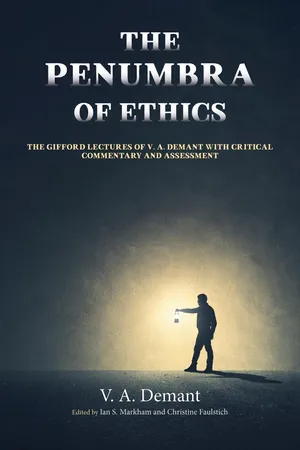
eBook - ePub
The Penumbra of Ethics
The Gifford Lectures of V. A. Demant with Critical Commentary and Assessment
- 358 pages
- English
- ePUB (mobile friendly)
- Available on iOS & Android
eBook - ePub
The Penumbra of Ethics
The Gifford Lectures of V. A. Demant with Critical Commentary and Assessment
About this book
Information
Topic
Theology & ReligionSubtopic
Christian TheologySECTION TWO
The Giffords
Introduction
I
A Gifford lecturer may fittingly ask himself whether his chosen subject could be properly considered as a contribution to “natural theology.” It is a necessary question because Lord Gifford intended the endowment of this lectureship to be used not merely for an academic exposition of what he called natural theology, but preeminently the presentation of it as a desirable discipline. The Gifford Lectures were meant to commend the subject and not only to describe it. His reasons must have been clearer to his contemporaries than they are to us nearly a century later. The terms of his will take for granted that he regarded natural theology as a unifying force among religious believers, in contrast to the divisive effects of the historical religions and churches, with their warrants in some kind of revealed truth. He also assumed that natural theology was a straightforward alternative to revealed theology, and that its avoidance of supernatural and miraculous elements would thereby give it more cogency in the minds of all sensible men.
For two reasons it is of significance for me to identify, as far as possible, in what sense Lord Gifford understood natural theology. One is that I find any coherent body of thought which has commanded attention, to be an exciting thing. It cannot be taken for granted as a necessary phase in the mental development of mankind or as a stage in social evolution, or as an occasional concentration of a diffused essence in universal human knowledge. It has a significance and morphology of its own which cannot be discerned in terms of what it came out of or what it leads into in a process of continuity. The second reason I have for seeking the affinities of natural theology in Lord Gifford’s understanding of it, is that it enables me to interpret my own account of religion and ethics in Christendom with some fidelity to the terms the founder laid down.
His affinities are undoubtedly with that system of religious thought which ranges roughly over the seventeenth and eighteenth centuries and can conveniently be denoted as the natural theology of the Enlightenment, with close connection with Deism. As Lord Gifford used a terminology which has close resemblances to that of this Enlightenment theology, he must be regarded like St. Paul “as one born out of due time,” for nearly a century elapsed between the foundation of his lectureships and the close of that vigorous but comparatively short-lived Enlightenment tradition. The nineteenth century saw that tradition displaced by a number of new approaches to religious phenomena.
In his Trust Disposition and Settlement of 1885 establishing this lectureship, Lord Gifford defined the subject in these terms: “The knowledge of God, the Infinite, the All, the First and only Cause, the one and sole Substance, the Sole being, the Sole Reality, and the Sole Existence, the knowledge of His Nature and Attributes, the knowledge of the Relations which men and the whole universe bear to Him, the knowledge of the Nature and Foundation of Ethics or Morals, and of all Obligations and Duties thence arising.” This language might suggest that Lord Gifford had been influenced by Spinoza two centuries earlier rather than by the intervening exponents of the Enlightenment. The Foundation document requires that “natural theology” shall be exercised “without reference to, or reliance upon, any supposed special, exceptional or so-called miraculous revelation.” There have not been wanting holders of this lectureship who have questioned the distinction between natural and revealed theology and have insisted that all knowledge of God or divine things are in some sense revealed. But Lord Gifford has left us no doubt that what he intended to exclude was any religious affirmation which derived its authority from a specific revelation or sacred scriptures or a historical record of divine acts or such images as Christ the Paschal Lamb.
A precursor of Enlightenment natural theology was Francis Bacon (1561–1626) who put it this way. “Natural theology is rightly called also divine philosophy. It is defined as that spark of the knowledge of God which may be had of the light of nature and the consideration of created things; and thus can fairly be held to be divine in respect of its object, and natural in respect of its source of information.”202
An even earlier forerunner was Raymond Sebonde whose treatise Natural Theology or Book of Creatures became influential through being translated by Montaigne. In his prologue to this work he wrote, “This science alleges no authorities, neither Holy Scripture nor any doctors, nay rather it confirms Holy Scripture, and by means of it a man believes firmly in the Holy Scriptures. And so in the order of our procedure it comes before Holy Scripture; and so there are two books given to sue of God, to wit the book of the world of creatures or book of nature, and another which is the book of Holy Scripture.”203 In brief, Sebonde held the written word to be superfluous, but it could be confirmed by the book of nature.
Early in the seventeenth century Edward, Lord Herbert of Cherbury enunciated in a slightly different form the priority of natural religion. In his major work: De Veritate print distinguitur a Revelatione, Verissimil, Pissibili, et a Falso (Paris 1624) he presents natural religion as a common feature in the various historical religions, but he regards it as able to stand alone by the side of them. These “common notions” as he calls them, are given universally by a kind of inner light to all men. Although an individual person may receive special revelations and gifts of grace from a particular providence, these are not necessary for man’s knowledge of God. The essentials of religion are within the hearts of man, apprehended by the natural reason, and are proven by moral virtue and the right use of our faculties. Lord Herbert’s position represents a step further away from that of both Francis Bacon and Raymond Sebonde, both of whom held to a recognizable identity between the divine object of natural and revealed religion.
Perhaps the most typical representatives of this school of natural theology in England, though hardly its greatest figures were John Toland and Mathew Tindal. The sub-titles of their famous works are indications of their position. In 1696 Toland published his Christianity not mysterious, showing that though there is nothing in the Gospel contrary to reason nor above it, and that no Christian Doctrine can properly be called a Mystery. And in 1730 Tindal issued Christianity as old as the Creation or the Gospel a Republication of the Religious Nature. Both these men upheld an original endowment given to the human reason coeval with creation. They attached no importance to the person of Christ; they underestimated the force of evil; they believed they were removing all obstacles to a new heaven and a new earth. What was specific in the New Testament they regarded as the product of superstition and credulity. For them, in line with others of this school, revelation can add nothing to the religion of nature apprehended by reason. We might say that they mentally projected the omnipotence of reason as understood in their own period upon the creation of the world. This looks like a touching remnant of desire for a theological warrant.
Toland and Tindal figure in the literature as among the Deists, and Toland proclaimed himself as avowed pantheist, and this is not incompatible. Tindal’s Christianity as old as Creation has been considered the Bible of Deism. A more complex form of deism is found in the work of William Paley who wrote Evidences of Christianity (1744) and Natural Theology (1803) at a time when nature was looked upon as a mechanism. His evidences for God’s existence constituted a form of argument from design, as in the famous “watch” model where the divine designer set the works in motion and dictated the laws of their behavior. In the same vein Paley accepted miracles as witness to a supernatural and arbitrary intervention into the world’s clockwork. Moreover, he found proof of God’s initiative from beyond the cosmic whole, in the originality of Christ’s character which could not be accounted for in terms of its antecedents or environment.
This turn of attitude presaged the demise of the whole movement. The appeal of Enlightenment natural theology was soon blunted by several influences. First came the attack upon it by its own followers, such as the skepticism of Hume and Voltaire. Hume rejected entirely the fundamental axiom of natural theology which he describes as belief that “the cause or causes of order in the universe probably bear some remote analogy to human intelligence.” He averred that a well-disposed mind would feel an intense longing that “H...
Table of contents
- Title Page
- Preface
- Acknowledgments
- Section One: V. A. Demant in Context
- Section Two: The Giffords
- Section Three: Assessment and Critique
Trusted by 375,005 students
Access to over 1.5 million titles for a fair monthly price.
Study more efficiently using our study tools.
Frequently asked questions
Yes, you can cancel anytime from the Subscription tab in your account settings on the Perlego website. Your subscription will stay active until the end of your current billing period. Learn how to cancel your subscription
No, books cannot be downloaded as external files, such as PDFs, for use outside of Perlego. However, you can download books within the Perlego app for offline reading on mobile or tablet. Learn how to download books offline
Perlego offers two plans: Essential and Complete
- Essential is ideal for learners and professionals who enjoy exploring a wide range of subjects. Access the Essential Library with 800,000+ trusted titles and best-sellers across business, personal growth, and the humanities. Includes unlimited reading time and Standard Read Aloud voice.
- Complete: Perfect for advanced learners and researchers needing full, unrestricted access. Unlock 1.5M+ books across hundreds of subjects, including academic and specialized titles. The Complete Plan also includes advanced features like Premium Read Aloud and Research Assistant.
We are an online textbook subscription service, where you can get access to an entire online library for less than the price of a single book per month. With over 1.5 million books across 990+ topics, we’ve got you covered! Learn about our mission
Look out for the read-aloud symbol on your next book to see if you can listen to it. The read-aloud tool reads text aloud for you, highlighting the text as it is being read. You can pause it, speed it up and slow it down. Learn more about Read Aloud
Yes! You can use the Perlego app on both iOS and Android devices to read anytime, anywhere — even offline. Perfect for commutes or when you’re on the go.
Please note we cannot support devices running on iOS 13 and Android 7 or earlier. Learn more about using the app
Please note we cannot support devices running on iOS 13 and Android 7 or earlier. Learn more about using the app
Yes, you can access The Penumbra of Ethics by V. A. Demant, Ian S. Markham,Christine Faulstich in PDF and/or ePUB format, as well as other popular books in Theology & Religion & Christian Theology. We have over 1.5 million books available in our catalogue for you to explore.