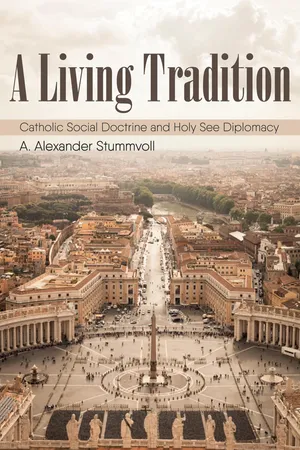
eBook - ePub
A Living Tradition
Catholic Social Doctrine and Holy See Diplomacy
- 218 pages
- English
- ePUB (mobile friendly)
- Available on iOS & Android
eBook - ePub
About this book
On the world stage, the Holy See acts as both a religious and a political actor. As the head of over 1.2 billion Catholics, the pope is a widely recognized spiritual authority. Politically, the Holy See maintains diplomatic relations with other states and actively participates in international organizations such as the United Nations.
A Living Tradition examines the normative sources and the dilemmas underpinning papal diplomacy. It does so in the context of four diverse case studies: the Vietnam War, John Paul II and Poland, the United Nations conferences in Cairo and Beijing, and the global campaign for debt relief.
While Catholic Social Doctrine offers a principled basis for Holy See diplomacy, living out religious norms is more complicated than simply preaching them, especially in global politics. This process leads to political and ethical policy dilemmas as well as to changing patterns of conflict and cooperation with other international actors.
By drawing upon unpublished archival documents from five countries, A Living Tradition offers a fresh and interdisciplinary view of both Catholic Social Doctrine and papal diplomacy that explores a key issue of the religious resurgence we are experiencing in the twenty-first century: how religious traditions function in global politics.
Information
Topic
Theology & ReligionSubtopic
Christian Denominations1
Introduction
Introduction
The Holy See is both a religious and a political actor in the international system. As Bishop of Rome and successor of the Apostle Peter, the pope is the spiritual and organizational head of the Catholic Church, the largest religious community of the world. Its baptized members count approximately 1.2 billion or 17.5 percent of the world’s population. Thanks to its international legal personality, the Holy See simultaneously can act like a state by maintaining diplomatic relations with other states and being an active part of international organizations. Catholic social doctrine provides a living tradition of thought and practice to the Holy See that stipulates normative guidelines on how Catholic Christians and all people of good will ought to engage with global topics such as war and peace, socialism, capitalism, sexuality, or family values.
Do popes and their diplomats only preach these norms or do they actually live, promote, and incarnate them in the sphere of global politics? Drawing upon the case studies of the Vietnam War, John Paul II and Poland, the United Nations’ (UN) conferences on population control and women in the nineties, and the global anti-debt campaign in the year 2000, I will argue that international relations are a difficult but not impossible realm for authentically living out Catholic social doctrine. International politics, by its very nature, remains a realm of compromise and suboptimal, temporary solutions. To reconcile political constraints and moral principles, the Holy See tends to live out Catholic social doctrine prudently and pragmatically, paying close attention to particular circumstances and possible repercussions for the safety of local Catholic constituencies, its global reputation, and the unity of the Catholic Church.
Joseph Stalin once mocked the Holy See’s lack of military power by asking “The pope! How many divisions has he got?”1 His invisible divisions, however, have shaped world affairs for over two millennia. In Roman times, the Bishop of Rome emerged from the catacombs. In the Middle Ages, he had become the spiritual leader of Christendom. In modern times, his authority has been inextricably intertwined with religious wars, European colonialism, and the global missionary movement that helped spread Catholicism to the Americas, Asia, and Africa. Until the nineteenth century, the papacy even ruled over the large territory of the Papal States, located on the Italian peninsula. It had its own army and frequently participated in the formation of diplomatic alliances and wars. After it had lost control over the Papal States in 1870 to Italian nationalists, the papacy was forced to recede to the tiny Vatican territory inside the city of Rome.2 As a consequence, popes had to recast their role in global politics with a fresh stress on moral authority and a new reliance on words and symbols rather than military and economic strength.3
The Holy See did not only play an important role in global politics in the distant past but it has and will continue to do so in the recent past, the present, and the future. Yet despite its importance in global politics, the Holy See remains understudied within the academic disciplines of political science and International Relations.4 Apart from some journal articles and book chapters,5 only a handful of monographs have been published on Vatican diplomacy in English over the last five decades. Notwithstanding some helpful insights, they are either outdated,6 have a narrow institutional-legal focus,7 fail to consult archival sources,8 or neglect to offer a broader theoretical account that explains the process through which religious norms and traditions influence, shape, and constrain religious actors’ practices in global politics.9 This book aspires to fill these lacunas by exploring the normative tradition underpinning Holy See diplomacy, and the political and ethical dilemmas that arise from translating and faithfully living out this tradition into the realities and complexities of global politics.
The lack of attention given to the Vatican’s role in global politics reflects a deeper secular disinterest which the social sciences in general and political science in particular have displayed toward religious issues.10 Traditionally, the popular assumption has been that modernity progressively leads to the decline of religion in the world. Religion, from this perspective, then simply is a cover for more important geopolitical conflicts between states or socioeconomic struggles between classes. Hence, the argument goes, we should study “real issues” instead of giving undue attention to religious norms or actors. Since the end of the Cold War and the terror attacks of 9/11, religion has increasingly become a more popular object of inquiry.11 The dominant mode of this budding literature is a focus on religion’s impact on politics. The politics that takes place inside politically influential religious communities has not been receiving nearly as much, if any, attention.
How do religious actors make their deliberations and decisions that underpin their engagement with international politics? What factors help us to understand why a religious actor like the Holy See acts the way it does in global politics? Scholars such as Scott Appleby, Ron Hassner, or Daniel Philpott provide some helpful insights and arguments for answering that sort of questions. Their work on the ambivalence of the sacred,12 on sacred places,13 and the political ambivalence of religion14 explains why religious actors generally tend toward violent or peaceful dispositions. What their studies overlook, however, are the difficulties and challenges religious communities—especially moderate, non-violent, and non-fundamentalist ones—face when they faithfully want to live out their very own religious norms in conditions of violent conflict, diplomatic tension, or political crisis.
While social scientists often overlook the importance of religious norms and the ways in which religious leaders have interpreted and implemented them in world affairs, religious elites often overstate their importance. Such moves result in broad statements such as “the Catholic Church promotes peace and social justice” or “Evangelicals foster democratic ideas and practices.” Such generalizations, even as they may contain some truth, equally prevent analysis of the political challenges that are inherent in attempts to promote peace, social justice, or democracy in concrete historical circumstances and in the face of competing political interests.
Theoretically, religious traditions are living traditions that provide a source of inspiration and advice, shape the perception of global politics, constitute actors’ identities and interests, and serve as constraints for what legitimately can be said or done. To fully unfold their meaning, however, religious traditions need to be interpreted and lived out by real people in real places. In the chaotic and inconclusive world of global politics, faithfully living out a religious tradition is, politically, considerably more difficult than preaching its content from a pulpit. Making sense of the logic of religious action in global politics and of the ensuing dilemmas thus requires not only careful theoretical and conceptual analysis, but also consideration of theological norms and historical context. For this reason, I will offer a fresh view of papal diplomacy which takes on a key issue: how religious traditions function in global politics and how even religious actors are not immune to the painful yet unavoidable dilemma of whether to raise their voices for moral considerations or to remain silent for prudential reasons.
Religious Traditions in International Relations
The relationship between religious ideas and religious actors’ politically salient practices remains largely unexamined. Alfred Stepan belittles the importance of religious ideas by arguing that they are so ambivalent—“multivocal”—that they can be used to justify any political project, from authoritarianism to democracy, from anti-Semitism to human rights.15 Fred Halliday insinuates that religious ideas are an ideological menu-of-choice that religious elites invent, manipulate, and control to disguise their own pre-defined political projects.16 Daniel Philpott, Timothy Shah, and Monica Duffy Toft, on the other hand, recognize the importance of political theology by arguing that “a religious actor’s political stance is traceable, at least in part” to their underlying “set of ideas.” Their assertion that “political theology translates basic theological claims, beliefs and doctrines into political ideals and programs” falls short, however, of analyzing how these normative programs actually are interpreted, debated, and applied in concrete circumstances. In God’s Century, they seek to provide the “strongest general explanation of why religious actors act as they do.”17 By this they mean the “kind of politics” they pursue, such as supporting or resisting democracy, terrorism, civil war, or peacemaking. By definition, their approach is unable to shed more light on the choices and dilemmas religious groups face when promoting peace or democracy in circumstances of ongoing warfare such as during the Vietnam War. Scott Appleby’s work on the “ambivalence of the sacred” has popularized the argument that religion can either be a force for peace or for conflict in the world. While this was a timely and important insight, his argument underplays the practical and political dilemmas involved in discerning what it actually means for a religious actor to promote peace in concrete and challenging circumstances. Taking the ambivalence of the sacred seriously requires a more concerted effort to study how religious norms are interpreted, applied, and used in practice.
Alasdair MacIntyre’s definition of a living tradition, I will argue in the next chapter, offers a helpful springboard for understanding the nature of religious traditions and the relationship between traditions and decisions. Living traditions are historically extended, socially embodied arguments about the “good life.” They are dynamic and evolving bodies of thought that do not only convey norms and ideas, but are intri...
Table of contents
- Title Page
- Preface
- Acknowledgments
- Abbreviations
- Chapter 1: Introduction
- Chapter 2: Religious Traditions in International Relations
- Chapter 3: Catholic Social Doctrine and Holy See Diplomacy
- Chapter 4: Promoting Peace in Vietnam
- Chapter 5: Converting Communism in Poland
- Chapter 6: Lamenting Liberalism in Cairo and Beijing
- Chapter 7: Criticizing Capitalism during the International Debt Crisis
- Chapter 8: Conclusion
- Bibliography
Trusted by 375,005 students
Access to over 1.5 million titles for a fair monthly price.
Study more efficiently using our study tools.
Frequently asked questions
Yes, you can cancel anytime from the Subscription tab in your account settings on the Perlego website. Your subscription will stay active until the end of your current billing period. Learn how to cancel your subscription
No, books cannot be downloaded as external files, such as PDFs, for use outside of Perlego. However, you can download books within the Perlego app for offline reading on mobile or tablet. Learn how to download books offline
Perlego offers two plans: Essential and Complete
- Essential is ideal for learners and professionals who enjoy exploring a wide range of subjects. Access the Essential Library with 800,000+ trusted titles and best-sellers across business, personal growth, and the humanities. Includes unlimited reading time and Standard Read Aloud voice.
- Complete: Perfect for advanced learners and researchers needing full, unrestricted access. Unlock 1.5M+ books across hundreds of subjects, including academic and specialized titles. The Complete Plan also includes advanced features like Premium Read Aloud and Research Assistant.
We are an online textbook subscription service, where you can get access to an entire online library for less than the price of a single book per month. With over 1.5 million books across 990+ topics, we’ve got you covered! Learn about our mission
Look out for the read-aloud symbol on your next book to see if you can listen to it. The read-aloud tool reads text aloud for you, highlighting the text as it is being read. You can pause it, speed it up and slow it down. Learn more about Read Aloud
Yes! You can use the Perlego app on both iOS and Android devices to read anytime, anywhere — even offline. Perfect for commutes or when you’re on the go.
Please note we cannot support devices running on iOS 13 and Android 7 or earlier. Learn more about using the app
Please note we cannot support devices running on iOS 13 and Android 7 or earlier. Learn more about using the app
Yes, you can access A Living Tradition by A. Alexander Stummvoll in PDF and/or ePUB format, as well as other popular books in Theology & Religion & Christian Denominations. We have over 1.5 million books available in our catalogue for you to explore.