Promise has a long pedigree in the history of Christian understandings of the gospel. This volume gathers together leading homileticians to consider the breadth of its understanding today in light of the struggle to reconcile God’s grace with God’s justice. Assuming that promise is a core sense of the gospel, how does this relate to the variety of contexts in which homiletical theology is done? In this final volume in the series, six homileticians from a variety of contexts and perspectives try to move specifically toward a homiletical theology of promise as a way to articulate the central theological gift and task that is preaching the gospel today.
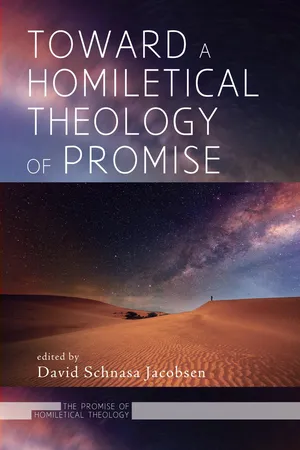
- 140 pages
- English
- ePUB (mobile friendly)
- Available on iOS & Android
eBook - ePub
Toward a Homiletical Theology of Promise
About this book
Information
1
The Promised Land
A Postcolonial Homiletic of Promise in the Asian American Context
Introduction
At the core of Asian American preaching is the promise of the Promised Land.6 This thesis I base on the fact that over the past century Asian Americans7 have constructed their unique faith deeply rooted in the liminal experience of living in a foreign land as a marginalized stranger or a “pilgrim.”8 In other words, the immigrant’s spiritual experience of pilgrimage, as the perpetual sojourner walking in a strange world and looking forward to another (heavenly) world, determines the constructs of faith. The metaphoric idea or the promise of the Promised Land best represents the other heavenly reality that Asian Americans perceive as the eventual terminal of their spiritual pilgrimage. What is important here is that the idea or perceived reality of the Promised Land is not really ethereal or purely other-worldly. Rather, the desired Promised Land synthesizes this-worldliness and other-worldliness. That is, Asian Americans see the Promised Land as already being established here on American soil, yet as also having an eschatological prospect. Preaching, as the most significant moment in the weekly liturgy and spiritual life of the Asian American ecclesia,9 concretizes the synthetic message of the Promised Land in the most verbal and explicit sense, as I will show through examples from Eunjoo Kim’s sermons toward the end of the chapter.
The main body of my article begins by investigating the socio-ecclesial context of Asian Americans, whose pilgrim identity is born out of their triple consciousness. Then, the article discusses the biblical (specifically, Abrahamic) and Augustinian traditions of the pilgrim spirituality that Asian Americans have adopted and adapted for their own context. Finally, I detail the Promised Land idea/ideal and the resulting Asian American pilgrim homiletic of promise. Though not explicit, the overall tone of the article is postcolonial, something that is inevitable given that a significant part of Asian American theological thought is an attempt to overcome their colonial experience, either geo-politically or spiritually. Yet, any discussion on postcolonial theology itself will remain in the background, given the article’s focus on pilgrim theology and the idea of the Promised Land.10
Socio-theological Context: The Triple Consciousness of Asian American Christians11
Asian American Christians, as this socio-religious designation of them itself indicates, live in a threefold cultural-religious reality as Asian, American, and Christian. To adopt and adapt W. E. B. Du Bois’ argument and terminology, Asian Americans construct their identity by means of triple consciousness. Du Bois once argued that African Americans live a “double consciousness” due to two predominant social and existential realities of being African and American. They oscillate between these often-conflicting identities, “two souls, two thoughts, two unreconciled strivings,” at times confused by and at times benefitting from double consciousness.12 Yet Du Bois realized that double consciousness itself is a thing to overcome, not something to be endured helplessly or to be purposefully appropriated. Thus, he argued for the creation of a holistic self-consciousness, self-realization, and self-respect beyond the tricky double consciousness in the minds of African Americans. Building on Du Bois’ argument, I therefore note that Asian American Christians have a triple consciousness: as Asian, as American, and as Christian, or specifically Christ-believing and Christ-following.13 Yet for Asian Americans, in contrast to African Americans, these three fundamentals of socio-religious consciousness do not necessarily contradict one another. Rather, Asian Americans find that being triple-minded is necessary for their survival. Specifically, their initial identity as Asian (or being a part of the Asian community) is crucial for their communal survival in a hostile foreign land, while a new identity as American is also essential for their daily socio-economic lives. At the same time, living as Christ-believing serves them as the most fundamental spiritual resolution to the inevitable psychological, social, economic, or political conflicts that stem from being both Asian and American. In what follows, Sang Hyun Lee, Matsuoka Fumitaka, and Kwok Pui-lan each articulate how this triple consciousness plays out richly in the Asian American Christian life.
In his From a Liminal Place: An Asian American Theology, Sang Hyun Lee first presents his theological analysis of the Asian American social context, especially its bicultural nature. Two concepts are significant in his writing: liminality and marginality. Asian Americans live a liminal life between two very different cultures, which makes their social status extremely marginalized from both cultures; that is, they do not and cannot truly belong to either of the two cultures, and thus are aliens to both. However, Lee is not pessimistic. Based on symbolic anthropologist Victor Turner’s positive conception of liminality, Lee contends that being situated in two different cultures is a profound and complex experience in which new and creative possibilities of life are born.14 Lee believes in particular that this experience of cultural liminality in the Asian American context can produce three invaluable benefits: 1) openness to the new or hidden potentials of society, 2) the emergence of communitas, and 3) a creative space for prophetic knowledge and subversive action.15 Lee’s belief is that Christ, himself a person from the social margins who once lived a liminal life between two sets of dualistic worlds (i.e., human and heavenly and Jewish and Greco-Roman), is the best model for the people of God of a person who (has) achieved the above threefold benefit. Then, Jesus-believing and Jesus-following becomes the third quintessential socio-religious consciousness of Asian Americans. That is, being Christian is a third ontological foundation for Asian Americans, along with being Asian and being American.
While agreeing on Lee’s arguments on liminality and Christian faith as a core ontological foundation of the Asian American life, Fumitaka Matsuoka in his Out of Silence: Emerging Themes in Asian American Churches calls for active social activism by Asian American Christians. He acknowledges that the Asian American church historically has served two socio-ecclesial functions for the people who are part of it. First, the church has been the reservoir of an original Asian cultural and linguistic heritage. In church, people celebrate their own culture and practice their own language that, outside of the church, cannot be celebrated or practiced fully. Second, the church has helped the people’s cultural integration into American society and the local community, providing necessary physical/emotional and economic help.16 Though Matsuoka finds these two social functions very helpful and necessary, he suggests they are insufficient, for they are too passive to make real social or spiritual changes in or out of the Asian American church, in the light of the larger American society. Because of their “ghettoization,” Asian American Christians specifically and Asian Americans in general have been silent or silenced in the broader dominant and colonizing culture. Matsuoka encourages the church to get out of its own ethnic and cultural enclave in order: 1) to demonstrate the church’s legitimate social place in the wider society, and 2) more importantly, to envision and strive to achieve a new American social reality of racial reconciliation, political equality, and socio-economic justice based on the lessons of Christian scriptures and the liberative message of Christ. Matsuoka agrees with Lee that Asian Americans can envision this new kind of transformed American reality because they are now living in the creative space of the “state of liminality.”17 That is, although Asian Americans seem to live in a fixed marginal reality defined by the powerful dominant culture, they are extremely open to new ideas, particularly ideas based on the vision of the Kingdom of God that could possibly transform American society.18 As is the case with Lee, so too Matsuoka is optimistic about the power and authority of the Christian faith in Christ the Inc...
Table of contents
- Title Page
- Contributors
- Acknowledgments
- Introduction
- Chapter 1: The Promised Land
- Chapter 2: A Promising, Trivocal Hermeneutic for Twenty-First-Century Preaching
- Chapter 3: The Spirit-Breathed Body
- Chapter 4: A Homiletical Theology of Promise
- Chapter 5: Promissory Kerygmatics
- Chapter 6: Promise as an Event of the Gospel in Context
- Bibliography
Trusted by 375,005 students
Access to over 1.5 million titles for a fair monthly price.
Study more efficiently using our study tools.
Frequently asked questions
Yes, you can cancel anytime from the Subscription tab in your account settings on the Perlego website. Your subscription will stay active until the end of your current billing period. Learn how to cancel your subscription
No, books cannot be downloaded as external files, such as PDFs, for use outside of Perlego. However, you can download books within the Perlego app for offline reading on mobile or tablet. Learn how to download books offline
Perlego offers two plans: Essential and Complete
- Essential is ideal for learners and professionals who enjoy exploring a wide range of subjects. Access the Essential Library with 800,000+ trusted titles and best-sellers across business, personal growth, and the humanities. Includes unlimited reading time and Standard Read Aloud voice.
- Complete: Perfect for advanced learners and researchers needing full, unrestricted access. Unlock 1.5M+ books across hundreds of subjects, including academic and specialized titles. The Complete Plan also includes advanced features like Premium Read Aloud and Research Assistant.
We are an online textbook subscription service, where you can get access to an entire online library for less than the price of a single book per month. With over 1.5 million books across 990+ topics, we’ve got you covered! Learn about our mission
Look out for the read-aloud symbol on your next book to see if you can listen to it. The read-aloud tool reads text aloud for you, highlighting the text as it is being read. You can pause it, speed it up and slow it down. Learn more about Read Aloud
Yes! You can use the Perlego app on both iOS and Android devices to read anytime, anywhere — even offline. Perfect for commutes or when you’re on the go.
Please note we cannot support devices running on iOS 13 and Android 7 or earlier. Learn more about using the app
Please note we cannot support devices running on iOS 13 and Android 7 or earlier. Learn more about using the app
Yes, you can access Toward a Homiletical Theology of Promise by David Schnasa Jacobsen, Jacobsen in PDF and/or ePUB format, as well as other popular books in Theology & Religion & Biblical Criticism & Interpretation. We have over 1.5 million books available in our catalogue for you to explore.