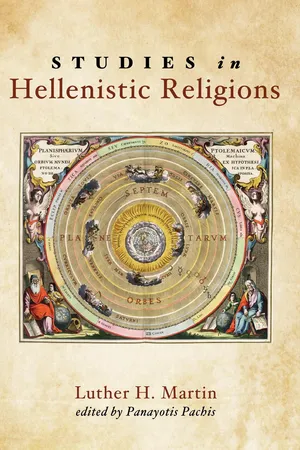
- 408 pages
- English
- ePUB (mobile friendly)
- Available on iOS & Android
eBook - ePub
Studies in Hellenistic Religions
About this book
This selection of essays by Luther Martin brings together studies from throughout his career--both early as well as more recent--in the various areas of Graeco-Roman religions, including mystery cults, Judaism, Christianity, and Gnosticism. It is hoped that these studies, which represent spatial, communal, and cognitive approaches to the study of ancient religions might be of interest to those concerned with the structures and dynamics of religions past in general, as well as to scholars who might, with more recent historical research, confirm, evaluate, extend, or refute the hypotheses offered here, for that is the way scholars work and by which scholarship proceeds.
Information
Topic
Teologia e religioneSubtopic
Storia dell'antica GreciaPart 1
The Graeco-Roman Religious World
1
Greek and Roman Philosophy and Religion
Doctrines must take their beginnings from that of the matters of which they treat.
Giambattista Vico7
Beginnings, it has been suggested, is a more useful category for the investigation of early Christianity than the more common notion of origins, an idea that implies an ahistorical view of religion as somehow sui generis. Commenting on the passage from Vico cited above, Edward Said has argued that beginnings acknowledges historical relationships of “continuity or antagonism or some mixture of both” between doctrines and institutions studied and their context.8 In this sense, any historical investigation of early Christian beginnings must include their intellectual and religious alternatives in the Graeco-Roman world and the relationship of the early Christianities to these alternatives.
The Graeco-Roman, or Hellenistic, World
A change in the course of Western history was initiated by the conquests of Alexander the Great of Macedon (356–323 BCE) who successfully united the Greek peoples in opposition to Persian hegemony and, in the process, established a Graeco-Macedonian empire that extended from the Aegean in the west to the Indus River in India and from the Black Sea in the north to Nubia and the Sahara in Africa.
Already, the second-century-CE Bithynian historian Arrian had written a seven-book history of Alexander, the Anabasis of Alexander, and a ten-book history of Affairs after Alexander (of which only fragments survive). It was not until the eighteenth century, however, that Alexander’s imperial conquests became defined as initiating a discrete period of history with a conclusion in 30 BCE, the year Augustus annexed Egypt, the final autonomous kingdom of Alexander’s former empire, into that of Rome.9 The significance of this period of history, defined in political terms as extending from Alexander to Augustus, was initially dismissed by scholars as “of no interest in itself, and is only so far of value as it helps us to understand the preceding centuries,” at least until “the absorption of Greece by the Romans.” It was certainly considered to have no influence “on the destinies of the future world.”10 Only in the final quarter of the nineteenth century did this important and transformational period of history begin to attract scholarly attention.
Scholarly neglect of the historical period after Alexander until late in the nineteenth century had much to do with the prevailing assumption among scholars in Christian Europe that a new historical era had been inaugurated during the reign of Augustus with the birth of Jesus (Luke 2:1–7). The “pagan” world of the period immediately preceding this Christian “charter event” became relegated, thereby, to a theologically and thus historically diminished background against which the emergence of a new Christian period of Western history might be writ. A predominantly Christian culture was only realized historically and politically, however, in the final decades of the fourth century CE with the imperial decrees of the Christian emperor Theodosius that prohibited all non-Christian religious practices and established Christianity as the sole legitimate religion of the Roman empire. From this perspective, a Graeco-Roman period of cultural—in contrast to political—history may be defined as extending from the encounter of ideas and religious practices occasioned by the internationalism of the first Western empire in the late fourth century BCE to the establishment of the West as a Christian culture in the late fourth century CE; it includes the intellectual and religious histories, not only of the Greek empire established by Alexander and those of his successors, but also that of the Roman imperium as well. It is out of the world of this Graeco-Roman period with its largely Hellenistic culture11 that the early Christianities emerged and were given their shape.
Broadly understood, the predicate “Hellenistic” refers to the general diffusion of Greek culture among those peoples conquered by Alexander as a consequence of his Hellenizing policies, a cultural program actively pursued by his successors. It included the establishment of Greek as the international language of politics and commerce, the introduction of Greek cultural and civic institutions into those cities among the peoples Alexander had incorporated into his empire, and even the founding of new Greek cities, such as Alexandria in Egypt, and subsequent Greek emigration as well as non-Greek immigration with a consequent dissemination of Greek values and ideas. Despite interactions that occurred as a consequence of cultural contact among the diverse cultures included in Alexander’s empire, especially in the area of religion, it was Greek values and ideas that dominated into late antiquity, even through the reign of Rome, and which defined a Hellenistic cultural world.
The category of world has reemerged in cultural studies to describe a boundaried set of social relationships together with its system of acquired knowledge. It differs from the earlier idea of Weltanschauung or “worldview” first used by Kant to describe the holistic comprehension of the phenomenal world.12 In the nineteenth century, the notion was internalized to designate the subjective “meaning” of the world in terms of an individual’s total experience of reality; its formulation was considered the proper function of culture, preeminently, of religion.
In contrast to its Enlightenment and Romantic predecessors, the current usage of world is as an analytic category employed to describe a particular religious system in terms of cosmos (κόσμος) and nomos (νόμος), coextensive scientific and sociopolitical categories of world formation and maintenance.13 Whereas the scientific framework of Hellenistic culture has received some attention in connection with the relationship between cosmology and religion,14 the ...
Table of contents
- Title Page
- Preface
- Acknowledgments
- Abbreviations
- Introduction
- Part 1: The Graeco-Roman Religious World
- Part 2: Oracular Dreaming
- Part 3: Graeco-Roman Mysteries
- Part 4: Hellenistic Judaism and Christianity
- Part 5: Gnosticism
Trusted by 375,005 students
Access to over 1.5 million titles for a fair monthly price.
Study more efficiently using our study tools.
Frequently asked questions
Yes, you can cancel anytime from the Subscription tab in your account settings on the Perlego website. Your subscription will stay active until the end of your current billing period. Learn how to cancel your subscription
No, books cannot be downloaded as external files, such as PDFs, for use outside of Perlego. However, you can download books within the Perlego app for offline reading on mobile or tablet. Learn how to download books offline
We are an online textbook subscription service, where you can get access to an entire online library for less than the price of a single book per month. With over 1.5 million books across 990+ topics, we’ve got you covered! Learn about our mission
Look out for the read-aloud symbol on your next book to see if you can listen to it. The read-aloud tool reads text aloud for you, highlighting the text as it is being read. You can pause it, speed it up and slow it down. Learn more about Read Aloud
Yes! You can use the Perlego app on both iOS and Android devices to read anytime, anywhere — even offline. Perfect for commutes or when you’re on the go.
Please note we cannot support devices running on iOS 13 and Android 7 or earlier. Learn more about using the app
Please note we cannot support devices running on iOS 13 and Android 7 or earlier. Learn more about using the app
Yes, you can access Studies in Hellenistic Religions by Luther H. Martin, Panayotis Pachis, Pachis in PDF and/or ePUB format, as well as other popular books in Teologia e religione & Storia dell'antica Grecia. We have over 1.5 million books available in our catalogue for you to explore.