- 158 pages
- English
- ePUB (mobile friendly)
- Available on iOS & Android
eBook - ePub
About this book
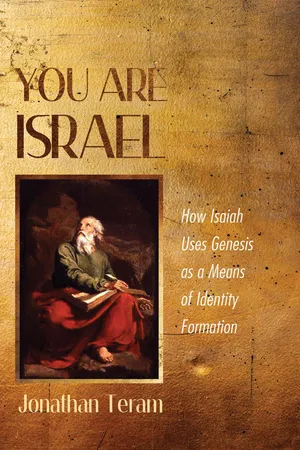
Isaiah has a richer theology of creation than any book of the Bible. Isaiah uses the Hebrew word for "create" more than any book of the Bible. Isaiah ends with a vision of the creation of a new heavens and a new earth.
Isaiah uses the name Jacob more than any book of the Bible except for Genesis itself. The name Jacob is used in Isaiah almost as many times as it is used in all of the books of the prophets combined. Isaiah even says that God created Jacob.
Isaiah also mentions the Garden of Eden, Abraham and Sarah, Noah and the flood, with echoes of Adam and Eve, Cain and Abel, the Tower of Babel, Isaac, Rachel, and Joseph and his brothers.
Many scholarly studies have ignored the importance of Genesis in Isaiah. This book argues Genesis is Isaiah's instrument to re-form the identity of the exilic and post-exilic Jewish communities.
Information
Subtopic
Études bibliquesChapter 1
Introduction
Genesis in Isaiah and Its Meaning
Isaiah uses Genesis as a means of re-forming the identity of the exilic and postexilic Jewish communities. Within this thesis are two components. First, Isaiah intentionally uses the text and/or oral traditions that today comprise the book of Genesis. While the full body of Isaiah’s intertextuality is vast, Genesis is of immense importance to Isaiah. Exploring Isaiah’s use of Genesis in no way diminishes the importance of Isaiah’s use of other texts and traditions; it enhances the richness of this prophetic book, especially since scholarship has generally been unappreciative of Genesis’s role in Isaiah. Second, Isaiah applies Genesis to the situation of the Jewish community, whose core problem, it is argued, was a crisis of identity. While there are frequent allusions to virtually every part of Genesis in Isaiah, the themes of creation, Abrahamic covenantal blessings (pertaining to the concern for children and land), and the Jacob saga are the most relevant. A major dimension of the book of Isaiah is lost without cognizance of these themes.
Methodology
Much has been written about the methodology of detecting intertextuality, though scholars often see different things when they read the same text, particularly the text of Isaiah. Can there be an objective way of detecting an allusion or an echo, and if so, how? Does quoting an oral tradition rather than having text in hand, as it were, count as intertextuality? And how can we be sure a similarity between two texts is not merely a coincidence? Michael Fishbane, for instance, thinks Job 7:17 is a purposeful allusion and subversion of Psalm 8:4 (5 in Hebrew)1 but one can argue the two texts are merely drawing from the same milieu.
The approach taken here is to note any similarities between Isaiah and Genesis a la Job 7:17 and Psalm 8:4. Some of those similarities will be explicit and some implicit. The implicit and more obscure similarities are noted in light of the clearer ones. Explicit similarities involve semantic overlap with key (and in many cases, rare) Genesis words as well as use of Genesis names, such as Abraham and Sarah. Yet two texts do not need to share the same vocabulary in order to be related, just as someone can tell a story from Genesis without quoting a single line. Thus thematic similarities are also taken into consideration, though again, in light of the clearer explicit references which serve as the foundation. No distinction will be made as to whether Isaiah alludes to an oral tradition or a text. It is granted that in some (many?) instances it cannot be proven that a text was used rather than an oral tradition. However, in this case the oral tradition is one that forms the basis of the book of Genesis. Either way, it is Isaiah using Genesis.
This thesis views Genesis as a whole book. It recognizes that Genesis is made up of different traditions and underwent an extensive (and ingenious) editing process. The separate traditions, defined by the Documentary Hypothesis, will be mentioned throughout when appropriate. Nevertheless, it ought to be recognized that a lot of assumptions go into the Documentary Hypothesis regarding authorship and dating of the various sources. These assumptions are bypassed when we consider that the only Genesis we have is the completed Genesis.
The same is true for Isaiah. This thesis accepts that Isaiah 1–39, 40–55, and 56–66 have different historical contexts. When appropriate, especially when interacting with scholarship, the terms “Proto-Isaiah,” “Deutero-Isaiah,” and “Trito-Isaiah” will be used. Otherwise, the term “Isaiah” will be used to refer to the whole book (not necessarily the author). The editing process of the book of Isaiah has been extensive, so much so that it is really impossible to tell what parts of, say, Proto-Isaiah were redacted during the postexilic period. It is true that the largest concentration of Genesis (so it is argued) is found in Deutero-Isaiah, yet there are also important references to Genesis in Proto- and Trito-Isaiah. Whereas previous scholarly studies of Isaiah have focused on only one particular part of Isaiah, this study focuses on Isaiah as a whole.
This thesis assumes the book of Genesis, in some form, was available to the Isaianic prophet of the exile. This is a controversial claim because many scholars argue that the P source was written in the postexilic period. They would also argue that the creation texts in Deutero-Isaiah are quite different from Genesis 1. Of course, there are scholars who argue for P’s antiquity. It will be argued here that JEDP were written before the exile but came together and were circulated in the exile. This is why there are strong similarities not only between Deutero-Isaiah and P, but also Ezekiel and P. And if that proposition turns out to be incorrect, that is, if P was indeed written after the exile, it nevertheless seems likely that Trito-Isaiah was aware of P.
This thesis is the result of an evolution rather than an epiphany. What follows is a retracing of the steps, i.e., textual discoveries and realizations, that led to the development of said thesis. This will enable the reader to understand the rationale behind it.
Creation in Isaiah
If one analyzes Genesis 1, with its relationship to Babylonian religion, and follows that trail throughout the Bible, one will inevitably arrive at Isaiah 40. Isaiah 40 is so saturated with cre...
Table of contents
- Title Page
- Abstract
- Chapter 1: Introduction
- Chapter 2: Intertextuality in Isaiah
- Chapter 3: Judah’s Identity Crisis in Exile
- Chapter 4: Parental Struggles
- Chapter 5: A New Heavens and a New Earth
- Bibliography
Trusted by 375,005 students
Access to over 1.5 million titles for a fair monthly price.
Study more efficiently using our study tools.
Frequently asked questions
Yes, you can cancel anytime from the Subscription tab in your account settings on the Perlego website. Your subscription will stay active until the end of your current billing period. Learn how to cancel your subscription
No, books cannot be downloaded as external files, such as PDFs, for use outside of Perlego. However, you can download books within the Perlego app for offline reading on mobile or tablet. Learn how to download books offline
Perlego offers two plans: Essential and Complete
- Essential is ideal for learners and professionals who enjoy exploring a wide range of subjects. Access the Essential Library with 800,000+ trusted titles and best-sellers across business, personal growth, and the humanities. Includes unlimited reading time and Standard Read Aloud voice.
- Complete: Perfect for advanced learners and researchers needing full, unrestricted access. Unlock 1.5M+ books across hundreds of subjects, including academic and specialized titles. The Complete Plan also includes advanced features like Premium Read Aloud and Research Assistant.
We are an online textbook subscription service, where you can get access to an entire online library for less than the price of a single book per month. With over 1.5 million books across 990+ topics, we’ve got you covered! Learn about our mission
Look out for the read-aloud symbol on your next book to see if you can listen to it. The read-aloud tool reads text aloud for you, highlighting the text as it is being read. You can pause it, speed it up and slow it down. Learn more about Read Aloud
Yes! You can use the Perlego app on both iOS and Android devices to read anytime, anywhere — even offline. Perfect for commutes or when you’re on the go.
Please note we cannot support devices running on iOS 13 and Android 7 or earlier. Learn more about using the app
Please note we cannot support devices running on iOS 13 and Android 7 or earlier. Learn more about using the app
Yes, you can access You Are Israel by Jonathan Teram in PDF and/or ePUB format, as well as other popular books in Théologie et religion & Études bibliques. We have over 1.5 million books available in our catalogue for you to explore.