eBook - ePub
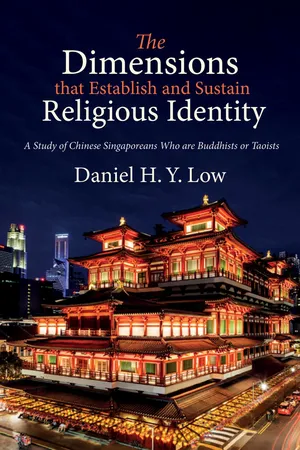
The Dimensions that Establish and Sustain Religious Identity
A Study of Chinese Singaporeans Who are Buddhists or Taoists
- 182 pages
- English
- ePUB (mobile friendly)
- Available on iOS & Android
eBook - ePub
The Dimensions that Establish and Sustain Religious Identity
A Study of Chinese Singaporeans Who are Buddhists or Taoists
About this book
Buddhism and Taoism remain vibrant and prominent in Singapore's religious landscape. Yet, little is known of why Chinese Singaporeans chose and remain in these ancient religions. Analyzing over thirty face-to-face interviews with Buddhists and Taoists in Singapore, this book provides a glimpse into their fascinating narratives consisting of encounters and experiences with the presence and power of spiritual realities. A renewed understanding of Buddhism and Taoism will, hopefully, encourage readers of other religious traditions to create space for each other's religious identity. Only then can we continue to live and share a multi-religious environment within the small nation-state.
Information
Topic
Theology & ReligionSubtopic
Asian ReligionsChapter 1
Introduction
Singapore has experienced rapid modernization and globalization over the last fifty years, morphing from a third-world country into a developed nation in a relatively short time. Despite significant economic progress and social changes within this secular state, the variety and vibrancy of age-old practices and rituals associated with the traditional Chinese religions of Buddhism and Taoism continue to feature prominently across Singapore’s social landscape.
These emotion-evoking and oft-repeated actions consist of both the highly formalized and less formal. Examples of the highly formalized ones include Taking Refuge in the Triple Gems—the Buddha, the Dharma and, the Sangha—inviting Buddhist monks or Taoist priests to perform the final rites for their deceased members, and participating annually in the physically demanding 三步一拜 (san bu yi bai, or Three-Step-One-Bow) ceremonies held at many Buddhist temples during Vesak Day. The less formal ones include individuals or families setting up makeshift 坛 (tan, or altars) at home, places of work, or along walkways filled with canned and freshly prepared food, and accompanied by candles, joss sticks, and large urns for the burning of 金纸 (jin zhi, golden paper or “hell notes”) during the Lunar Seventh Month; practicing the values prescribed by the Five Precepts, Eight-fold Path or 道德经 (Dao de jing, or Classic of The Way and Virtue); meditating or chanting alongside kalyana mitras (spiritual friends) with the help of suttas; and the daily offering of joss sticks before various family gods, such as 观音菩萨 (Guan yin pu sa, or Bodhisattva Guan yin), 大伯公 (Da bo gong, or Grand Uncle), 关帝 (Guan di, also known as God of War), or 齐天大圣 (Qi tian da sheng, Great Sage Equal of Heaven, or, more commonly, the Monkey God).
While the prominence of these vibrant practices and rituals is to be expected, given that the number of Buddhists and Taoists constitute more than half of the island’s population and Buddhism and Taoism continue to be the religions of choice for the majority of Chinese Singaporeans, what are the plausible explanations for the persistent practice of these traditional religions in modern Singapore? How do Buddhists and Taoists remain lifelong adherents even as the island rapidly transforms due to the exponential growth of cutting edge and high value-added industries (e.g. petrochemicals, life sciences, and precision engineering) and the government’s relentless push for the island to be a Smart Nation?
Scholarly studies that have emerged from Singapore and explored this phenomenon point to the enduring and renewed strength of the Buddhists’ and Taoists’ religious identity or religious identification.1 This strength is often attributed to effectiveness in processes of religious modernization and changes undertaken by these two religions, which include rationalization and intellectualization, so much so that both continue to attract new adherents.2 At the same time, such strength has also been linked to the close affinity between religious identity and ethnic identity, i.e., Chinese Singaporeans, particularly those who use predominantly Mandarin or Chinese dialects, accordingly practice the Chinese traditional religions of Buddhism, Taoism, or an amalgamated form of both.3
Although these studies are undoubtedly valuable in shedding insight into the significant and sustained impact of Buddhism and Taoism on the lives of many Chinese Singaporeans, they have failed to fully account for what establishes and sustains the religious identity of the Buddhists and Taoists and how religious identity is defined and understood. While the gaps in these studies will be further explored in chapter 2, it is sufficient at this juncture to provide an overview of the key issues and how this study proposes to address these issues.
First, although many of the existing studies are peppered with the use of “religious identity” as a term, these studies have not attempted to give the term any theoretical precision. It is often used either conjointly with social or racial identity or group category4 or synonymously with closely associated terms such as “religious identification” or “religiosity.”5 Yet, religious identity is a unique component within an individual’s identity that encompasses the important characteristics embedded within the overlapping but distinct entities of identity and religion.6 These characteristics include, within the entity of identity, an inherent sense of invigorating continuity and well-being amidst the various transformations experienced by an individual such that identity functions as a personal code or referent system.7 Within the entity of religion, the key characteristics include experiences with one or more of the following metaphysical or divine realities: sacred beings, texts, community, and actions or forms.8
Thus, its use should be differentiated from religious identification, which is essentially a process undertaken by an individual to connect with “others in an organizational sense (as in becoming a formal member) or in a symbolic sense (as in thinking of oneself as part of a particular group).”9 At the same time, religious identity should also be differentiated from religiosity, as religiosity is largely viewed as “ways of being religious”10 or expressions of one’s beliefs (e.g., religious participation).
With the continued and pervasive importance of Buddhism and Taoism among Chinese Singaporeans, this study proposes that religious identity be adopted as an analytical construct in light of the unique characteristics pointed out above in order to discover and explain the dimensions that undergird Chinese Singaporeans’ choice to remain as Buddhists or Taoists. Religious identity will be defined as an individual’s awareness of and commitment to: (a) a continuous and invigorating inner well-being and (b) a sense of belonging and desire to extend the well-being to the sociocultural community associated with the divine. The awareness and commitment arise out of an individual’s reciprocal interactions with the divine and the sociocultural community associated with the divine. The incorporation of these characteristics is in line with Gleason’s call for a more responsible use of the concept, where the intrinsic complexities of the subject matter are taken into account.11
The unabated importance and renewed flourishing of Buddhism and Taoism in Singapore, even gaining converts from Chinese Singaporeans who are educated in institutions of higher learning, have ensured that both religions continu...
Table of contents
- Title Page
- Foreword
- Preface
- Acknowledgments
- Chapter 1: Introduction
- Chapter 2: Review Of Studies On Buddhism And Taoism And Religious Identity In Singapore
- Chapter 3: Review of Theories of Identity and Religious Identity
- Chapter 4: Research Methods and Procedures
- Chapter 5: Emerging Domain: Recognition
- Chapter 6: Emerging Domain: Appreciation
- Chapter 7: Emerging Domain: Dedication
- Chapter 8: The Centrality of Spiritual Realities in Religious Identity
- Appendix A: Sample Interview Guide
- Bibliography
Trusted by 375,005 students
Access to over 1.5 million titles for a fair monthly price.
Study more efficiently using our study tools.
Frequently asked questions
Yes, you can cancel anytime from the Subscription tab in your account settings on the Perlego website. Your subscription will stay active until the end of your current billing period. Learn how to cancel your subscription
No, books cannot be downloaded as external files, such as PDFs, for use outside of Perlego. However, you can download books within the Perlego app for offline reading on mobile or tablet. Learn how to download books offline
Perlego offers two plans: Essential and Complete
- Essential is ideal for learners and professionals who enjoy exploring a wide range of subjects. Access the Essential Library with 800,000+ trusted titles and best-sellers across business, personal growth, and the humanities. Includes unlimited reading time and Standard Read Aloud voice.
- Complete: Perfect for advanced learners and researchers needing full, unrestricted access. Unlock 1.5M+ books across hundreds of subjects, including academic and specialized titles. The Complete Plan also includes advanced features like Premium Read Aloud and Research Assistant.
We are an online textbook subscription service, where you can get access to an entire online library for less than the price of a single book per month. With over 1.5 million books across 990+ topics, we’ve got you covered! Learn about our mission
Look out for the read-aloud symbol on your next book to see if you can listen to it. The read-aloud tool reads text aloud for you, highlighting the text as it is being read. You can pause it, speed it up and slow it down. Learn more about Read Aloud
Yes! You can use the Perlego app on both iOS and Android devices to read anytime, anywhere — even offline. Perfect for commutes or when you’re on the go.
Please note we cannot support devices running on iOS 13 and Android 7 or earlier. Learn more about using the app
Please note we cannot support devices running on iOS 13 and Android 7 or earlier. Learn more about using the app
Yes, you can access The Dimensions that Establish and Sustain Religious Identity by Daniel H. Y. Low in PDF and/or ePUB format, as well as other popular books in Theology & Religion & Asian Religions. We have over 1.5 million books available in our catalogue for you to explore.