- 264 pages
- English
- ePUB (mobile friendly)
- Available on iOS & Android
eBook - ePub
About this book
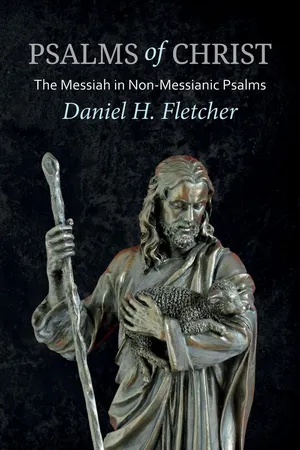
The book of Psalms is a treasure trove of teaching about Jesus Christ. While the church has traditionally recognized only about fifteen psalms as "messianic," anticipating God's promised Messiah, the issue is how Christians should understand the other 135 psalms of the Hebrew Psalter. Psalms of Christ applies the New Testament conviction that the whole book of Psalms speaks prophetically about Christ to select "non-messianic" psalms. Following the New Testament as the guide for how to read the Old in light of the gospel, Psalms of Christ proposes fresh readings of so-called non-messianic psalms by illustrating their christological character, and exploring how they testify to the gospel by evoking Jesus's person, purpose, and passion.
Information
Psalm 1
“Christ most certainly came in the way of sinners by being born as sinners are, but he did not stand in it, for worldly allurement did not hold him.”—Augustine
History
Psalm 1 is the ideal introduction to the Psalter because it models the life of discipleship that delights in following God’s instruction, and calls the reader to do likewise. One cannot simply read this psalm and walk away without making a decision as to the direction of one’s life. As James Mays remarks, “Let the readers understand and ask in what way their feet are set.”57 In many ways, the remainder of the Psalter illustrates the difference between the “righteous” and the “wicked” and the respective paths on which they walk. This idea of two paths is pervasive in Hebrew wisdom literature, especially the book of Proverbs (Prov 2:20–22; 3:12–17), and it is in this context that Ps 1 also teaches that one’s life is a journey; one chooses a particular route for existence. While the word wisdom does not appear in the psalm, its main point is nonetheless clear: to show the reader the wisdom of walking in the ways of God and the folly of ungodly living.58 Therefore, Ps 1 has been classified as a wisdom psalm.59
While Ps 1 is a fitting introduction to the Psalter, it should not be read in isolation from Ps 2. In fact, Ps 2 immediately carries forward the distinction between the righteous and the wicked into the context of God’s anointed king and those who oppose him. Nancy deClaissé-Walford rightly points out that Pss 1—2 together form the introduction to the Psalter: “Psalm 1 urges the reader to meditate upon the Torah as the oath to right living, and Psalm 2 states that, regardless of the useless plotting of earthly rulers, the God who sits in the heavens is sovereign over the created order.”60 Psalm 1 offers a sharp contrast between those who seek God and those who ignore him. On one hand, it describes one who delights in the instruction of the Lord, which results in an intimate relationship with him. On the other hand, it sets in contrast to this one who spurns God’s instruction, opting instead for a life of autonomy resulting in wickedness.
“Blessed” (1:1) describes the individual who is content to walk with God rather than the wicked. It is possible to define “blessed” as happy because some Hebrew lexicons offer it as the first definition among others.61 This psalm, therefore, portrays the individual who exists in a state of happiness as an outgrowth of one’s covenant obedience.62 “Happy” may even be parallel to the “delight” that the individual has when meditating on God’s “law” (torah, v. 2). However, words get their connotations from the contexts in which they are used and from everyday use, not from dictionaries. A dictionary gives a range of possible meanings for a word based on common usage, and not a definitive definition in every case. While the word often translated “blessed” (ashrey) in most English translations of verse 1 can mean happy, in some cases (possibly even this one), it is important not to understand happiness here in the sense of a mere passing emotion. In the context of Ps 1, the close relationship between the righteous one (the “blessed” one in v. 1 is also “righteous” in vv. 5–6) and God brings blessedness, and is better understood in terms of “contentment.”63 That is, the blessed one is content in life because of the intimate relationship he has with God, and as a result avoids and abhors wickedness.
The one who is “blessed” is not anyone but a specific, although unknown, individual. More specifically, it is a certain “man” who is blessed. The original language of verse 1 reads: “Blessed is the man who . . . ” Patrick Reardon explains that the words here are “emphatically masculine—that is, gender specific.”64 In other words, the psalm does not pronounce a blessing on obedient people in general (i.e., humanity), but on a specific “man.” The Hebrew language has two different words for “man”: ish, which is a male/husband, and adam as in “humanity,” which includes males and females collectively.65 The same occurs in the Greek language where anēr refers to a specific man/husband and anthrōpos to humanity in general. Both the Hebrew and Greek versions of the OT use ish and anēr respectively, indicating that 1:1 refers to a particular man who is blessed and obedient.66 Given the canonical placement of Pss 1—2 as a lens through which to read the Psalter, it is not a stretch to identify the “blessed man” in Ps 1 with the anointed king of Ps 2 who devotes his life to God, the true sovereign of the cosmos. The combined effect of the two psalms is that he becomes a model of covenant obedience, a true subject of the King.
While English poetry is often—though not always— known for its rhyme, Hebrew poetry is most known for its parallelism.67 Parallelism occurs when two or three (or more) lines (sg. “colon” pl. “cola”) have some kind of relationship to each other. This sometimes comes across in English translations as what seems to be more or less simple repetition. For example in 1:1, one who “walks not in the counsel of the wicked” (colon A) is basically the same as one w...
Table of contents
- Title Page
- Preface
- Abbreviations
- Introduction
- Psalm 1
- Psalm 23
- Psalm 29
- Psalm 30
- Psalm 46
- Psalm 67
- Psalm 88
- Psalm 100
- Psalm 119
- Psalm 127
- Psalm 137
- Psalm 148
- Conclusion
- Bibliography
Trusted by 375,005 students
Access to over 1.5 million titles for a fair monthly price.
Study more efficiently using our study tools.
Frequently asked questions
Yes, you can cancel anytime from the Subscription tab in your account settings on the Perlego website. Your subscription will stay active until the end of your current billing period. Learn how to cancel your subscription
No, books cannot be downloaded as external files, such as PDFs, for use outside of Perlego. However, you can download books within the Perlego app for offline reading on mobile or tablet. Learn how to download books offline
Perlego offers two plans: Essential and Complete
- Essential is ideal for learners and professionals who enjoy exploring a wide range of subjects. Access the Essential Library with 800,000+ trusted titles and best-sellers across business, personal growth, and the humanities. Includes unlimited reading time and Standard Read Aloud voice.
- Complete: Perfect for advanced learners and researchers needing full, unrestricted access. Unlock 1.5M+ books across hundreds of subjects, including academic and specialized titles. The Complete Plan also includes advanced features like Premium Read Aloud and Research Assistant.
We are an online textbook subscription service, where you can get access to an entire online library for less than the price of a single book per month. With over 1.5 million books across 990+ topics, we’ve got you covered! Learn about our mission
Look out for the read-aloud symbol on your next book to see if you can listen to it. The read-aloud tool reads text aloud for you, highlighting the text as it is being read. You can pause it, speed it up and slow it down. Learn more about Read Aloud
Yes! You can use the Perlego app on both iOS and Android devices to read anytime, anywhere — even offline. Perfect for commutes or when you’re on the go.
Please note we cannot support devices running on iOS 13 and Android 7 or earlier. Learn more about using the app
Please note we cannot support devices running on iOS 13 and Android 7 or earlier. Learn more about using the app
Yes, you can access Psalms of Christ by Daniel H. Fletcher in PDF and/or ePUB format, as well as other popular books in Theology & Religion & Biblical Criticism & Interpretation. We have over 1.5 million books available in our catalogue for you to explore.