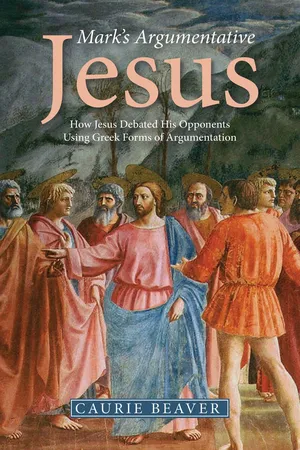
eBook - ePub
Mark’s Argumentative Jesus
How Jesus Debated His Opponents Using Greek Forms of Argumentation
- 162 pages
- English
- ePUB (mobile friendly)
- Available on iOS & Android
eBook - ePub
Mark’s Argumentative Jesus
How Jesus Debated His Opponents Using Greek Forms of Argumentation
About this book
The author claims that the gospel of Mark is a speech or sermon. To prove this he shows how Mark used many of the elements of Aristotle's rhetoric. Literary critics noticed these rhetorical features in Mark, but remained with a literary critical model of that gospel instead of a rhetorical view that the evidence called for. They continued to translate the first word of Mark, arche, as "beginning" to provide Mark's story of Jesus with a chronological beginning. The author translates Mark's first word as "guiding principle" to provide Mark's persuasive speech or sermon with a logical starting point.
Information
Chapter I
The Beginning
Why Mark Has No Birth Story of Jesus
In Jesus’ day there were at least three ways one could become a son of God: by having a lineage that led back to God (Lk. 3:38), by having God as one’s immediate father (Matt 1:18, Lk 1:35), or by being rewarded at death for a lifetime of achievement (like Roman Emperors, philosophers, and heroes; Mk 15:39).
Like the Gospel of John, but unlike Matthew and Luke, Mark has no birth story of Jesus. If we had only the gospels of Mark and John, we would have no Christmas, no nativity, and no genealogy of Jesus showing that he was descended from King David.
So how did Mark explain how and when Jesus became the Son of God? In this regard, two passages are especially relevant: the one in which Jesus rejected his natural family in favor of his true family, the ones who did the will of God (Mk 3:35), and the one in which Jesus argued that the Messiah could not have been the son of David because David called him his Lord (Mk 12:35–37).
Resurrection as Translation
If Mark had Jesus become the Son of God by some process other than birth, there would have been no birth story to tell. It so happens that Mark did explain how Jesus’ followers became his brothers, sisters, and mothers and it was not by a birth (or even a re-birth) process. Jesus’ family heard about his activities and that people thought that he was insane so they came to take him home. When Jesus was told that his family was outside the house where he was staying, he did not invite them in, but instead asked, “Who are my mother and my brothers?” (Mk 3:33). Then he answered his own question by pointing to the ones seated around him and saying, “Whoever does the will of God is my brother and sister and mother” (Mk 3:35). The father was not mentioned presumably because God would be their father.
If Jesus’ followers became a part of the family of God by doing the will of God, then Jesus probably became the Son of God in the same manner by doing the will of God by dying on the cross. In the garden of Gethsemane, Jesus prayed to God to let him live, but added, “. . .not what I will but what you will” (Mk 14:36). In other words, Jesus was not born the Son of God, but achieved that status by doing the will of God by dying on the cross, which, of course, ruled out a birth story for the Son of God at least.
Surprisingly, all this would imply that Mark did not consider Jesus the Son of God during his lifetime, but only at his death. It was when the centurion at the cross saw how Jesus died that he said, “Truly, this man was God’s son” (Mk 15:39). This view would also explain the scarcity of the title Son of God in Mark. If Jesus achieved this status by his death on the cross, it could only be hinted at during his lifetime by demons blurting it out (Mk 3:11) and by God’s declaring it as his baptism, Jesus’ symbolic death (Mk 1:11), and at his transfiguration, his symbolic resurrection/parousia (Mk 9:7).
This view also agrees with the early Christology in Paul’s letters and acts in which Jesus’ exaltation to divine status was placed at his death and resurrection and not at his birth. In his letter to the Romans, Paul wrote:
. . .descended from David according to the flesh and was declared to be the Son of God with power according to the spirit of holiness by resurrection from the dead . . . (Rom 1:3–4).
Scholars agree that Paul is here quoting an early “Christian” creed that claimed that Jesus was designated or appointed the Son of God at his resurrection. The RSV has chosen to translate the key word declared to be the Son of God, the assumption being that Jesus was already the Son of God during his lifetime and was only declared to be such at his resurrection. To translate the word in question as designated or appointed implies that Jesus was not the Son of God during his lifetime, but was designated such at his resurrection. Although Paul spoke of Jesus’ pre-existence elsewhere, he did not describe him as the Son of God during his lifetime; instead, he referred to Jesus as being in “the form of a slave,” “in human form,” and “according to the flesh” (Phil. 2:7; 2 Cor. 5:16). Peter, speaking on the Day of Pentecost, said, “Therefore, let the entire house of Israel know with certainty that God has made him both Lord and Messiah, this Jesus whom you crucified” (Acts 2:36).
After discussing this early Christology in Paul’s Letters and Acts, Raymond Brown noted that even in Mark, it was only after Jesus’ death that he was finally clearly revealed to be the Son of God. Then he added, “Thus Mark has partially preserved the older understanding.”36 But why only partially? Why not completely? It would appear that Brown failed to develop the implications of this insight in relation to the Gospel of Mark. In her massive study of resurrection in the New Testament, Pheme Perkins also treated at some length the concept of resurrection as translation. Perkins claimed that when Luke describes Jesus’ resurrection as translation he “has taken a Christian datum and made it intelligible to his audience by using a widely available literary model.”37 This distinction between Luke’s “Christian datum” and the “literary model” held by his audience is illegitimate. Why not simply assume that Luke shared the views of his audience?
According to Adela Yarbro Collins, what we are dealing with here is a broad cultural phenomenon. Like the Greco-Roman heroes, philosophers, and emperors, Jesus acquired his divine status by translation to heaven from the grave. Collins’s own statement of the matter cannot be improved upon
Rather, the narrative pattern according to which Jesus died, was buried, and then was translated to heaven was a culturally defined way for an author living in the first century to narrate the resurrection of Jesus.38
On the same page, she also wrote:
If according to Mark, Jesus was translated from the grave to heaven, then there was no period of time during which the risen Jesus walked the earth and met with his disciples.39
For Mark, resurrection was an eschatological event that coincided with the end of the world. When the Son of Man appeared, it would be from heaven; he contemplated no post-resurrection appearance of Jesus except at his coming as the Son of Man.
David’s Son or God’s Son?
A second reason why Mark did not have a birth story of Jesus may seem even more indirect, but since it is consistent with the view expressed here, it is worth noting. Mark had Jesus argue that since David called the Messiah his Lord, he could not be his son because a father does not address his son with a superior title. The passage reads as follows:
While Jesus was teaching in the Temple, he said “How can the scribes say that the Messiah is the son of David? David himself, by the Holy Spirit declared: “The Lord (God) said to my Lord (the Messiah), Sit at my right hand, until I put Your enemies under your feet. David himself calls him Lord; so how can he be his son?” and the large crowd was listening to him with delight (Mk 12:35–37, RSV).
Of course, there are assumptions here that we may not accept such as that David wrote the Psalm on which Mark’s Jesus based his argument (Ps. 110:1), or the culturally conditioned belief that a father cannot address his son with an exalted title. However, if we entertain these notions in order to understand Mark’s logic, the Messiah could not be the son of anyone else who called him Lord. The same reasoning would apply to all of the early followers of Jesus who...
Table of contents
- Title Page
- Preface
- Acknowledgments
- Introduction
- Chapter I: The Beginning
- Chapter II: Arché
- Chapter III: What difference does it make?
- Chapter IV: Mark’s “Simple” Rhetorical Arguments
- Chapter V: Complex Rhetorical Arguments
- Chapter VI: The Enthymeme or Rhetorical Syllogism that Generated Mark’s Persuasive Speech
- Chapter VII: Elijah Must Come First
- Chapter VIII: The Logos Must Come First
- Chapter IX: Conclusion
Trusted by 375,005 students
Access to over 1.5 million titles for a fair monthly price.
Study more efficiently using our study tools.
Frequently asked questions
Yes, you can cancel anytime from the Subscription tab in your account settings on the Perlego website. Your subscription will stay active until the end of your current billing period. Learn how to cancel your subscription
No, books cannot be downloaded as external files, such as PDFs, for use outside of Perlego. However, you can download books within the Perlego app for offline reading on mobile or tablet. Learn how to download books offline
Perlego offers two plans: Essential and Complete
- Essential is ideal for learners and professionals who enjoy exploring a wide range of subjects. Access the Essential Library with 800,000+ trusted titles and best-sellers across business, personal growth, and the humanities. Includes unlimited reading time and Standard Read Aloud voice.
- Complete: Perfect for advanced learners and researchers needing full, unrestricted access. Unlock 1.5M+ books across hundreds of subjects, including academic and specialized titles. The Complete Plan also includes advanced features like Premium Read Aloud and Research Assistant.
We are an online textbook subscription service, where you can get access to an entire online library for less than the price of a single book per month. With over 1.5 million books across 990+ topics, we’ve got you covered! Learn about our mission
Look out for the read-aloud symbol on your next book to see if you can listen to it. The read-aloud tool reads text aloud for you, highlighting the text as it is being read. You can pause it, speed it up and slow it down. Learn more about Read Aloud
Yes! You can use the Perlego app on both iOS and Android devices to read anytime, anywhere — even offline. Perfect for commutes or when you’re on the go.
Please note we cannot support devices running on iOS 13 and Android 7 or earlier. Learn more about using the app
Please note we cannot support devices running on iOS 13 and Android 7 or earlier. Learn more about using the app
Yes, you can access Mark’s Argumentative Jesus by Caurie Beaver in PDF and/or ePUB format, as well as other popular books in Theology & Religion & Biblical Criticism & Interpretation. We have over 1.5 million books available in our catalogue for you to explore.