eBook - ePub
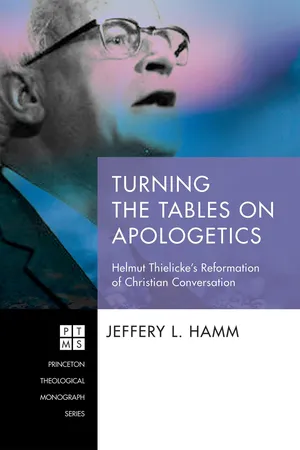
Turning the Tables on Apologetics
Helmut Thielicke’s Reformation of Christian Conversation
- 244 pages
- English
- ePUB (mobile friendly)
- Available on iOS & Android
eBook - ePub
Turning the Tables on Apologetics
Helmut Thielicke’s Reformation of Christian Conversation
About this book
Does apologetic method matter? Helmut Thielicke argues that the method should conform to its own message. He thus rejects traditional apologetic methodologies beholden to supposedly neutral scientific and philosophical paradigms. Seeking to reform Christian conversation, Thielicke discovers a lost way of persuasion, that is, the table-turning approach found in Christ's conversations. Whenever Jesus is questioned, he seldom answers directly. For he refuses to allow the conversation to be framed by an autonomous mindset, and instead responds with a counterquestion. Christ's style of persuasion--as the controller of the question--subverts his hearers' presuppositions and challenges their unbelief. This approach is the reverse of the defensive, answer-giving mode of traditional apologetics. In view of renewing Christ's method, Thielicke insists that the task of apologetics is "something which is always on the offensive and, far from giving ready-made answers to the doubtful questions of men, turns the tables by putting questions on its own account--aggressive, violent, radical questions--and striking straight to the hearts of men." Christian conversation must integrate Christ's method with his message in order to advocate the message itself. For it is not the world that questions Christ, but rather Christ questions the world.
Information
Topic
Theology & ReligionSubtopic
Logic in Philosophy1
A Theology for Apologetics
Among Thielicke’s early works is an untranslated collection of essays bound together under the rubric Theologie der Anfechtung,1 the label which he employs to categorize his theological methodology. The foreword to the volume explains the trademark title and thus provides the lens through which Thielicke views the entire theological landscape, and it would be important to note that especially prominent in this scene is his apologetic.
Etymologically, the term apologetics is derived from the Greek word apologia, a combination of the preposition apo (from) and root logos (word), which literally means a “word from.” The lexicon defines it as a “speech of defense.”2 A classic example from antiquity of such an apologia is Plato’s dialogue, The Apology, a retelling of the defense of his famous teacher, Socrates, against the accusation of marketing strange gods. In Scripture, the word is employed by the Apostle Peter in the exhortation to his readers, Gentile believers slandered unjustly, “but in your hearts honor Christ the Lord as holy, always being prepared to make a defense [apologia] to anyone who asks you for a reason for the hope that is in you” (1 Pet 3:15).3 From this mandate has arisen the modern theological discipline of apologetics, which deals with the reasoned defense of the faith.4 Traditionally, theologians saw the subject as the prolegomena to or preparation for systematic theology, which categorizes the orthodox doctrines of theology proper, Christology, soteriology, anthropology, ecclesiology, and eschatology.
In Thielicke’s Theologie der Anfechtung, however, he never sees apologetics in distinction from his theology but rather as its destiny. He explains, “In this respect it is not about apologetics, but rather theology—of course a form of theology which in a particular way forces itself upon the author as his fate.”5 Elsewhere Thielicke boldly asserts that “all theology which pursues the genuine goal of ungenuine apologetics has a character of a ‘theology of Anfechtung.’”6 To this, theology’s mission statement, Thielicke adds, “Theologians to a high degree have the task of representatively carrying the intellectual and spiritual conflict on behalf of their contemporaries. Here, if we are not afraid of an overloaded term, is the apologetic task of theology.”7 According to Thielicke, the primary task of theology, reflecting its true goal, is apologetic.8 This apologetic purpose of theology then eliminates the false dichotomy between theology and apologetics as it is traditionally known. Instead, for Thielicke, they are one and the same.9 Theology is apologetics and apologetics is theology. Consequently, to understand Thielicke’s apologetic reformation, it is critical to comprehend his theology of Anfechtung.10
Anfechtung in Luther
Anfechtung, as Thielicke employs it, is a German term borrowed originally from Martin Luther (1483–1546). Within the American edition of Luther’s Works, the word is rendered as “temptation,” “trial,” “affliction,” “assaults,” as well as “tribulation.”11 In The Theology of Martin Luther, written by Thielicke’s Doktorvater, Erlangen professor Paul Althaus, the translator notes about Anfechtung: “This word has been translated in various ways, e.g., trials, temptations, assault, perplexity, doubt.”12 Finally he settles on “temptation,” as per his explanation: “the theology of faith is and remains, however, the theology of temptation {Theologie der Anfechtung}.”13 David Scaer, in his helpful essay, “The Concept of Anfechtung in Luther’s Thought,” states that Anfechtung, and its Latin counterpart tentatio, could be listed among those unique words that “defy adequate translation” and consequently suggests since the reformer’s concept of Anfechtung is so multifaceted, “it is best left untranslated.”14 Recently a work of Oswald Bayer—Thielicke’s eventual successor as professor of theology at the University of Tübingen15—was published in English by the title, Theology the Lutheran Way. The translators also acknowledge the staggering linguistic challenge presented by the word Anfechtung, yet do not take Scaer’s good-humored path of “theological and literary cowardice.”16 Instead, after citing a few common options for translation, the duo offer their own dynamic definition, “The word Anfechtung is difficult to render into English. It can mean trial, testing, temptation, challenge, or attack. The precise meaning it has in a given place will depend on the context. Usually we have translated it as spiritual attack.”17 Their innovative rendering of Anfechtung as “spiritual attack” is attractive, but there is still more to be considered. For in an encyclopedia article on Anfechtung, authored by Thielicke himself, the word is also translated by the entry “Temptation.” The editor, however, hastens to note that “the English word ‘temptation’ is not quite adequate as a translation of the German word Anfechtung” and defensively insists that this “article d...
Table of contents
- Title Page
- Acknowledgments
- Abbreviations and Shortened Titles
- Introduction
- Chapter 1: A Theology for Apologetics
- Chapter 2: A Confession for Apologetics
- Chapter 3: The Rejection of Traditional Apologetics
- Chapter 4: An Apologetic of the Cross
- Chapter 5: The Apologetic Method of Christ’s Conversations
- Chapter 6: The Apologetic Venture of Faith
- Chapter 7: The Advance of Christian Apologetics
- Chapter 8: Conclusion
- Bibliography
Trusted by 375,005 students
Access to over 1.5 million titles for a fair monthly price.
Study more efficiently using our study tools.
Frequently asked questions
Yes, you can cancel anytime from the Subscription tab in your account settings on the Perlego website. Your subscription will stay active until the end of your current billing period. Learn how to cancel your subscription
No, books cannot be downloaded as external files, such as PDFs, for use outside of Perlego. However, you can download books within the Perlego app for offline reading on mobile or tablet. Learn how to download books offline
Perlego offers two plans: Essential and Complete
- Essential is ideal for learners and professionals who enjoy exploring a wide range of subjects. Access the Essential Library with 800,000+ trusted titles and best-sellers across business, personal growth, and the humanities. Includes unlimited reading time and Standard Read Aloud voice.
- Complete: Perfect for advanced learners and researchers needing full, unrestricted access. Unlock 1.5M+ books across hundreds of subjects, including academic and specialized titles. The Complete Plan also includes advanced features like Premium Read Aloud and Research Assistant.
We are an online textbook subscription service, where you can get access to an entire online library for less than the price of a single book per month. With over 1.5 million books across 990+ topics, we’ve got you covered! Learn about our mission
Look out for the read-aloud symbol on your next book to see if you can listen to it. The read-aloud tool reads text aloud for you, highlighting the text as it is being read. You can pause it, speed it up and slow it down. Learn more about Read Aloud
Yes! You can use the Perlego app on both iOS and Android devices to read anytime, anywhere — even offline. Perfect for commutes or when you’re on the go.
Please note we cannot support devices running on iOS 13 and Android 7 or earlier. Learn more about using the app
Please note we cannot support devices running on iOS 13 and Android 7 or earlier. Learn more about using the app
Yes, you can access Turning the Tables on Apologetics by Jeffery L. Hamm in PDF and/or ePUB format, as well as other popular books in Theology & Religion & Logic in Philosophy. We have over 1.5 million books available in our catalogue for you to explore.