eBook - ePub
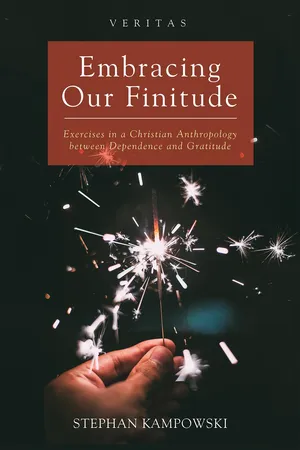
Embracing Our Finitude
Exercises in a Christian Anthropology between Dependence and Gratitude
- 188 pages
- English
- ePUB (mobile friendly)
- Available on iOS & Android
eBook - ePub
Embracing Our Finitude
Exercises in a Christian Anthropology between Dependence and Gratitude
About this book
Memento mori--remember death--this is how the medieval monks exhort us. Our life, given in birth and taken by death, is radically marked by finitude, which can be a source of great fear and anguish. Our finitude, however, does not in itself need to be something negative. It confronts us with the question of our life's meaning and spurs us on to treasure our days. Our contingency, as evidenced in our birth and death, reminds us that we have not made ourselves and that there is nothing necessary about the marvelous fact that we exist. Particularly from a Judeo-Christian perspective, embracing our finitude will mean gratefully accepting life as a completely gratuitous gift and living one's days informed by a sense of this gratitude.
Information
Topic
Teologia e religioneSubtopic
Metafisica filosoficaPart One
Nature and Culture
Appreciating What Is Given
1
Dependence and Gratitude
What ultimately stills the fear of death is not hope or desire but remembrance and gratitude.
—Hannah Arendt, Love and Saint Augustine
The Human Condition: Between Resentment and Gratitude
“Now I am become Death, the destroyer of worlds.”1 These words, originally found in the sacred Hindu writing Bhagavad Gita, were uttered by Robert Oppenheimer when he witnessed the first successful test of an atomic bomb, the violence of which far exceeded the expectations of the scientists whom he directed and with whom he was working on the Manhattan Project, the purpose of which was to put Einstein’s relativity theory to work in order to build a most deadly weapon and thus to bring World War II finally to a quick, though bloody and violent, end. For Hannah Arendt this day, July 16, 1945, marks nothing less than the end of modernity and the beginning of a new epoch.2 With the advent of the atomic bomb, for the first time human beings have acquired the potential to extinguish all life on earth and possibly even to make the planet explode. Empires of the past were known to rise and fall but the continuous succession of one kingdom by another was still thought to be lasting, with humanity itself being what guaranteed the existence of civilization. But now humanity itself is at risk to die off by the work of human hands. And the planet Earth, which, until that date, had been the quintessence of permanence in the shifty sand of human affairs, has now itself become as precarious as the human beings that inhabit it. We can thus say that July 16, 1945 ushered in a new liquid age, deprived as it were of the pillars of mundane permanence.
In this present context we are not proposing a historical reflection on the different epochs of human history. Rather, we want to consider the destructive tendency inherent in human ingenuity—the epitome of which is represented by the nuclear bomb, but which is, of course, also present in other human pursuits. Whence the destruction? What we want to propose here is that one of the roots of the human persons’ destructive propensities is the difficulty to accept the fact that they are not the creators of themselves; humans are contingent and dependent beings. Life is given to us under certain conditions: for instance, we are born; we will have to die; we do not live alone in this world. Hannah Arendt refers to these givens of the human condition using the terms natality, mortality and human plurality.3 These facts are an expression of our contingency, and for Arendt much of the technological revolution of the last centuries, of which the nuclear weapon is no doubt a legitimate child, can be seen as “a rebellion against human existence as it has been given.”4
I do not wish to say that technology as such is evil. What I want to affirm is rather that there are certain destructive tendencies in technology, which derive—as I should like to propose—from the human beings’ difficulty to be reconciled with their contingency. Ultimately, then, what I would like to reflect on is the meaning of the very fundamental fact that human beings are contingent and dependent. Taking my basic inspiration from Hannah Arendt, I would like to suggest that there are three ways in which we could respond to this fact: (1) confronted with our dependency we may resent this fact and seek to destroy all the conditions of our life that are not self-made, pretending complete self-sufficiency; (2) we may resign and despair at life’s absurdity, which denies us self-sufficiency; 3) and finally, we may be reconciled to the conditions under which life has been given to us, accept life as a gift and respond in gratitude.5
Human Contingency in Philosophical Reflection
As Alasdair MacIntyre points out, human dependency, as fundamental a fact as it is, has curiously been neglected or forgotten in philosophical reflections.6 Thus he explains that Aristotle’s reflections on ethics and politics center around the independent, healthy, strong, adult male citizen, while the experience of women, children, slaves, and workers is generally ignored.7 In this way, these are essentially excluded from the good life. The ideal, in fact, is that of the magnanimous man, who “dislikes any recognition of his need for aid from and consolation by others.”8 In reality, however, the years in which human beings are relatively independent are rather few in number. In the old age people often become dependent on others once again as when young. A healthy adult becomes ill at times or may even become permanently disabled. Human beings are living organisms and are susceptible to aging, sickness, and death, and it would seem that a serious philosophical reflection should address these issues. Instead, much of the history of modern philosophy can be read as a single attempt to explain human existence without having to take recourse to our bodiliness. From René Descartes’s res cogitans to Edmund Husserl’s transcendental ego, the human being is not a body, or at least his or her body can be “bracketed” (see Husserl’s epoché). Great philosophers such as Immanuel Kant or David Hume seem to, at times, simply “forget the body”—to put it in Hans Jonas’s terms.9 The same holds true also for Martin Heidegger, for whom Dasein refers to a mortal, concerned existence, but is nonetheless curiously oblivious to the evident physical needs of a mortal being. Jonas comments on the issue: “Is the body ever mentioned? Is ‘care’ ever traced back to it, to concern about nourishment, for instance—indeed to physical needs at all? Except for its interior aspects, does Heidegger ever mention that side of our nature by means of which, quite externally, we ourselves belong to the world experienced by the senses, that world of which we, in blunt objective terms, are a part? Not that I know of.”10
Forgetfulness of our body ultimately means forgetfulness of our contingent condition, of our vulnerability and dependency. And perhaps it is no accident that Heidegger, somewhat unmindful of the body, comes dangerously close to identifying Dasein, the one being for whom the question of being-as-such is an issue, with precisely this being-as-such, notwithstanding all his emphasis on the ontological difference.11 But attempts to deny human contingency or, conversely spoken, the search for self-sufficiency, have existed in the philosophical tradition already since antiquity. The Stoics’ ideals of apatheia (passionlessness) and ataraxia (undisturbedness) are nothing but expressions of the attempt at autarchy, thought to render the will all-powerful. If I always will what happens anyway, nothing can happen against my will,12 even if I were to be roasted alive in Phalaris’s bull.13 Stoicism of course simply makes use of a mental trick, quickly exposed by St. Augustine: If one cannot get what one wants, one simply wants what one can get.14 But this could hardly be what it means to be all-powerful or self-sufficient.
Forgetfulness or straight-out denial of human contingency has, however, not been the only way in which our topic has been treated in the history of philosophy. Some thinkers have indeed thematized it as a problem. We may think for a moment of Emmanuel Levinas. Many of us may be familiar with what is perhaps his central idea: the first word that the face of the other tells me is, “Do not kill me!”15 This actually sounds very good, and Levinas continues by speaking about one’s infinite and absolute responsib...
Table of contents
- Title Page
- Credits
- Introduction
- Part One: Nature and Culture
- Part Two: Society and Utopia
- Bibliography
Trusted by 375,005 students
Access to over 1.5 million titles for a fair monthly price.
Study more efficiently using our study tools.
Frequently asked questions
Yes, you can cancel anytime from the Subscription tab in your account settings on the Perlego website. Your subscription will stay active until the end of your current billing period. Learn how to cancel your subscription
No, books cannot be downloaded as external files, such as PDFs, for use outside of Perlego. However, you can download books within the Perlego app for offline reading on mobile or tablet. Learn how to download books offline
Perlego offers two plans: Essential and Complete
- Essential is ideal for learners and professionals who enjoy exploring a wide range of subjects. Access the Essential Library with 800,000+ trusted titles and best-sellers across business, personal growth, and the humanities. Includes unlimited reading time and Standard Read Aloud voice.
- Complete: Perfect for advanced learners and researchers needing full, unrestricted access. Unlock 1.5M+ books across hundreds of subjects, including academic and specialized titles. The Complete Plan also includes advanced features like Premium Read Aloud and Research Assistant.
We are an online textbook subscription service, where you can get access to an entire online library for less than the price of a single book per month. With over 1.5 million books across 990+ topics, we’ve got you covered! Learn about our mission
Look out for the read-aloud symbol on your next book to see if you can listen to it. The read-aloud tool reads text aloud for you, highlighting the text as it is being read. You can pause it, speed it up and slow it down. Learn more about Read Aloud
Yes! You can use the Perlego app on both iOS and Android devices to read anytime, anywhere — even offline. Perfect for commutes or when you’re on the go.
Please note we cannot support devices running on iOS 13 and Android 7 or earlier. Learn more about using the app
Please note we cannot support devices running on iOS 13 and Android 7 or earlier. Learn more about using the app
Yes, you can access Embracing Our Finitude by Stephan Kampowski in PDF and/or ePUB format, as well as other popular books in Teologia e religione & Metafisica filosofica. We have over 1.5 million books available in our catalogue for you to explore.