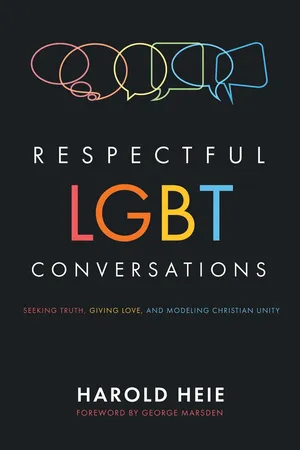
eBook - ePub
Respectful LGBT Conversations
Seeking Truth, Giving Love, and Modeling Christian Unity
- 322 pages
- English
- ePUB (mobile friendly)
- Available on iOS & Android
eBook - ePub
Respectful LGBT Conversations
Seeking Truth, Giving Love, and Modeling Christian Unity
About this book
In stark contrast to the shrill and nasty interactions among many Christians regarding contentious LGBT issues, this book models a redemptive mode of engagement by featuring respectful conversations among deeply committed Christians who hold to diverging traditional and non-traditional views. The foundational values guiding these conversations are the quest for truth, giving the gift of love to all brothers and sisters in Christ, and modeling Christian unity. Emerging from these conversations are practical steps for a way forward that include creating safe spaces for ongoing conversation and practicing courageous Christian leadership. Based on case studies for a Christian university and two Christian churches, this book provides helpful advice for navigating conflict within churches, Christian denominations, and Christian educational institutions.
Information
1
Voices from the Gay Community
We often resort to talking “about” or “at” persons with whom we have disagreements rather than talking “with” them. As with all of my life’s work, this project emphatically rejects that approach.1 If there is to be any hope for sorting through strong disagreements among Christians regarding LGBT issues, we first must listen to the stories and reflections of Christians who self-identify as members of the LGBT community.
Two such persons are the conversation partners for this first round of conversations, Justin Lee and Eve Tushnet, both of whom have been asked to address the following Leading Question: What are your beliefs about morally appropriate relationships between persons who experience same-sex attraction?
Justin and Eve disagree about the moral appropriateness of sexual intimacy between same-sex couples. Justin takes what has been called a “Side A” position that God will bless a consummated same-sex relationship characterized by a lifelong commitment; while Eve takes a “Side B” position that sex is reserved for heterosexual marriage alone, and that there is therefore no situation in which it would be appropriate for a same-sex couple to be sexually intimate.
However, as the following narrative will reveal, they do share some common ground despite this fundamental disagreement, starting with the following point of agreement.
GAY PEOPLE TAKE PRIORITY OVER GAY ISSUES
Justin confesses that a mistake he made in his early attempts to address gay (or more broadly, LGBT) issues was that “I treated gay people as an issue instead of as people.”2
Eve emphatically agrees with Justin that treating gay people in terms of issues rather than as people is a mistake, adding that “this is an area where both churches and individuals would do well to start with introspection and repentance.”
Justin and Eve agree that a conversation about gay (or LGBT) “issues” must start with the stories and reflections of those Christians who self-identify as being gay and who are struggling with the concrete question of how best to live as faithful gay Christians. Some of these stories and reflections follow.
CHURCHES CAN BE BRUTAL
Eve reports the following about her experience in the Catholic tradition.
I was extraordinarily lucky to come into the Church in a community where being gay was not treated as shameful or sinful. I was not sent to psychiatrists who claimed they could fix my sexuality; I was not told to fear friendship as a “near occasion of sin”; I was not ostracized, bullied, disowned, or even much gossiped about by people who claimed they were acting for my own good in the name of Jesus. Out of all the gay or same-sex attracted people I know who are seeking to lead lives faithful to the Catholic sexual ethic on homosexuality, I am the one with the least contact with “ex-gay” movements and ideologies by far.
Not all gay Christians have shared Eve’s positive experience. One reader responds to Eve that “Of course you ponder and discern within the faith community that ‘homes’ you,” adding the following heartbreaking testimony of his experiences of being “chopped and slashed and sliced in deep inward body-mind-feeling-heart-and-spirit places that hardly ever stop hurting” in churches (Protestant and Catholic) that were his “home.”
Honestly, between the repeat cycles of fasting and prayer, amplified by the exorcism prayer meetings, I felt like a cancer patient who is increasingly trying to bear up under the most intense but state of the art cancer treatment available. O the mighty yet arduous “cures” for being gay!
Believe me when I say, it all hurt more than I can possibly report or describe. The spiritual abuse of me as a young man with a male body, my sensuality as well as my sexuality, not to minimize the brutally spiritual neglect and abuse and violence—well, gee, that has all been nearly unbearable and continues in retrospect to be nearly unbearable . . .
Alas, so far, no “call to home” has ever stood even a little test of time and of heart. Lord have mercy.
In a later comment, our anonymous reader adds.
I am very old now, well into my sixties. I tried the ex-gay and celibacy paths for at least ten years between about age thirteen and age twenty-three years. Then four or five decades on from back then.
All that heartache could not, in the end, be worth it. I should have been one of those guys who hung himself in the rafters of the empty garage of the abandoned house next door, or perhaps who found a wild moment to jump from the college bell tower or high rise science buildings. Instead, I just doggedly went on and on and on.
Life has just about been like a forced prisoner of war march, or perhaps in shallower extent like the Native American trails of tears.
If that story doesn’t break your heart, nothing will.
“Lord have mercy” indeed.
IT’S NOT ALL ABOUT SEX
Eve makes the good suggestion that the Leading Question I posed (What are your beliefs about morally appropriate relationships between persons who experience same-sex attraction?), while “important” (because of its focus on “relationships”), is not the central question. The central question is, “How are gay and same-sex attracted people called to give and receive love?”
It appears to me that implicit in Eve’s statement of the “central” question is her brief answer to the Leading Question that I posed: The most appropriate relationship between those who experience same-sex attraction is a relationship that “gives and receives love.” I concur, and I would add that the giving and receiving of love is the most appropriate relationship between any two persons, whatever their sexual orientation (more about that later).
As noted by Eve, this focus on the giving and receiving of love calls into question the problematic assumption in “American Christian cultures” that sexual relationships are the only form of love between adults.
Justin shares common ground with Eve on this point, saying that “She’s absolutely right in calling out our modern obsession with a particular kind of love [involving sexual relationships] and our relative neglect of other paths [for giving and receiving love].”
Before elaborating on these other paths of love, it is important to note the way in which conversations about giving and receiving love must go beyond talking about sexual relationships, as pointed out by Justin.
In brief, Justin notes that a second mistake he made earlier in his pilgrimage was to “treat a complex set of questions as if they were only one question . . . what does the Bible say about same-sex sex?” He now realizes there are “bigger questions” for him as a gay Christian, like “Where is my place in the church? What is my vocation? What does my future look like? If I’m single the rest of my life, what happens when I get old? Who will take care of me?” He further suggests that the church also needs to address some “bigger questions,” like “How can we love the gay people in our midst—and the broader LGBT community—how can we provide them support, understanding, unconditional love, and sanctuary?”
NEGLECTED FORMS OF GIVING AND RECEIVING LOVE
Eve asserts that “Regardless of what our churches believe about gay marriage, they must rediscover the many forms of love, kinship, and care which exist outside of marriage.” She then identifies four such “hidden paths of love.”
Friendship: Eve suggests that “we can learn a few things from Jesus’ description and practice of friendship.”
First, we learn that both cross-sex and same-sex friendship can mirror the love between God and humans, since the followers and friends of Jesus included both men and women.
Second, we can see that Jesus, Love Himself, forged an intimate friendship with the “beloved disciple” John. Friendship for Jesus was not an abstract matter of obedience but a tender and personal relationship. Jesus weeps for his friend Lazarus; his friend John reclines on his breast at dinner. Friendship linked the disciples into a community which became the early church.
Eve goes on to say that “Nobody wants every friendship to be this kind of lifelong, promise-adorned, caregiving relationship. But both married and unmarried lay Christians would find their callings in life so much better supported if friendship-as-kinship were more recognized as a possibility.3
Service: Eve asserts that “In service my own neediness meets the neediness of others,” citing the example of Henri Nouwen, the celibate, gay Catholic priest and “beloved spiritual author,” who “found his home at L’Arche, a network of community homes for people with intellectual disabilities,” adding that “In living with those who had obvious physical needs, his own spiritual and emotional longings were answered.” Surely this is an example of giving and receiving love.
Celibate partnership: Eve notes that she has “friends who are living out this unusual vocation. They know that they have been called by God to ‘do life together.’ They live together, care for one another as kin, share a common prayer life, and grow in holiness through partnership.”
While wanting to highlight the three forms of love noted above and “the challenges they pose to the view that marriage is the one adult form of love for Christians,” Eve suggests that “There are many other ways of love—I know LGBT or same-sex attracted people who have taken religious vows or entered ‘mixed-orientation marriages’ (marriages in which one spouse is openly gay or same-sex attracted, but discerns a calling to marry an opposite-sex spouse—life is complicated, y’all). Teaching, art, godparenthood (which can be one way of honoring and deepening a friendship), adoption and fostering: All can be forms of love to which gay or same-sex attracted people are called.”
Eve notes three characteristics that these various hidden forms of love have in common.
First, “they are caregiving relationships,” most of which “involve a long-term commitment to stability and permanence.” She adds that these caregiving relationships are also “fruitful: They serve the next generation or the surrounding community.”
Secondly, these callings also have in common the fact that they are not imitations of marriage, “marriage lite,” or “marriage minus [X], or consolation prizes for people who can’t make a Christian marriage.” She notes that “My friends in a celibate partnership sometimes describe their relationship as having ‘elements of marriage and elements of monasticism’” (more about that later).
Finally, “These relationships have in common the fact that they are largely unrecognized and unsupported, not o...
Table of contents
- Respectful LGBT Conversations
- Foreword
- Preface
- Acknowledgments
- Chapter 1: Voices from the Gay Community
- Chapter 2: Biblical Understandings
- Chapter 3: Findings from the Sciences
- Chapter 4: Constitutional Framework for Public Policy
- Chapter 5: Same-Sex Marriage
- Chapter 6: Anti-Discrimination Laws
- Chapter 7: Voices from Younger Christians
- Chapter 8: Churches and the LGBT Community
- Chapter 9: Case Study Conversations about LGBT People and Issues
- Chapter 10: Conclusion
- Recommended Readings
- Bibliography
- Authors
- Conversation Partners
Trusted by 375,005 students
Access to over 1.5 million titles for a fair monthly price.
Study more efficiently using our study tools.
Frequently asked questions
Yes, you can cancel anytime from the Subscription tab in your account settings on the Perlego website. Your subscription will stay active until the end of your current billing period. Learn how to cancel your subscription
No, books cannot be downloaded as external files, such as PDFs, for use outside of Perlego. However, you can download books within the Perlego app for offline reading on mobile or tablet. Learn how to download books offline
Perlego offers two plans: Essential and Complete
- Essential is ideal for learners and professionals who enjoy exploring a wide range of subjects. Access the Essential Library with 800,000+ trusted titles and best-sellers across business, personal growth, and the humanities. Includes unlimited reading time and Standard Read Aloud voice.
- Complete: Perfect for advanced learners and researchers needing full, unrestricted access. Unlock 1.5M+ books across hundreds of subjects, including academic and specialized titles. The Complete Plan also includes advanced features like Premium Read Aloud and Research Assistant.
We are an online textbook subscription service, where you can get access to an entire online library for less than the price of a single book per month. With over 1.5 million books across 990+ topics, we’ve got you covered! Learn about our mission
Look out for the read-aloud symbol on your next book to see if you can listen to it. The read-aloud tool reads text aloud for you, highlighting the text as it is being read. You can pause it, speed it up and slow it down. Learn more about Read Aloud
Yes! You can use the Perlego app on both iOS and Android devices to read anytime, anywhere — even offline. Perfect for commutes or when you’re on the go.
Please note we cannot support devices running on iOS 13 and Android 7 or earlier. Learn more about using the app
Please note we cannot support devices running on iOS 13 and Android 7 or earlier. Learn more about using the app
Yes, you can access Respectful LGBT Conversations by Heie, Harold Heie in PDF and/or ePUB format, as well as other popular books in Theology & Religion & Biblical Criticism & Interpretation. We have over 1.5 million books available in our catalogue for you to explore.