eBook - ePub
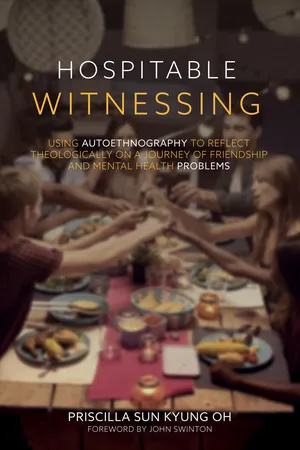
Hospitable Witnessing
Using Autoethnography to Reflect Theologically on a Journey of Friendship and Mental Health Problems
- 210 pages
- English
- ePUB (mobile friendly)
- Available on iOS & Android
eBook - ePub
Hospitable Witnessing
Using Autoethnography to Reflect Theologically on a Journey of Friendship and Mental Health Problems
About this book
Drawing on her own experience of befriending a person suffering from a long-term mental health challenge, Priscilla Oh reflects on the meaning of care and friendship theologically. Using autoethnography, she goes beyond the personal experience and examines various issues surrounding mental health. Hospitable Witnessing candidly takes readers into the everyday life of being with a mentally ill person. There are emotional challenges and contingencies in sustaining friendship and caring for a person with a long-term mental health problem. Oh points out that those who care for a loved one during a long-term illness inevitably experience "burnout" resulting from the constant care requirements. Under such an enormous disruption, we need to be compassionate toward another's suffering and be willing to be present and available for them. This book suggests our need of one another and identifies three important Christian practices: caring as we are being made in the image of God, compassion as being present with the sufferer, and lament as to revitalize our faith and hope.
Information
Chapter One
What Is Autoethnography?
Autoethnography is a qualitative research method: with autoethnography, we use our experience to engage ourselves, cultures, others, and social research. The method involves multiple levels of consciousness in the research process to produce a particular kind of knowledge. While focusing on experience and relationships, the method enables the researcher to creatively use personal experiences to interrogate and critique cultural practices and beliefs, and sensitively to recognize the intricate relationship between the researcher’s self and others.32
The Crisis of Representation
As a genre of writing and a qualitative approach, autoethnography refuses the assumption of traditional scientific research that the researchers can separate themselves from the research experience.33 Laurel Richardson put it this way: “Many of us no longer wish to become the kind of ethnographers—distant, removed, disengaged, above it, that traditional ethnography would have us be.”34
The crisis of representation motivated researchers to acknowledge as to how their identities, lives, beliefs and relationships could influence their approach to the research process and their findings. This trend encouraged qualitative researchers to seek more transparent, reflexive, and creative ways to represent their research outcome. The position of the postmodernists is similar in that no theory, method or disclosure has the right to claim an objective form of knowledge, but rather it should be subject to question and critique.35
John Van Maanen’s Tales of the Field addresses this crisis of representation. He offers three types of representational forms that would merge the mode of presentation, the voice of the researcher and the field work; the three features of representation are impressionist, confessional and realistic narrative. While the realist form of narrative concentrates on the study of culture and using the third person narrative, in the confessional presentation, by using the first-person narration, he demonstrates the researcher’s vulnerability and liminality. With the combination of realist and confessional styles, in the impressionist narratives, he focuses equally on the researcher and the culture. Although these forms overlap with regards to the author’s voice and fieldwork, the form of confessional tales focuses more on the ethnographer’s self-reflection and perception.36 The mode of confessional narratives calls for the researcher to engage the research practice with authenticity and ethical practice as the author commits himself/herself to be candid and open in the process of investigation and its findings. It calls for the ethics of truthfulness in telling and showing the author’s story as he/she navigates through the research process with authenticity and moral commitments.
Autoethnography as a Relational-Narrative Approach
The Rise of Autoethnography
Autoethnography has sprung from the “turns” in the understanding of human inquiry driven by the recognition of the limits of scientific knowledge; the method has now blossomed in a range of styles and representation. One of the fundamental elements of autoethnographic research is the recognition of how the narrative of self is constructed, changed and developed in relation to culture, group, and individual stories.
In 1979, David Hayano referred to autoethnography as a set of issues in the field of studies being judged and raised by anthropologists of their people. For the problem of anthropological data, he made a clear distinction between autoethnography and self-ethnography.37 Hayano used the term, “autoethnography” to refer to the work of “insider’s anthropologist and researching their own people.”38 He asserts that in a post-colonial era, ethnographers need to study their own social world and their sub-cultures.
During the 1980s in sociology and anthropology, many scholars began to write personal narratives and engaged the issue of subjectivity, particularly for women’s gender studies and marginalized groups, and became more interested in the importance of the narrative approach and the involvement of personal traces.39 Gradually, the method has evolved and widened from there to include research techniques and strategies such as “narrative of the self,”40 “reflective ethnographies,”41 “collaborative autoethnography,”42 “analytic autoethnography,”43 and “autoethnodrama.”44 With all of these approaches, the role of the researcher is now to facilitate multifaceted stories and identify self-reflexivity observation and to make the ethnographer’s voice visible and explicit in representation, which is itself worthy of expression.45 One of the cornerstones of autoethnography is that the narrative places the self within a particular social context.
Norman Denzin and Yvonna Lincoln consolidated into a fifth moment in the history of qualitative research, “the postmodern period of experimental ethnographic writing.”46 Autoethnography has become the part of this methodological trend. In contemporary ethnography, the particularity of characteristics has developed through diversity and a continuing series of tensions, crises of legitimation, representation, and praxis. This process has adopted innovative textual mechanisms for writing the self into the text. Moreover, the approach gives a way to reflect personal experiences and relationships through drafting the autobiographical narrative of representation.47
Ellis and Bochner define autoethnography as:
an autobiographical genre of writing and research that displays multiple layers of consciousness, connecting the personal to the cultural. Back and forth autobiographers’ gaze, first through an ethnographic wide-angle lens, focusing outward on social and cultural aspects of their personal experience; then they look inward, exposing a vulnerable self that is moved by and may move through, refract, and resist cultural interpretation.48
In their development of the method, Ellis and Bochner emphasize how a researcher could bring their subjectivity and emotion into the human sciences and work reflexively through the various...
Table of contents
- Title Page
- Foreword
- Acknowledgments
- Introduction
- Chapter 1: What Is Autoethnography?
- Chapter 2: Witnessing My Friend’s Mental Health Problems
- Chapter 3: Thinking with Illness Stories & I–Thou Relationships
- Chapter 4: Behind Ordering Psychiatric Diagnosis
- Chapter 5: Emotional Cost: “What Do We Owe?”
- Chapter 6: On Caring: When My Friend with the Illness Came Home
- Chapter 7: Memory, Compassion, and Friendship
- Chapter 8: Practicing Lament: It’s the Beginning
- Chapter 9: Coda: Hospitable Witnessing
- Bibliography
Trusted by 375,005 students
Access to over 1.5 million titles for a fair monthly price.
Study more efficiently using our study tools.
Frequently asked questions
Yes, you can cancel anytime from the Subscription tab in your account settings on the Perlego website. Your subscription will stay active until the end of your current billing period. Learn how to cancel your subscription
No, books cannot be downloaded as external files, such as PDFs, for use outside of Perlego. However, you can download books within the Perlego app for offline reading on mobile or tablet. Learn how to download books offline
Perlego offers two plans: Essential and Complete
- Essential is ideal for learners and professionals who enjoy exploring a wide range of subjects. Access the Essential Library with 800,000+ trusted titles and best-sellers across business, personal growth, and the humanities. Includes unlimited reading time and Standard Read Aloud voice.
- Complete: Perfect for advanced learners and researchers needing full, unrestricted access. Unlock 1.5M+ books across hundreds of subjects, including academic and specialized titles. The Complete Plan also includes advanced features like Premium Read Aloud and Research Assistant.
We are an online textbook subscription service, where you can get access to an entire online library for less than the price of a single book per month. With over 1.5 million books across 990+ topics, we’ve got you covered! Learn about our mission
Look out for the read-aloud symbol on your next book to see if you can listen to it. The read-aloud tool reads text aloud for you, highlighting the text as it is being read. You can pause it, speed it up and slow it down. Learn more about Read Aloud
Yes! You can use the Perlego app on both iOS and Android devices to read anytime, anywhere — even offline. Perfect for commutes or when you’re on the go.
Please note we cannot support devices running on iOS 13 and Android 7 or earlier. Learn more about using the app
Please note we cannot support devices running on iOS 13 and Android 7 or earlier. Learn more about using the app
Yes, you can access Hospitable Witnessing by Priscilla Sun Kyung Oh in PDF and/or ePUB format, as well as other popular books in Psychology & Mental Health in Psychology. We have over 1.5 million books available in our catalogue for you to explore.