eBook - ePub
Both Here and There
Studies in Concentric Parallelism in the Gospel of Luke
- 196 pages
- English
- ePUB (mobile friendly)
- Available on iOS & Android
eBook - ePub
About this book
Chadwick moves the talk about concentric parallelism (chiasm) in biblical prose out of academia and into the pastor's study. The author displaces "reasons why we shouldn't" with ways we can confirm and interpret large concentric structures in scripture. Chadwick methodically unpacks the Galilee-to-Jerusalem travel narrative in Luke and brings to light three other lengthy concentric structures in the Third Gospel. He helps pastor-exegetes apply a productive hermeneutic that can lead to theologically rich preaching and teaching from Luke's Gospel. Any experienced Bible student will find Both Here and There fresh and fruitful.
Information
Part 1
The Galilee Narrative
Luke’s Galilee narrative describes the period in Jesus’ ministry from his return to Galilee (4:14) after John’s baptism and the devil’s temptation to the moment when Jesus departs from Galilee toward Jerusalem (9:51). Rumors swirl around about Jesus (4:22, 23c, 37; 5:15; 7:18) and people come from near and far to see what he is doing and hear for themselves what he says.
Luke provides for Theophilus an account of Jesus’ early ministry, an account aimed at convincing Theophilus of Jesus’ uniqueness and of a requisite response to Jesus. Luke’s presentation of Jesus’ ministry in Galilee for Theophilus includes episodes arrayed in three large concentric parallelisms. These structures gather the story of Jesus up into theological units for a discerning reader.
Part 1 of this book identifies and interprets three concentric parallelisms in the first third of Luke’s Gospel, with our chapters 1, 2 and 3 offering detailed validations and systematic interpretations. Readers should study these three concentric structures well before moving on to the fourth structure in Part 2.
1
Disciples and Apostles
Luke 4:40–6:19
Luke writes his narrative to a person he calls “most excellent Theophilus” in order to clarify for him a variety of teachings about Jesus that were circulating. He intends to provide Theophilus with “certainty” about the person and activity of Jesus (Luke 1:1−4). For Theophilus and for any other readers, certainty about what God is up to in the “word” about Jesus (2) warrants theological and practical consequences. Perhaps more on the practical side is the question, how does one become a follower of Jesus?
In order to answer this question, Luke organized a concentric prose discourse in Luke 4:40–6:19, that erects the following structure.16
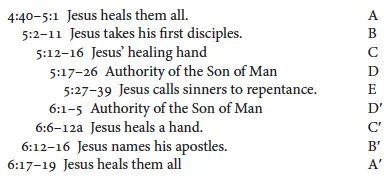
The justifications for dividing the text of Luke in this way make up a significant portion of this chapter, followed by an exposition on what Luke consequently teaches (through Jesus’ words and actions) about following Jesus as his disciples. In the course of our analysis we address Luke’s unique perspective on disciples. Next we document the form. Finally we interpret the form.
Luke’s Unique Perspective
Luke alone among the Gospels presents Jesus as calling disciples after a distinct time of individual ministry. Matthew, Mark, and John all describe Jesus as calling a band of disciples after his baptism and temptation. Matthew and Mark place the call of Simon Peter, Andrew, James, and John just after Jesus’ withdrawal from the Judean wilderness to Galilee (Matt 4:12–22, Mark 1:14–20). John states that Simon Peter and others “came and saw” Jesus while all were still in the vicinity of John the Baptist (John 1:39). Subsequently Jesus calls them, renames Simon, and welcomes them to stay with him (1:29–51). Luke, however, uniquely places the gathering of disciples by Jesus as happening only after a period of unaccompanied ministry.
In Luke, Jesus returns to Galilee from the time of temptation in the Jordan wilderness, news about him spreads, he teaches in synagogues and then in the Nazareth synagogue. Later, in the Capernaum synagogue, he drives out a demon from a man, but leaves there in favor of ministry in Simon’s home, where he heals diseases and casts out more demons until there is reason for Jesus to seek out temporary solitude (Luke 4:14–44).
Luke describes all of this as happening after Jesus’ baptism and temptation in the wilderness, but before Jesus calls any disciples. At first Luke shows Jesus as a people’s prophet, but not as the kind who gathers a band of followers. He seems to be like Elijah and Elisha (4:24–27), although not yet having any followers analogous to the “sons of the prophets.”17 But unlike those prophets he attracts crowds of the curious and the needy. “All” were transfixed by his teaching (4:20), “all spoke well of him and marveled” at his words (22), “all” were “amazed” at his authoritative power (36), people brought “all” the sick and diseased to him for healing and Jesus healed “every one” (40). “The people” want access to Jesus and to his amazing power; they would keep him for themselves (42).
Then Luke tells of Jesus beginning to call out (from 5:2) a band of disciples, some of whom Jesus will eventually, after a period of training, send out to broaden his ministry (9:1–6, 10:1–24). The story of whom he gathered and Luke’s concurrent discourse on how persons become disciples extends through a long portion of text from 4:40 through 6:19, a portion which begins with Jesus having no disciples and ends with having twelve designated apostles (6:12–16) and “a great crowd of . . . disciples” (17), a portion centered on the statement “I have not come to call the righteous but sinners to repentance” (5:32).
Luke’s unique presentation of this period in Jesus’ ministry is made up of concentrically parallel rings of narration. These rings of encounters radiate out from a central teaching section in which Jesus teaches about calling disciples and becoming discipl...
Table of contents
- Title Page
- Preface
- Introduction
- Part 1: The Galilee Narrative
- Part 2: The Journey Narrative
- Conclusion
- Appendix 1: Glossary
- Appendix 2: Jesus’ Journey and Elijah’s Journey
- Bibliography
Trusted by 375,005 students
Access to over 1.5 million titles for a fair monthly price.
Study more efficiently using our study tools.
Frequently asked questions
Yes, you can cancel anytime from the Subscription tab in your account settings on the Perlego website. Your subscription will stay active until the end of your current billing period. Learn how to cancel your subscription
No, books cannot be downloaded as external files, such as PDFs, for use outside of Perlego. However, you can download books within the Perlego app for offline reading on mobile or tablet. Learn how to download books offline
Perlego offers two plans: Essential and Complete
- Essential is ideal for learners and professionals who enjoy exploring a wide range of subjects. Access the Essential Library with 800,000+ trusted titles and best-sellers across business, personal growth, and the humanities. Includes unlimited reading time and Standard Read Aloud voice.
- Complete: Perfect for advanced learners and researchers needing full, unrestricted access. Unlock 1.5M+ books across hundreds of subjects, including academic and specialized titles. The Complete Plan also includes advanced features like Premium Read Aloud and Research Assistant.
We are an online textbook subscription service, where you can get access to an entire online library for less than the price of a single book per month. With over 1.5 million books across 990+ topics, we’ve got you covered! Learn about our mission
Look out for the read-aloud symbol on your next book to see if you can listen to it. The read-aloud tool reads text aloud for you, highlighting the text as it is being read. You can pause it, speed it up and slow it down. Learn more about Read Aloud
Yes! You can use the Perlego app on both iOS and Android devices to read anytime, anywhere — even offline. Perfect for commutes or when you’re on the go.
Please note we cannot support devices running on iOS 13 and Android 7 or earlier. Learn more about using the app
Please note we cannot support devices running on iOS 13 and Android 7 or earlier. Learn more about using the app
Yes, you can access Both Here and There by Dennis Chadwick in PDF and/or ePUB format, as well as other popular books in Theology & Religion & Biblical Criticism & Interpretation. We have over 1.5 million books available in our catalogue for you to explore.