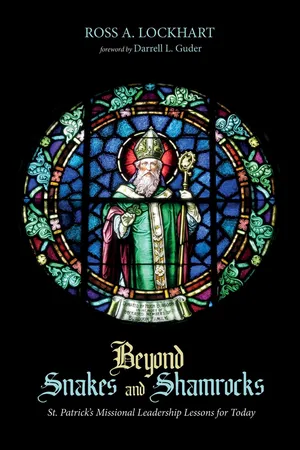
eBook - ePub
Beyond Snakes and Shamrocks
St. Patrick’s Missional Leadership Lessons for Today
- 184 pages
- English
- ePUB (mobile friendly)
- Available on iOS & Android
eBook - ePub
About this book
Somewhere in the mists of time, between history and hagiography, stands the great evangelist and missionary St. Patrick. Raised a "cultural Christian," Patrick's encounter with God during captivity in Ireland transformed his life and the history of a people. Freedom from slavery, and a return home to Britain, produced the divine summons--Vox Hibernia--to return to Ireland and the place of captivity in order to witness to the gospel of Jesus Christ. Christian witness in twenty-first-century Vancouver, Seattle, or Portland is a world away from fifth-century Armagh, Slane, or Cashel. Yet, the great evangelist to pre-Christian peoples of Hibernia has much to teach us as we seek to engage our secular, post-Christian context. There is wisdom in the missional leadership of the one we call St. Patrick that goes well beyond tales of snakes and shamrocks. How might Patrick's mission experience with pre-Christian peoples direct our contemporary missional encounter with post-Christian peoples? Come explore the story of the shepherd slave turned shepherd of souls and discover that there is power still in the legacy of Patrick, when yoked with the Spirit-filled presence and purpose of the risen Christ.
Information
Topic
Theology & ReligionSubtopic
Religious Biographieschapter one
Bannaventa Berniae
Growing Up Christian
It will be people with a passionate conviction of God’s power to transform our present situation who will evangelize today.
—Alan J. Roxburgh, Reaching a New Generation
St. Patrick was born in Roman Britain around 387 AD1 at Bannaventa Berniae,2 a settlement difficult to pinpoint on a map but believed to be somewhere on the west coast of Britain, possibly in Cumbria.3 St. Patrick, or Patricius as he was known then, was a preacher’s kid.4 His grandfather Potitus was a priest and his father Calpornius was a deacon and town councilor.5 There is no evidence, however, that Patrick came from a family of great evangelical conviction and it is far more likely that his Dad took on the role less out of pietistic commitment and more out of practicality, as the position came with great financial advantages.6 Patrick lived a comfortable life. As Jonathan Rogers notes, “He was a good Roman—a Latin-speaking son of Roman wealth and Roman privilege. . . . Patrick’s Roman bona fides were impeccable. His given name was the Latin Patricius, which means ‘highborn,’ and indeed he was.”7 Patrick’s home would have been comfortable: “the principal rooms of the Romano-British villa were colorfully decorated, and the wall-paintings on plaster generally executed in red, olive-green and brown. Sometimes the ceiling was painted too.”8 While Patrick’s family did not belong to the highest order of Roman British society known as “colonia,” their status in the lesser administrative unit of “victus” still granted them considerable privilege above the “pagus” or rural folk.9
Patrick grew up on the edge of empire but in one of the first generations of Christendom—the fifteen hundred-year experiment of privilege for the Christian church in Western culture. The rise of Christianity in 33 AD nearly coincided with the arrival of the Romans in Britain under Emperor Claudius in 43 AD. Christianity spread throughout Britain as a minor sect along with the more dominant Roman pagan cults. The edict of toleration towards Christians in 311 AD by Emperor Galerius (a week before his death) and Constantine’s Edict of Milan in 313 AD removed persecution and moved Christianity from a minority (estimated by some to be as high as 10 percent of the population in the Roman Empire) to a nominal majority by the time of Patrick’s birth. How different Patrick’s experience of the church would have been growing up than someone in Britain 200 years or more before him. By the late fourth Century, the church in Britain appeared in similar form to that of the rest of the Roman Empire. As Darrell Guder describes the early stages of the Christendom experiment:
Building on ancient Roman patterns of provinces and territories, the church divided up its realm into manageable units, presided over by bishops. Their districts or dioceses were in turn divided into parishes, and a church with a steeple and a bell was placed at the center of every parish, often on the main square of the village or town. Everyone lived within hearing range of the bells. The calendar that shaped everyone’s life was dominated by the themes of the Christian tradition. It was the church’s task to ensure that these religious services would always be available to all its members—which was really the entire population.10
Emperor Constantine’s moderate policies for Christianity beginning in 313 AD, and continuing support of the Christian faith by the Roman establishment (with notable moments of reversal and persecution) throughout the rest of the fourth century meant that Patricius was born into a very different world than that of the New Testament Roman Empire. The church in Roman Britain would have appeared similar to the rest of Europe by the time of Patrick’s birth. According to Thomas O’Loughlin, the established church structure of Patrick’s day meant “the density of bishops in other parts of the Empire at the time would equally have applied in Britain and that density meant that every town . . . would have a bishop . . . There may have been a bishop of Bannavem Taburniae,”11 where Patrick grew up. This new, highly structured and state-influenced ecclesiastical world for Christians in the Roman Empire was home for Patricius, including a family that embraced “cultural Christianity” in an era when the world was becoming more unsettled and dangerous.
Indeed, while Christianity was gaining power during this era, other significant events were also shaping the landscape. The Roman Empire was in trouble, as Germanic Visigoths threatened the “Eternal City,” eventually sacking Rome in 410 AD and sending shockwaves through the crumbling empire. As with most institutions in trouble, there was a move to centralize power and protect the core. As a result of this crumbling empire, the Roman navy was called home from the Irish Sea to the Mediterranean Sea. This foreign policy move in Rome, however, would have a direct bearing on the future saint of Ireland. With the Roman navy withdrawn, Saxons, Picts, and Irish sporadically began raiding Roman communities. “Homeland security” took on a new emphasis, as Britons felt threatened in ways they had not experienced since Emperor Claudius arrived ushering in Pax Romana with his war elephants and 40,000 Roman soldiers in Britain in 43 AD. One night, when Patricius was sixteen years old and his parents were in the nearby fortified town, Irish raiders attacked their lightly defended villa complex, hauling off slaves, including the young man history now remembers as St. Patrick, beginning his long exile in a foreign land.
Exile is a familiar term for Christians today in North America. The biblical narrative of the people of Israel hauled off into captivity by King Nebuchadnezzar in 586 BC from Jerusalem has been applied to the state of the Euro-stock church in North America for decades. Thanks to scholars like Walter Brueggemann, we are well acquainted in the church today with the language of exile as a way of describing the church in the West. Mark Labberton recently wrote,
I believe the people of God live in exile. The tantalizing possibilities of getting lost in Promised Land visions live on for many, of course, but others are increasingly realizing it is a mirage. Meanwhile, exile—life as strangers in a strange land—is our context. We have allowed and contributed to a dominant secular culture that has now engulfed us and in which we are ever more fully the minority. We are a declining cultural force against countervailing pressures of spiritual decline. The church of Christendom is fading and flailing.12
This fading and flailing means that the church now in exile is recognizing that it is no longer a social or political power-broker but instead has been “chased away from its place of privilege and is now seeking to find where it belongs amid the ever-changing dynamics of contemporary culture.”13
Nowhere is the end of Christendom and life in exile clearer in North America than here in Cascadia. The kind of leadership now required for missionary disciples is more like the courage and vision of Daniel in the lion’s den or the fiery furnace faith of Meshach, Shadrach, and Abednego (or as my real estate agent friend calls them—my shack, your shack and a bungalow). For some of our aging saints in the pews, their lifetime of discipleship has witnessed the church in North American society (as they know it) bundled up and hauled off to a foreign land of despair. This is particularly true for those of us who come from what we might call the “formerly mainline” denominations.
For many, it is forcing us to take a long, hard look at what we’ve known to be our experience of church and what it means to be disciples of the risen Christ. Missiologist David Fitch suggests that this season of our discipleship in the West is an invitation to rediscover God’s faithful presence in the exile-like ruins of Christendom. Today, we are called to witness to the presence of the Triune God in our everyday, ordinary...
Table of contents
- Title Page
- Foreword
- Preface
- Acknowledgements
- Introduction
- Chapter 1: Bannaventa Berniae
- Chapter 2: Slemish
- Chapter 3: Uillula
- Chapter 4: Auxerre
- Chapter 5: Saul
- Chapter 6: Slane
- Chapter 7: Cashel
- Chapter 8: Armagh
- Chapter 9: Monasterboice
- Chapter 10: Ail
- Chapter 11: Croagh Patrick
- Chapter 12: Downpatrick
- Discussion Questions
- Further Reading
Trusted by 375,005 students
Access to over 1.5 million titles for a fair monthly price.
Study more efficiently using our study tools.
Frequently asked questions
Yes, you can cancel anytime from the Subscription tab in your account settings on the Perlego website. Your subscription will stay active until the end of your current billing period. Learn how to cancel your subscription
No, books cannot be downloaded as external files, such as PDFs, for use outside of Perlego. However, you can download books within the Perlego app for offline reading on mobile or tablet. Learn how to download books offline
Perlego offers two plans: Essential and Complete
- Essential is ideal for learners and professionals who enjoy exploring a wide range of subjects. Access the Essential Library with 800,000+ trusted titles and best-sellers across business, personal growth, and the humanities. Includes unlimited reading time and Standard Read Aloud voice.
- Complete: Perfect for advanced learners and researchers needing full, unrestricted access. Unlock 1.5M+ books across hundreds of subjects, including academic and specialized titles. The Complete Plan also includes advanced features like Premium Read Aloud and Research Assistant.
We are an online textbook subscription service, where you can get access to an entire online library for less than the price of a single book per month. With over 1.5 million books across 990+ topics, we’ve got you covered! Learn about our mission
Look out for the read-aloud symbol on your next book to see if you can listen to it. The read-aloud tool reads text aloud for you, highlighting the text as it is being read. You can pause it, speed it up and slow it down. Learn more about Read Aloud
Yes! You can use the Perlego app on both iOS and Android devices to read anytime, anywhere — even offline. Perfect for commutes or when you’re on the go.
Please note we cannot support devices running on iOS 13 and Android 7 or earlier. Learn more about using the app
Please note we cannot support devices running on iOS 13 and Android 7 or earlier. Learn more about using the app
Yes, you can access Beyond Snakes and Shamrocks by Ross A. Lockhart in PDF and/or ePUB format, as well as other popular books in Theology & Religion & Religious Biographies. We have over 1.5 million books available in our catalogue for you to explore.