- 198 pages
- English
- ePUB (mobile friendly)
- Available on iOS & Android
eBook - ePub
About this book
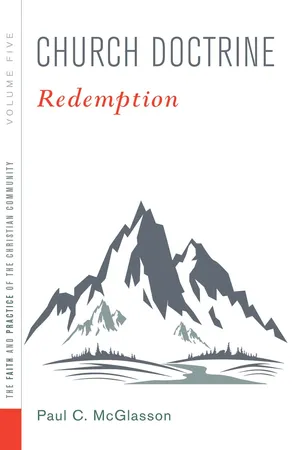
The present volume is the fifth in a five-volume study of church doctrine. The multivolume set covers the major parts of church doctrine: Canon, God, Creation, Reconciliation, and Redemption. The first volume begins with an introduction to the entire project on why doctrine matters, which stresses the ecumenical, global, and above all biblical horizons of church doctrine as a primary expression of Christian witness.
The purpose of this fifth volume is to explicate the full reality of God's redeeming love for the whole creation. In the doctrine of redemption, the church looks forward in hope. Through the gift of the Spirit at Pentecost the church is gathered out of all nations and peoples of the earth, and looks forward to the coming day of final redemption for the whole cosmos. Yet even now, the promise of God's coming is active in the world, rendering the church into a new humanity, establishing a new society, calling every individual to a new life of joy in discipleship.
Church doctrine is not a luxury, but a necessity for the living community of faith, by which its witness in word and deed is tested against the one true measure of Christ the risen Lord.
Information
Topic
Theology & ReligionSubtopic
Christian Theology1
The Gift of the Spirit
In 1537—during the transition from Easter to Pentecost in fact—Martin Luther preached a series of sermons on John 14 to 16, the so-called Farewell Addresses of Jesus to his disciples. In these chapters, according to Luther, Christ himself gives what amounts to a “sermon on the Holy Spirit.”1 The sermon of Christ contains, as it were, three points, spread across these three chapters in the Gospel of John.
First of all, the Spirit gives comfort. Without the Spirit, there is the smug self-righteousness of the world. By sharp contrast, those who struggle before God “will be wretched and subject to despair because of the world and of themselves, unless they are especially preserved by strong and divine comfort from heaven.”2 The Holy Spirit is not a Spirit of anger and fear, but always brings grace and sheer consolation. Indeed, the Spirit is more powerful than one’s own unique feelings of anxiety and self-accusation. When God’s Word of free grace, and one’s own experience of one’s self, come into conflict, the Christian is called to believe in God’s gracious Word, not in the dictates of experience. And it is the Spirit alone who works this power in the human person: “He is the one who can fill a saddened heart with laughter and joy toward God, bids you to be of good cheer because of the forgiveness of sins, slays death, opens heaven, and makes God smile upon you.”3 Indeed, according to Luther, the Spirit is the comforter, in this way, of “all the weak, not only for us but for everyone in the whole world.”4 Thus, the scope of the Spirit’s work of comfort is focused on the church, but certainly not limited to it.
Second, the Spirit is “also a Spirit of Truth.”5 He is reliable; he will not deceive or fail. Because of this dimension of the Spirit’s work it is the mark of the Christian to live with boldness, intrepid before the threats of the world. Luther makes clear that he does not mean—that Christ in his sermon does not mean—a kind of foolhardy defiance, a “daredevil display” that has nothing to do with Christian confidence inspired by the Spirit.6 Such fearless defiance is in fact the worst kind of reliance on one’s own strength. Christ gives us the courage of truth, which is to put one’s confidence in those things that are genuinely reliable, things that “do not fail or deceive.”7 Thus, for Luther, truth is defined in reference to the absolute reliability of God in all things; so much so that the Christian can say, in desperate times, “for his sake I will cheerfully suffer what I can. If anyone does not like it, he can lump it!”8 This is the true, genuine defiance of the Holy Spirit, which is based, not only upon human pride or strength, but upon the absolute truth of God. If we must suffer in the truth, there is nothing for it but to “let Christ worry about it,” for he will by his Spirit without fail give us courage to endure.9
And third, the Spirit will renew in the hearts of God’s children the power of the gospel, the word of Jesus Christ. Sadly, the devil is an “excellent theologian”;10 a master at manipulating and distorting the teaching of Scripture to the hurt and terror of the sinner. The Spirit preaches Jesus Christ in the very heart, so that the Word of Christ is not only heard, but with the result that “you need no longer have any doubt regarding the truth of this or that article pertaining to your salvation.”11 Every Christian will become a doctor and master in matters of faith, simply because the Spirit alone is the Teacher of the church. Where there is uncertainty, where the church is set against itself in schism and despair, the Spirit speaks: “This is the truth; that is fabrication, no matter how long it is adorned with the name of the church and of Christ . . . .”12 Indeed, the crucial role of the Spirit in deciding the Truth in sovereign authority over the church is “the Holy Spirit’s own specific office; by means of it one must discern all other doctrine.”13 So, Luther, in his own sermons, on the Sermon of Christ concerning the Holy Spirit in John’s gospel.
Comfort, confidence, certainty; these are signs of the Spirit’s work in the community of faith. Without the presence of the Spirit, there is no church, no faith, no life for the Christian. Through the presence of the Spirit, there is peace without measure, hope without end, love without limit. We turn now to the church doctrine of the gift of the Spirit. The grammar is intentionally ambiguous. The Spirit is God himself present as gift to the church, and to the individual Christian. Likewise, the Spirit evokes a new creation as gift in the life of the community, and in the individual Christian life. The Spirit is the Giver and the Gift, and we now consider both dimensions of the Spirit’s work.
a. Creator Spirit
A brief survey of the church’s reflection upon the gift of the Spirit reveals slow growth, flashes of enormous insight, inexorable decline in understanding, profound misunderstanding, and badly missed opportunities along the way. As always, any notion of “steady progress” in the teaching of the church is betrayed by the periodic crises which both afflict and stimulate theological reflection, in this doctrine as in others.14
Much of the theological labor of the early church regarding the Holy Spirit was given to the task of simply asserting, once and for all, the deity of the Spirit, within the full matrix of the emerging doctrine of the Trinity. From Origen through Cyril of Jerusalem, and finally reaching full expression in Athanasius, the fully divine reality of the Spirit—coequal with the Father and the Son—is demonstrated from the witness of Scripture. The pinnacle of this trajectory of early church reflection is only finally reached in a sermon preached in 380 by Gregory of Nazianzus, the so-called Fifth Theological Oration. Gregory not only summarizes the issues which preceded his work, and many other theological positions that were still alive in his day, he uses the confusing picture presented to ordinary Christians to illuminate and clarify the content of the biblical witness in a brilliantly persuasive way, with influence far into the future. Some in Gregory’s day are still speaking of the Spirit as an impersonal force, still others as one of God’s exalted creatures, still others withholding any designation at all on the grounds that Scripture itself is ambiguous. Gregory will have none of it.
It is not enough, according to Gregory, merely to take a lexical approach; that it, merely to count up and catalogue the number of times “Spirit” is used in the Bible. In that kind of biblicism they fight for the letter, all the while failing to understand that it is the letter itself which is pointing to the eternal Spirit: “We will get us up into a high mountain, and will shout, if we be not heard, below; we will exalt the Spirit; we will not be afraid; or if we are afraid, it shall be of keeping silence, not of proclaiming.”15 Claims to confusion about the status of the Spirit in Scripture are swept away by the inner logic of the subject matter of the Bible itself. Either the Spirit is a creature, or the Spirit is God. If he is God, then any “confusion” on this point is mere subterfuge: “But if he is God, then he is neither a creature, nor a thing made, nor a fellow servant, nor any of these lowly appellations.”16 The Spirit is in fact God; Gregory forever closes the door on obscurantist biblicism. The Godhead is one; the Persons are three; we worship in glory three in one, one in three. Once again, Gregory is not bothered by the lack of an explicit vocabulary for the Deity of the Spirit in Scripture: “Over and over again you turn upon us the silence of Scripture. But that it is not a strange doctrine, nor an afterthought, but acknowledged and plainly set forth both by the ancients and many of our own day, is already demonstrated by many persons who have treated of this subject, and who have handled the Holy Scriptures, not with indifference or as a mere pastime, but have gone beneath the letter and looked into the inner meaning, and have been deemed worthy to see the hidden beauty, and have been irradiated by the light of knowledge.”17 Thus, for Gregory, it is in the light of the Spirit that we come to know the Spirit through the witness of Scripture. The Spirit alone guides us from syllables of the text—easily manipulated and misunderstood apart from the theological framework of Scripture—to the reality itself. Finally, it is not enough, according to Gregory, simply to affirm the Deity of the Spirit, without at the same time recognizing the power of his presence, which transforms everything: “And indeed from the Spirit comes our new birth, and from the new birth our new creation, and from the new creation our deeper knowledge of the dignity of Him from whom it is derived.”18 The Spirit is our guide in this world, indeed our “genuine comrade and companion.”19
If it was given to the early church, in the fullness of time, to insist upon the full divinity of the Holy Spirit in the context of the church doctrine of the Trinity, it would be given to the protestant Reformers to reflect with rigor and creative imagination upon the work of the Spirit in the church and the world. Nearly every major and minor Reformer; nearly every Reformation catechism and confession; nearly every biblical commentary, liturgical design, hymn, and prayer, aimed in some sense to give full measure to the creative power of the divine Spirit. While the period of the Reformation is usually associated with the rediscovery of the gospel of justification found in the Bible, and indeed with the reawakening of a new openness to the Bible itself—to the themes of justification and sanctification, and their complex interrelation, and to the sovereign reality of divine grace—a case can surely be made that fresh attention to the church doctrine of the Holy Spirit belongs among the prime achievements of the Reformation era. Nor am I referring to the so-called “radical Reformation,” which in the eyes of such figures as Luther and Calvin drastically undercut the full force of the new discovery of the gospel, and indeed threatened the genuinely radical quality of the Reformation itself. Rather, at the heart of the mainstream Reformation witness the attention given to the gift ...
Table of contents
- Title Page
- Preface
- Abbreviations
- Introduction
- Part V: Redemption
- Chapter 1: The Gift of the Spirit
- Chapter 2: The Kingdom of God
- Chapter 3: The Church
- Chapter 4: The New Society
- Chapter 5: The Return of Christ
- Chapter 6: The Joy of Discipleship
- Bibliography
Trusted by 375,005 students
Access to over 1.5 million titles for a fair monthly price.
Study more efficiently using our study tools.
Frequently asked questions
Yes, you can cancel anytime from the Subscription tab in your account settings on the Perlego website. Your subscription will stay active until the end of your current billing period. Learn how to cancel your subscription
No, books cannot be downloaded as external files, such as PDFs, for use outside of Perlego. However, you can download books within the Perlego app for offline reading on mobile or tablet. Learn how to download books offline
Perlego offers two plans: Essential and Complete
- Essential is ideal for learners and professionals who enjoy exploring a wide range of subjects. Access the Essential Library with 800,000+ trusted titles and best-sellers across business, personal growth, and the humanities. Includes unlimited reading time and Standard Read Aloud voice.
- Complete: Perfect for advanced learners and researchers needing full, unrestricted access. Unlock 1.5M+ books across hundreds of subjects, including academic and specialized titles. The Complete Plan also includes advanced features like Premium Read Aloud and Research Assistant.
We are an online textbook subscription service, where you can get access to an entire online library for less than the price of a single book per month. With over 1.5 million books across 990+ topics, we’ve got you covered! Learn about our mission
Look out for the read-aloud symbol on your next book to see if you can listen to it. The read-aloud tool reads text aloud for you, highlighting the text as it is being read. You can pause it, speed it up and slow it down. Learn more about Read Aloud
Yes! You can use the Perlego app on both iOS and Android devices to read anytime, anywhere — even offline. Perfect for commutes or when you’re on the go.
Please note we cannot support devices running on iOS 13 and Android 7 or earlier. Learn more about using the app
Please note we cannot support devices running on iOS 13 and Android 7 or earlier. Learn more about using the app
Yes, you can access Church Doctrine, Volume 5 by Paul C. McGlasson in PDF and/or ePUB format, as well as other popular books in Theology & Religion & Christian Theology. We have over 1.5 million books available in our catalogue for you to explore.