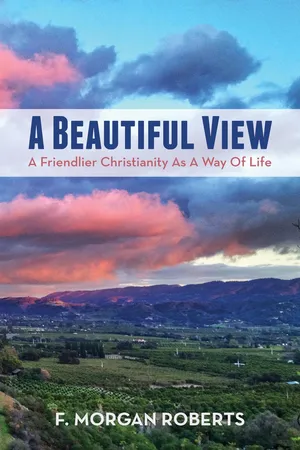
- 108 pages
- English
- ePUB (mobile friendly)
- Available on iOS & Android
eBook - ePub
About this book
"God will never be mad at you!" Although the Bible assures us that God's essential nature is love, how seldom one hears such encouraging words in church. Maybe you are one of the many people who have dropped out of the church because of its prevalent portrayal of God as an unfriendly old man who is always angry with those who don't shape up and, worse yet, plans to punish those who don't believe and behave correctly with eternal conscious torment. If you've ever wondered whether the Bible supports such an irritated image of God, this book is for you. Looking closely at major beliefs and key passages of Scripture, author Morgan Roberts introduces us to a friendlier God, a God who is incapable of anything other than love, a God who will never give up on anyone--a God who even loves our enemies! Such a beautiful view of God is the result of the author's lifetime journey as a pastor and teacher, a journey that began when, as a teenager, he happened to find a copy of the New Testament and began reading about a God who is endlessly, foolishly, and incredibly merciful.
Information
Topic
Theology & ReligionSubtopic
Christian TheologyChapter 1
The Goal
A Friendlier Faith
I hope that my book will help us to rewire our hearts and minds with a friendlier, Christlike faith. It’s hard to argue with such a goal. Even members of other faiths (or no faith) who have no intention of embracing Christianity wish that Christians, in both belief and behavior, were more authentically like the Jesus who is often portrayed, even in some popular songs, as the friend of little children. Jesus is not the problem; the problem is with the people who profess to be his followers. One of my former associate pastors who died of AIDS had a favorite bumper sticker that expressed what he had to endure from many “true-believer” Christians during his long illness. It said, “God, please save me from your followers.”
It is because of such unfriendly versions of our faith that I am struggling to express what it might be like if we could develop a kindlier Christianity. For that matter, I think my book is about a more contemplative and beautiful view of life, one lived on a higher plateau where, moment by moment, we live breathing what someone once called, “the keen bracing air of those silent mountains where God is known.”
To begin at the beginning, let’s look at the friendly faith of Jesus as it was displayed in the first sermon he delivered in his hometown synagogue in Nazareth (Luke 4:16–19). His Scripture lesson was from Isaiah, but listen to what he read: “The Spirit of the Lord is upon me, because he has anointed me to bring good news to the poor. He has sent me to proclaim release to the captives and recovery of sight to the blind, to let the oppressed go free, to proclaim the year of the Lord’s favor.” That’s where the Scripture reading ended, where he rolled up the scroll and began to preach. But wait, there’s something missing because, when we check our Bibles, we find that he had omitted Isaiah’s last words which read, “and the day of vengeance of our God” (Isa 61:2). Jesus hadn’t come to talk about a vengeful God, and felt free to edit and reinterpret Holy Scripture! If we continue to follow Jesus’ teaching, it becomes apparent that he felt free to read Scripture critically in terms of his own vision of God as a friendly father. Jesus consistently ignored large portions of Hebrew Scripture in which God is depicted as an angry, violent, and unfriendly tyrant. So much for the notion that all Scripture is equally “authoritative Scripture”! It certainly wasn’t that for Jesus.
Moving on from Jesus into what we learn about the faith of the earliest Christians, we see the same radical faith in a God who upended the unfriendly power of the Roman Empire. Notice what we see. Because Jesus had been raised from the dead, everything had changed. The resurrection was the undeniable sign that God was now in charge. Caesar was no longer king of kings, and the followers of Jesus were now citizens of another kingdom, the kingdom of God, and their allegiance was to King Jesus. The agenda of the early church was to bring the friendly rule of God to earth. Their basic prayer expressed that agenda: “Thy kingdom come, thy will be done on earth.” Early Christianity was involved, not in escaping hell and getting into heaven, but in bringing God’s heavenly rule down to earth, especially for the multitudes for whom life on earth was hellish. If you don’t get this main point, you’ve missed the whole point!
All of the ancient, cruel distinctions were gone. As Paul wrote, “There is no longer Jew or Greek, there is no longer slave and free, there is no longer male and female; for all of you are one in Christ Jesus” (Gal 3:28). Or in another letter, “There is no longer Greek and Jew, circumcised and uncircumcised, barbarian, Scythian, slave and free, but Christ is all and in all!” (Col 3:11). This was the end of harsh dualistic and divisive thinking about our life, the end of saved/lost, good guy/bad guy thinking.
Early Christianity was a cheerful, joyful, friendly faith, a stark contrast to the world of Roman oppression in which it was born, a world characterized by slavery, poverty, cruelty, and debauchery. In the midst of such darkness, early Christians believed not only that God had come to earth in Jesus to live with us humans, but also that God in Christ was living in all of us. When John wrote that “the Word became flesh” (John 1:14), he meant all flesh. Their Christ was a cosmic, universal Christ. When God took on human flesh in the life of Jesus, God was showing us what had always been true from the beginning: that we are all (and have always been) the children of God. We bear the image of God. Our physical bodies are God’s sanctuary, temples of the Holy Spirit.
It was an entirely different and inclusive worldview. Paul said, “From now on, therefore, we regard no one from a human point of view” because “God was in Christ, reconciling the world to himself” (2 Cor 5:26–19). Just listen to the preaching of Peter and Paul in Acts. Peter goes to the home of a Roman centurion and begins his sermon by saying, “I truly understand that God shows no partiality, but in every nation anyone who fears him and does what is right is acceptable to him. You know the message he sent to the people of Israel, preaching peace by Jesus Christ—he is Lord of all” (Acts 10:34–36). And then Paul preaches to the Athenians and says, “Indeed, he [God] is not far from any of us. For in him we live and move and have our being; as even some of your own poets have said, ‘For we too are his offspring’” (Acts 17:27–28). Their message was that we are all in Christ; God’s incarnation in Christ has made it clear that we are all what we have always been since the dawn of creation, children of God. The apostolic message called all people to be what they already were: precious children of God!
No wonder Rome went after them; their message was treasonous. God, instead of Caesar, was running the show. Every life had dignity in Christ. Slavery as an economic system was being undermined. The Roman way of life was being challenged. The very fact that early Christians were persecuted proves that their agenda was threatening. If the usual heaven/hell agenda had been their message, Rome would never have bothered them. If the message of the early church had been “pie in the sky by and by,” Rome would have been delighted; such a new religion would keep the enslaved multitudes pacified by the future hope of heaven. Obviously, that wasn’t the message of the early church. Instead, the proclamation of the universal kingdom of God and the end of all distinctions was a dangerous gospel and needed to be crushed.
But nothing could crush the friendly, joyful spirit of the early Christians. They believed that we are living in a world made lovely by Christ’s pervading presence. And that is the way of life that I hope to inspire and revive. I hope that you, finally, will arrive at a “beautiful view” of this Christ-haunted, enchanted world in which we’re living. That’s where we’ll be going in the coming chapters.
Chapter 2
Where It All Began
I need to begin by telling you “where I’m coming from” because if it hadn’t begun where and how it did, I wouldn’t be writing this book—or any book—and my life would have been something entirely different from what it turned out to be. I was raised in a neighborhood with a beautiful view; that’s why it was called Bellevue. However, except for the good and simple people who were my neighbors, the view was the only beautiful thing about Bellevue. We lived at the far end of the city, as close to the countryside as you could get without being out of the city. I don’t know who gave Bellevue its name, but suspect that it was because it was located on a plateau from which, if I walked across the street and up the hill, I could enjoy a magnificent view of a historic valley. I’ve never been able to get that vista out of my heart. Harry Truman had to work at remembering where he came from. He once said, “I tried never to forget who I was and where I’d come from.” It hasn’t been that way for me; I’ve never forgotten where I came from. Bellevue has always been in my heart, even though most people would never brag about being from Bellevue.
Despite its fancy name, Bellevue was definitely blue collar. Down the street there was a nice little public park, but up the street it was different. In three short blocks, one came to a German beer-drinking park for the many soccer-loving Germans in our neighborhood. Next to their park was “the big blue house.” It was a brothel; why it was allowed to operate, and how it got there I don’t know. Maybe it was because our neighborhood was on the far west end of the city where, in past years, there had been a harness racing track, which would have drawn the gambling, drinking crowd. Despite the presence of that “house of ill repute,” our neighborhood was a decent place to live. People took good care of their little homes, and children were safe to play on the streets. So, the bordello was an embarrassment for us. Its customers came from other parts of town, or from out of town. Thus, the residents of Bellevue ignored it, and went about their plain way of life, most of them working daily at what was called “the plant.”
Bellevue was located at the edge of a thriving industrial city where, during World War II, materials for the war effort were being manufactured. However, it was the work going on in those factories that got me, as a city boy, out into the country. Because the real country boys on small farms had come to the city to earn bigger money at the factories, those small farms had to accept such help as they could get from boys who lived on the edge of the cities. I was one such teenager who peddled out and back every day on my bicycle to earn an hourly wage of thirty-five cents, pitching hay and doing other farm chores, all of which I enjoyed, especially on this particular farm that was still being worked in the old-fashioned way with horses instead of tractors. Because I had no vocational or college plans, I thought that life in the country on a farm would be something I’d enjoy, even though such a life would hardly ever be possible for me. How could I ever accumulate enough money to buy a farm? It would make more sense for me to stay in the city and work in the same factory where my father, cousins, and uncles would spend most of their lives.
The plant had given them a good life, despite their lack of education. None of my parents, uncles, or aunts had ever been encouraged to finish school. My maternal grandmother was illiterate and couldn’t even sign her name on her wedding license in 1869. My paternal grandparents also were mostly illiterate; my paternal grandfather, in the days before the “horseless carriage,” was a street sweeper. But even with these limitations, both the men and women of this immigrant family from South Wales had been able to find stable employment, in the earliest years in the iron mill in a nearby city, or in the collar shop (where my mother was a buttonhole stitcher). Later on, they all moved to our city, and worked at the plant, where they were enjoying the American dream of home ownership. So, there was a sensible, available future for me. I could enjoy a semi-rural life without working on a farm. In the valley below our neighborhood there were woods in which to roam, plus a stream for fishing and trapping. Having no other goals, that would be my life—or so I was thinking in 1944. But it all began to change one night when I heard Roy Acuff singing a ballad entitled “A Prodigal Son.”
On every Saturday night, at exactly 10:30 pm, I would sit in my attic bedroom and tune in radio station WSM Nashville, via WWVA Wheeling, to hear my favorite program, the Grand Ole Opry. This was the original Opry, before today’s glitzier version from Opryland. It came from the old Ryman Auditorium in Nashville, and featured Roy Acuff and the Smoky Mountain Boys. Back then, such music was not called “country,” but “hillbilly.” My high school friends would have been enjoying 1940s big band music, perhaps at a dance or at some soda fountain on a jukebox. But for some reason, I stayed home on Saturday nights for this broadcast. And on one special night, I heard Roy Acuff singing “A Prodigal Son.” Later I played the 78-rpm recording of that song so many times that I can still sing most of the lyrics from memory. However, remembering those words this many years later, I cannot imagine why I was so captivated by them.
I was not like that prodigal son who had strayed from his family home to a faraway country where, in the words of the King James Version, he had “wasted his substance with riotous living” (Luke 15:18). And I was certainly not, as the song promised, looking for Jesus to descend from the sky to wash all my sins away. My sins were the usual small stuff of a teenager, but not so troublesome as to want them washed away. I was not burdened by any fear of dying, nor had I any interest in going home to heaven as in the longing words of the song, even though several of the older boys from my high school had gone off to war, never to return. I still can’t explain what drew me to that ballad, unless it was a certain sehnsucht, a longing for some kind of homecoming. Most interesting of all, I didn’t know that the song had some connection with a parable of Jesus.
However, some time after hearing that ballad, there was a crucial coincidence. I wasn’t even looking for it, but in those same months in which I was accumulating a large pile of 78-rpm Roy Acuff recordings, I “happened” to find an old leather-bound New Testament in my attic bedroom—or better yet, maybe it found me! This doesn’t sound like an extraordinary find. There must have been a Bible downstairs among my parents’ possessions. They belonged to a church but, like many blue-collar families during the Great Depression, had ceased from being regular churchgoers. Thus, my exposure to church or Sunday school was very limited. During my high school years I was a happy, though unchurched, teenager. But now this discovery became all-important.
This New Testament had belonged to my Aunt Susan, whose signature was on the flyleaf with the date of 1900. W...
Table of contents
- Title Page
- Acknowledgments
- Introduction
- Chapter 1: The Goal
- Chapter 2: Where It All Began
- Chapter 3: We Know How the Story Ends
- Chapter 4: The Good News from the Garden of Eden
- Chapter 5: What Happened on the Cross?
- Chapter 6: The Great Dinner Dance
- Chapter 7: I Like You Just the Way You Are
- Chapter 8: Jesus, the Extraordinary Ordinary
- Chapter 9: What About Evangelism and Being Born Again?
- Chapter 10: The Evidence for the Empty Tomb
- Chapter 11: Home at Last
- Conclusion: A Life of Wordless Prayer
- Ideas for Group Study, Personal Reflection, and Additional Reading
Trusted by 375,005 students
Access to over 1.5 million titles for a fair monthly price.
Study more efficiently using our study tools.
Frequently asked questions
Yes, you can cancel anytime from the Subscription tab in your account settings on the Perlego website. Your subscription will stay active until the end of your current billing period. Learn how to cancel your subscription
No, books cannot be downloaded as external files, such as PDFs, for use outside of Perlego. However, you can download books within the Perlego app for offline reading on mobile or tablet. Learn how to download books offline
Perlego offers two plans: Essential and Complete
- Essential is ideal for learners and professionals who enjoy exploring a wide range of subjects. Access the Essential Library with 800,000+ trusted titles and best-sellers across business, personal growth, and the humanities. Includes unlimited reading time and Standard Read Aloud voice.
- Complete: Perfect for advanced learners and researchers needing full, unrestricted access. Unlock 1.5M+ books across hundreds of subjects, including academic and specialized titles. The Complete Plan also includes advanced features like Premium Read Aloud and Research Assistant.
We are an online textbook subscription service, where you can get access to an entire online library for less than the price of a single book per month. With over 1.5 million books across 990+ topics, we’ve got you covered! Learn about our mission
Look out for the read-aloud symbol on your next book to see if you can listen to it. The read-aloud tool reads text aloud for you, highlighting the text as it is being read. You can pause it, speed it up and slow it down. Learn more about Read Aloud
Yes! You can use the Perlego app on both iOS and Android devices to read anytime, anywhere — even offline. Perfect for commutes or when you’re on the go.
Please note we cannot support devices running on iOS 13 and Android 7 or earlier. Learn more about using the app
Please note we cannot support devices running on iOS 13 and Android 7 or earlier. Learn more about using the app
Yes, you can access A Beautiful View by F. Morgan Roberts in PDF and/or ePUB format, as well as other popular books in Theology & Religion & Christian Theology. We have over 1.5 million books available in our catalogue for you to explore.