eBook - ePub
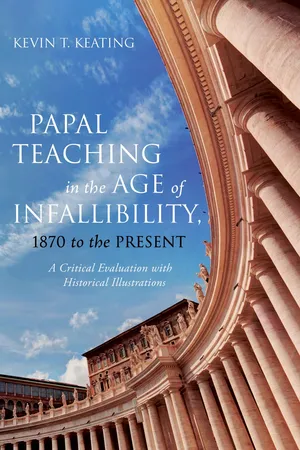
Papal Teaching in the Age of Infallibility, 1870 to the Present
A Critical Evaluation with Historical Illustrations
- 300 pages
- English
- ePUB (mobile friendly)
- Available on iOS & Android
eBook - ePub
Papal Teaching in the Age of Infallibility, 1870 to the Present
A Critical Evaluation with Historical Illustrations
About this book
Kevin Keating examines the major writings of the Roman Pontiffs from Pius IX in the last half of the nineteenth century to the most recent writings of Francis. He explores the shift in papal focus from internal church matters and attacks on modern thought to concern for matters affecting all of humanity--not just spiritually, but socially, politically, and economically as well. Looming over all of these teachings is the specter of the doctrine of infallibility. First defined in 1870 to cover only papal infallibility, it would be expanded in the 1960s to include the exercise of infallibility by the worldwide college of bishops.
Keating discusses the most significant themes dealt with by popes during this period--the Bible, religious freedom, church-state relations, social doctrine, human sexuality, ecumenism, and interreligious dialogue. He describes how papal teaching has changed, developed, and even been contradicted by later popes, although they have failed to expressly acknowledge departures from prior teaching. He details how the doctrine of infallibility, far from serving to bolster the credibility of papal teaching, often has served to undermine it.
Information
Topic
Teologia e religioneSubtopic
Chiesa cristiana1
Vatican I: The Definition and Exercise of the Doctrine of Papal Infallibility
The bishop of the Roman Church . . . is the head of the college of bishops, the Vicar of Christ, and the pastor of the universal Church on earth. By virtue of his office he possesses supreme, full, immediate, and universal ordinary power in the Church, which he is always able to exercise freely.
—Code of Canon Law
Power tends to corrupt, and absolute power corrupts absolutely.
—Lord Acton
The promulgation of the doctrine of papal infallibility by the First Vatican Council on July 18, 1870 could not have come at a less auspicious time. One day later, Prussia declared war on France, thereby inaugurating the Franco-Prussian War. The outbreak of the war led France to withdraw its troops from Rome, where they had been providing the pope with protection against the threat from Italian forces seeking to establish Rome as the capital of a unified Italy. Following the French withdrawal, Italian troops crossed into the Papal States in early September and their attack on Rome began on September 20. On October 20, Pius declared the council adjourned; it was never reconvened.15 It had accomplished its main objective, however, of declaring as a divinely revealed truth a doctrine with little scriptural or historical support. At a time when the pope was being stripped of his temporal powers by the forces of Italian nationalism, his spiritual power was being declared absolute. In fact, it was the definition of the doctrine of papal infallibility which prompted Lord Acton, an English Catholic Member of Parliament who was in Rome at the time of the council, to pen his famous remark: “‘Power tends to corrupt, and absolute power corrupts absolutely.’”16
The Medieval Antecedents of the Doctrine
The history of the doctrine of papal infallibility prior to 1870 is sparse. Its roots can be traced to a late thirteenth-century internal dispute between two groups of Franciscans over the proper interpretation of the Rule of St. Francis. The most astonishing aspect of this dispute is that the concept of papal infallibility initially was proposed as a means of constraining papal power, not of enhancing it.
As a mendicant order founded by Francis of Assisi in the early thirteenth century, the Order of Friars Minor, commonly known as the Franciscans, did not own goods individually or in common, relying instead on the kindness of strangers for their subsistence. Francis’s will provided that his followers could take no action to change his rule for the order to make it less strict.17 To one group of Franciscans—the Conventuals—this is all that the rule required. Another group of Franciscans—the Spirituals—interpreted the rule as requiring the friars to practice “severe frugality” in their daily lives.18 One of the leaders of the Spirituals was Peter Olivi, an eccentric theologian who frequently railed against clergy and bishops who lived a life of luxury, in contrast to the life of poverty that Jesus and his apostles practiced.
The cause of Olivi and the other Spirituals was strengthened when Pope Nicholas III issued the constitution Exiit qui seminat in 1279, siding with the Spirituals’ interpretation of the rule. Nicholas gave the Spirituals even more ammunition in their dispute against the Conventuals by declaring that his interpretation of the rule was to be binding on the Order in perpetuity. “We judge that this Our constitution, declaration, or ordination is to be observed exactly as such and inviolably by the friars themselves for all time.”19
Olivi, however, was not content with this victory. Fearing that a future pope might decline to follow Nicholas’s interpretation of the rule, he developed a doctrine of infallibility which would bind the hands of any future pope. A papal decree on a matter of faith or morals, once pronounced, could not be subject to revision by a future pontiff.20 Under Olivi’s proposed doctrine of papal infallibility, no future pope could overturn the judgment set forth by Nicholas. Unfortunately for Olivi and the Spirituals, future popes would not feel so bound. Twenty-five years after Olivi’s death, John XXII issued the papal bull Quia quorundam. John rejected the Spirituals’ understanding of the practice of Jesus and his apostles in connection with the ownership of personal property. John was not perturbed by the fact that his bull contradicted the earlier pronouncement of Nicholas, since Nicholas’s teaching itself had been contrary to that of his predecessors. John proceeded to declare that those who teach the erroneous views of Olivi “have fallen into condemned heresy, and [are to be treated] as heretics to be avoided.”21 He would not permit Olivi’s notion of papal infallibility to be used as a limitation on the exercise of his papal power. More than five centuries later, an ecumenical council would first proclaim as a dogma of faith a doctrine whose roots lay neither in Scripture nor in the earliest Christian traditions, but rather in a seemingly esoteric thirteenth-century squabble among the followers of St. Francis.
Nineteenth-Century Threats to the Temporal Power of the Pope
The doctrine of papal infallibility lay fallow for several centuries, until it burst forth as...
Table of contents
- Title Page
- Introduction: The Pope as Teacher
- Chapter 1: Vatican I: The Definition and Exercise of the Doctrine of Papal Infallibility
- Chapter 2: Vatican II: The Announcement of the Infallibility of the College of Bishops
- Chapter 3: Opposition: The Church and Modern Thought
- Chapter 4: Sole Authority: The Bible
- Chapter 5: Contradiction: Religious Freedom
- Chapter 6: Ambivalence: Church and State
- Chapter 7: Silence: The Morality of Wars
- Chapter 8: Development and Discontinuity: Catholic Social Doctrine
- Chapter 9: Confusion: The Necessity of the Catholic Church for Salvation
- Chapter 10: Arrogance: Ecumenism and Interreligious Dialogue
- Chapter 11: Constancy: Human Sexuality—Marriage and Divorce, Birth Control, and Homosexuality
- Chapter 12: Certainty: Murder, Abortion, Euthanasia, and the Death Penalty
- Chapter 13: Not an Option: The Priestly Ordination of Women
- Chapter 14: Avoidance: The Problem of Evil and Suffering
- Postscript: Uncertainty: The Boundaries of the Infallibility of the College of Bishops
- Bibliography
Trusted by 375,005 students
Access to over 1.5 million titles for a fair monthly price.
Study more efficiently using our study tools.
Frequently asked questions
Yes, you can cancel anytime from the Subscription tab in your account settings on the Perlego website. Your subscription will stay active until the end of your current billing period. Learn how to cancel your subscription
No, books cannot be downloaded as external files, such as PDFs, for use outside of Perlego. However, you can download books within the Perlego app for offline reading on mobile or tablet. Learn how to download books offline
Perlego offers two plans: Essential and Complete
- Essential is ideal for learners and professionals who enjoy exploring a wide range of subjects. Access the Essential Library with 800,000+ trusted titles and best-sellers across business, personal growth, and the humanities. Includes unlimited reading time and Standard Read Aloud voice.
- Complete: Perfect for advanced learners and researchers needing full, unrestricted access. Unlock 1.5M+ books across hundreds of subjects, including academic and specialized titles. The Complete Plan also includes advanced features like Premium Read Aloud and Research Assistant.
We are an online textbook subscription service, where you can get access to an entire online library for less than the price of a single book per month. With over 1.5 million books across 990+ topics, we’ve got you covered! Learn about our mission
Look out for the read-aloud symbol on your next book to see if you can listen to it. The read-aloud tool reads text aloud for you, highlighting the text as it is being read. You can pause it, speed it up and slow it down. Learn more about Read Aloud
Yes! You can use the Perlego app on both iOS and Android devices to read anytime, anywhere — even offline. Perfect for commutes or when you’re on the go.
Please note we cannot support devices running on iOS 13 and Android 7 or earlier. Learn more about using the app
Please note we cannot support devices running on iOS 13 and Android 7 or earlier. Learn more about using the app
Yes, you can access Papal Teaching in the Age of Infallibility, 1870 to the Present by Kevin T. Keating in PDF and/or ePUB format, as well as other popular books in Teologia e religione & Chiesa cristiana. We have over 1.5 million books available in our catalogue for you to explore.