- 156 pages
- English
- ePUB (mobile friendly)
- Available on iOS & Android
eBook - ePub
About this book
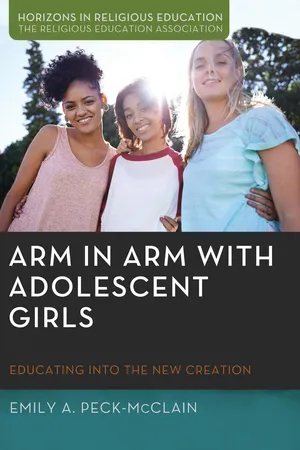
Adolescent girls are filled with passion, excitement, joy, critique, wit, and energy, even as they face and overcome a wide variety of difficult challenges. Some challenges are spirit- and even life-threatening. The stories of more than twenty adolescent girls are put into dialogue with the Apostle Paul, especially in Rom 6-8. Through that perhaps unlikely pairing, those who love and work with adolescent girls will find a depth of understanding and a call to action. Christian educators, pastors, youth workers, parents, and adolescent girls will find a new way to look at the world around them and a new way to bring Scripture to bear on real-life experience. By offering this powerful, scripturally-grounded approach to the world around us, adolescent girls and others will learn compelling methods for putting a new perspective into action in their personal lives, social circles, and churches. This thoughtful and respectful look at the lives of adolescent girls seeks to equip faithful Christians in the church to use their prophetic voices to call out the sins of racism, sexism, homophobia, and sizeism in the experiences of these strong and resilient girls.
Information
Topic
Theology & ReligionSubtopic
Education Generalchapter 1
This Body of Mine
I spent the summer of 2013 driving and taking public transportation all around the New York Annual Conference of the United Methodist Church. This geographic area spans New York City, Long Island, Western Connecticut, and New York’s Hudson Valley (on both side of the river) almost as far north as Albany. My time was divided into two-hour interviews with twenty-four adolescent girls ages 12–19. Each conversation I had was a gift. I learned so much about the individuals, their communities, and their experiences. I welcomed their anger, confusion, hope, and passion. I found myself in awe of their wisdom and honesty, and about how much they care about their churches, families, friends, and the world. Sometimes I spent those conversations thinking about how I could hear my own experiences as a teenager echo in their words. Sometimes I felt like I could not have had a more different adolescent experience. Each time I felt I was on holy ground in those church basements, youth rooms, coffee shops, cafés, and apartments.
The racial makeup of the group is fairly diverse. I asked the girls to share with me how they describe their race; here are their self-reported answers: Eleven girls are white; four girls are African American; two girls are Asian American; three girls are Latina American (one of whom mentioned she is the first in her family born in the United States); three girls are Caribbean American (one of whom mentioned that she immigrated to this country when very young); one girl is half Latina and half Spanish. Two of the three Caribbean American girls also self-identify as Black.
Of all these young women, I have chosen to spend significant time focusing on Sam, Sadie, Tay, Brooke, Raven, and Genevieve. Although any of the girls would have fit as focus points for this project, these six girls were diverse in their theological commitments and life experiences, thus forming an interesting sample on whom to focus. About half of the interviews were conducted one-on-one, the other half were conducted in groups. This sample group of six accurately reflects that split: three were interviewed in a group, three were one-on-one. Although these girls are not meant to be representative of all adolescent girls or even all adolescent girls in the New York Annual Conference of the United Methodist Church, they do illustrate clearly some of the common challenges adolescent girls are facing now. Their stories show opportunities for how the ideas of Pauline theology can enrich the lives of girls of different backgrounds and social and theological locations. Sam is Asian American, Brooke is Latina American and Spanish American, Raven is Caribbean American, Genevieve, Tay, and Sadie are white. These girls are from varying socio-economic backgrounds, ranging from lower middle to upper middle class.
Sam and Sadie both attend the same church. They have been attending their church for as long as they can remember and are friends outside of their involvement in church activities, although they attend different high schools. They both live near their church. Sam is 17 years old and a junior in high school. Sadie is 15 years old and a freshman in high school. I knew both of these girls prior to the interview.
When asked about her ethnicity, Sam describes herself as Asian and as “a banana.” When asked to share more about what that means to her, she says, “yellow on the outside, white on the inside. I don’t know, I don’t really see myself as Asian, though. I don’t see myself as anything else . . . I am Asian. I do like my skin color.” Sam was adopted from her birth country by two white American parents. She lives in a predominantly white neighborhood. She attends a school with a diversity of races and cultures and where her group of friends is not white. Sam lives with her mother, father, and younger sister, who was also adopted from an Asian country. When asked about her sexuality, Sam responded that she is gay, something she has known about herself “ever since I was little.” She came out to her parents in eighth grade. She describes this process as going “fine.” Her mother works for a computer company in another state, but works mostly from home. Her father is a stay-at-home dad.
Sadie lives with her father, mother, and younger brother. When asked about her ethnicity, Sadie responded, “I’m white. I know . . . it doesn’t sound good to say I wish I wasn’t white, ‘cause that shows a lack of understanding. Because it’s a lot easier to be white. And that’s why I wish I wasn’t white.” Like Sam, most people in Sadie’s neighborhood are white, but most people in her high school are not. When asked about her sexuality, she responded, “Oof, I wish I knew . . . It bothered me so much that I couldn’t, like I couldn’t tell if I was gay or if I was straight, and then so I was like I’m bisexual, because that’s both. And then I decided that, like, I’m neither . . . But then my brother, like, he’s always saying like, ‘Sadie’s gay,’ but that bugs me because I’m not gay. I don’t literally like boys, but I don’t feel gay.” Her parents are both professionals, working for nonprofits.
Brooke describes herself as 50% Spanish and 50% Latina. Her parents are deceased and she lives with her aunt and uncle, both of whom are retired. She moved in with them once her mother passed away when she was 11. Her mother passed away from complications from surgery for a condition from which she herself also suffers. A year ago, she underwent the same surgery that resulted in her mother’s death. She is 16 years old. She also has an older half-brother, with whom she has not lived since their father died when she was 3. She describes her sexuality as “straight.” She and her mother tried attending churches when she was younger but they never found one that they liked. She began attending her local United Methodist church when she moved in with her aunt and uncle because it was the church that they attended.
Genevieve is a member of the same church as Brooke. The two of them were part of a group interview, along with three other girls from their church. She went through Confirmation Class with Brooke and both of them joined the church after that class ended. Genevieve is 17 years old and in her junior year in high school. She lives with her father, mother, and two brothers. Her mother has a part time job, which Genevieve could not specify. Her father works for a manufacturing company. She describes her ethnicity as “white” and her sexuality as “straight.” She was brought up in her local United Methodist Church and says that she always attended and went to Sunday school. She has lived in her town for her whole life.
Raven is 18 years old. Our interview took place during summer vacation after she had just graduated from high school and was preparing to attend a state university in the fall. Her interview was also a group interview, along with three other girls from her church. She moved to the United States from the Caribbean country in which she was born 13 years ago with her mother. Her father and his family remain in that country. She has strong ties to that country, its culture, and its food. She has been attending her local United Methodist Church since she came to the United States. Her mother works as a financial representative for a hospital. It is clear that she and her mother struggle some financially. She states that her mother “believed in the whole ‘American dream’ you could find a better life living here . . . Which is completely a lie.” She describes her sexuality as “straight.”
Tay is 17 years old and also just completed her senior year in high school. She plans to attend community college for two years and then transfer to a design school where she wants to major in photography. Her parents both work at different stores. Her father is a salesman and her mother works as a receptionist with some responsibilities for bookkeeping. She was looking for a job at the time of our meeting so that she could buy a car in order to get to her classes at college in the fall while living at home with her parents. Tay has had a difficult relationship with church. Her church has gone through several different pastors in her time involved there. One of her previous pastors, who was there during Tay’s confirmation, was known to be ineffective in ministry. Tay described how this situation caused her father to stop being involved in the church until their current pastor was appointed about a year ago. Tay herself also has some difficulties with the attitudes of some of the members of her local church whom she calls judgmental. She has been active in a denominational Christian formation program that involves retreat weekends and small groups. This is where she finds the most support for herself and her faith. When talking about her ethnicity, she refers to the many European countries from which her family ancestry originates. She describes her sexuality as “bisexual,” something that she has only recently come to terms with and has not shared with her parents.
Of the many topics we covered in these interviews, a few stand out as the ones around which the girls were most energized. As I present the stories of Sam, Sadie, Brooke, Genevieve, Raven, and Tay, along with several other girls, I do so around these topics. Whether asked explicitly about them or asked seemingly unrelated questions, girls’ experiences seemed often to stimulate mention of these topics. The qualities of resilience, critical thinking, engagement, and willingness to tell truth all come through in conversations surrounding these especially important topics. These separate but connected topics contribute to the picture of what life is like for these adolescent girls. Their own words about these topics most important to them demonstrate their emerging sense of identity, their critical thinking skills, their faith formation, and their general perspectives on the world.
These parts of our conversations show what these girls are struggling with and how they think through the problems with which they are faced. Also clear in these conversations is that girls are ready to share their wisdom and experiences openly when asked and when their answers are taken seriously. They have so much to offer the church, they are as much as part of the church as any other mem. Practical theologian Joyce Mercer in her book Girl Talk/God Talk concluded that girls do not separate out faith from other subjects when they share their stories.4 I found the same to be true in my conversations with these girls. Their faith is woven seamlessly into their conversations about school, home, friends, and current events. I can see, however, that for some adults, this integrated faith might seem surprising. Adults often excuse faith from some of the messiness of life. Adolescent girls welcome their faith to unexpected places. So although these topics are all topics of faith for them, I have divided the topics into two groups for the purposes of discussion. The first set of topics, covered in this chapter, are the topics having to do with being an embodied human being. More specifically, these topics are “Clothing the Body,” “Racism,” and “Sexism.” Because they are Christian, the challenge of understanding and appreciating themselves as embodied includes how to think about their bodies in the context of their faith, even as some of them critique the way faith is lived out in their churches in regards to bodies.
Clothing the Body
The girls I interviewed often voiced complex emotions about their bodies, which are changing and beautiful and complicated. Many girls talked about their bodies with grief or disappointment. Many talked about their bodies with defensiveness or confusion. Some talked about their bodies with appreciation or even awe. Nearly all of them told about experiences with comments and looks they have received in response to their bodies and clothing. These responses come from peers and from adults, sometimes in church settings and sometimes in school or social settings. Girls’ perspectives on and experiences through their bodies were connected to their understanding of their faith.
I found these girls often concerned with their appearances. They talked a lot, whether prompted by a question or not, about clothes, body image, and how their appearance is received by others. They were well aware and critical of what lies beneath the surface of their appearances and others’ responses to their appearances. Through these conversations, I heard sharp critiques of consumerism, the fashion industry, pressure to have a certain body type, generational differences, sexism, racism, and other assumptions made about them based on appearance. I also heard their desire to be attractive. Girls are not thinking surface level when it comes to their appearances. Neither did these conversations stem from self-absorption, as is often assumed from topics like this.5
Adolescent girls experience their lives as embodied. They do not see their bodies as separate from their emerging identities, but rather integral to it. Social historian Joan Brumberg writes that for contemporary adolescent girls, the body is the site of expression of the self, “[t]he body is a consuming project because it proves an important means of self-definition, a way to visibly announce who you are to the world.”6 Womanist theologian M. Shawn Copeland explains the value of the body to one’s experience as a Christian, stating that “the body is the site and mediation of divine revelation.”7 The body, then, is an essential way to express oneself, to be in the world, and to experience and understand the Holy. This is no less true for adolescent girls than it is for adult men and women. For the girls I interviewed, their bodies are an important way they experience their lives and a lens through which they seek to understand their faith and their faith communities.
They learn a lot about their bodies from the media, of course, but also from their churches. Connecting the body and soul together in a positive way is unusual in Western Christianity, which tends to negate the body or to view it as inherently problematic or even dangerous to a person’s spiritual life. This view of particularly the female body as problematic or dangerous is shared by American culture as well.
I met with Sadie in the youth room at her church. She appeared confident and energetic. She was eating some granola and yogurt and was immediately chatty. When I asked Sadie what makes her faith journey more difficult, her answer was quite succinct, “I would say myself...
Table of contents
- Title Page
- Series Foreword
- Preface
- Acknowledgments
- Introduction
- Chapter 1: This Body of Mine
- Chapter 2: Waiting and Hoping for the New Creation
- Chapter 3: Pauline Theology for Adolescent Girls
- Chapter 4: Confronting the Powers in Community
- Chapter 5: An Epistle to Adolescent Girls and Their Churches
- Appendix
- Bibliography
Trusted by 375,005 students
Access to over 1.5 million titles for a fair monthly price.
Study more efficiently using our study tools.
Frequently asked questions
Yes, you can cancel anytime from the Subscription tab in your account settings on the Perlego website. Your subscription will stay active until the end of your current billing period. Learn how to cancel your subscription
No, books cannot be downloaded as external files, such as PDFs, for use outside of Perlego. However, you can download books within the Perlego app for offline reading on mobile or tablet. Learn how to download books offline
Perlego offers two plans: Essential and Complete
- Essential is ideal for learners and professionals who enjoy exploring a wide range of subjects. Access the Essential Library with 800,000+ trusted titles and best-sellers across business, personal growth, and the humanities. Includes unlimited reading time and Standard Read Aloud voice.
- Complete: Perfect for advanced learners and researchers needing full, unrestricted access. Unlock 1.5M+ books across hundreds of subjects, including academic and specialized titles. The Complete Plan also includes advanced features like Premium Read Aloud and Research Assistant.
We are an online textbook subscription service, where you can get access to an entire online library for less than the price of a single book per month. With over 1.5 million books across 990+ topics, we’ve got you covered! Learn about our mission
Look out for the read-aloud symbol on your next book to see if you can listen to it. The read-aloud tool reads text aloud for you, highlighting the text as it is being read. You can pause it, speed it up and slow it down. Learn more about Read Aloud
Yes! You can use the Perlego app on both iOS and Android devices to read anytime, anywhere — even offline. Perfect for commutes or when you’re on the go.
Please note we cannot support devices running on iOS 13 and Android 7 or earlier. Learn more about using the app
Please note we cannot support devices running on iOS 13 and Android 7 or earlier. Learn more about using the app
Yes, you can access Arm in Arm with Adolescent Girls by Emily A. Peck-McClain in PDF and/or ePUB format, as well as other popular books in Theology & Religion & Education General. We have over 1.5 million books available in our catalogue for you to explore.