eBook - ePub
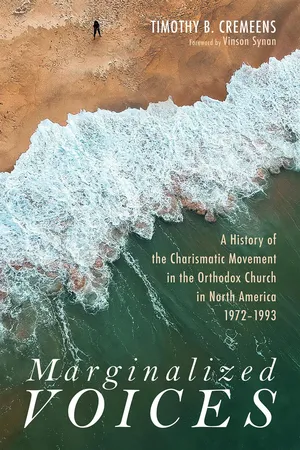
Marginalized Voices
A History of the Charismatic Movement in the Orthodox Church in North America 1972–1993
- 210 pages
- English
- ePUB (mobile friendly)
- Available on iOS & Android
eBook - ePub
Marginalized Voices
A History of the Charismatic Movement in the Orthodox Church in North America 1972–1993
About this book
The Orthodox Church has been characterized by some as "the best-kept secret in North America." Making use of personal interviews and correspondence, magazine and news articles, and other publications, Timothy Cremeens weaves the story of a spiritual renewal movement that began in the United States in the early 1960s and rapidly spread around the globe touching millions of Roman Catholics and Protestants, what is today called the Charismatic Renewal Movement. In 2017, this Movement, celebrated its 50th Jubilee anniversary in the Roman Catholic Church. However, Cremeens presents here the never-before heard story of that Movement among the Orthodox Churches in North America. He recounts the history of this spiritual renewal movement through the first-hand accounts and eyewitnesses of Orthodox clergy and laity who testify to their life-changing encounters with the Holy Spirit.
Information
Topic
Theology & ReligionSubtopic
Christian Denominationschapter 1
The Beginnings
The history of Christianity is marked by many defining moments. Beginning with the birth of the Christian Church on the day of Pentecost to the advent of Monasticism in the third century, the conversion of Constantine the Great, the schism between the churches of Rome and Constantinople, the nailing of Martin Luther’s 95 theses to the door of the chapel at Wittenberg marking the beginning of the Protestant Reformation, all these events, and hundreds more, have contributed to the shape of contemporary Christianity. It could be asserted that each century contains at least one of these defining moments. The twentieth century is no exception. Possibly the greatest event in Christianity, at the beginning the twentieth century, was the birth of the Pentecostal Movement, its subsequent spread to every continent on the planet, and its further influence upon the wider Charismatic Movement, which dominated the religious news for the last forty years of the twentieth century and profoundly affected every Christian church and denomination. The Pentecostal and Charismatic Movements’ emphasis upon the person and ministry of the Holy Spirit lends weight to Dr. Vinson Synan’s apt description of the twentieth century as the “Century of the Holy Spirit.”1
Considering the above facts, this work chronicles the advent, formation and early years of the Charismatic Movement among Orthodox Christians in North America.2 Focusing on four primary leaders of the Charismatic Renewal among the Orthodox clergy: the Right Reverend Archimandrite Athanasios Emmert of the Antiochian Orthodox Christian Archdiocese of North America, the Right Reverend Archimandrite Eusebius Stephanou of the Greek Orthodox Archdiocese of North America, the Reverend Father Boris Zabrodsky of the Ukrainian Orthodox Church of America, and the Reverend Father Orest Olekshy, principle leader of Charismatic Renewal among the Orthodox in Canada and a priest in the Orthodox Church of America. This book presents a historical narrative of the Movement within the Orthodox Church in North America by looking at their lives, ministries, writings and personal reflections.3 The main question it seeks to answer is: why was the Charismatic Movement not embraced by the hierarchy of the Orthodox Church in North America and as a result, repudiated by the vast majority of the Orthodox faithful, clergy and laity alike? The answers to this question, which the facts will bear out, is: First, the Charismatic Movement at its very core was perceived by the hierarchy of the Orthodox Church to be essentially rooted in evangelical Protestant spirituality and theology and therefore inconsistent and incompatible with an Orthodox approach to the Christian life. Second, the Movement, in the minds of a majority of the Orthodox Church’s leadership, became synonymous with the person and ministry of Fr. Eusebius Stephanou, who was believed, in reality or perception, to be rebellious and arrogant and who consistently criticized the Orthodox Church leadership overall, especially the hierarchy of the Greek Orthodox Archdiocese of the Church, and persisted in using what was characterized as classical Pentecostal terminology and methodology in his ministry. Stephanou’s weaknesses, initially in the mind of the Greek Orthodox hierarchy, and by extension, the remainder of the Orthodox hierarchs in North America, were the Movement’s weaknesses. Third, and directly related to the first two, the Movement among the Orthodox, unlike its counterparts in the various Protestant traditions and Roman Catholic Church, failed to communicate itself successfully in an Orthodox Christian spiritual and theological idiom that was comfortable, familiar, and acceptable to Orthodox clergy and laity alike. This confirms what Pentecostal historian Vinson Synan has so accurately stated,
Orthodoxy has always claimed to be charismatic in its worship and piety. At no time has it held to a theory of the cessation of the gifts of the Holy Spirit. Signs and wonders, including prophecy, healing, and miracles, have traditionally been accepted as a part of the heritage of the church. Despite this tradition, no major body of Christians in the world has been less affected by the charismatic movement of recent decades.4
Several types of sources have been employed in presenting the above-mentioned Orthodox Charismatic leaders. Articles and essays written by them, as well as several hours of personal taped interviews, present their thoughts and personal reflections. Stephanou is the author of several, all related to the subject of Charismatic or Spiritual Renewal in the Orthodox Church. In addition, in 1968, Father Eusebius began to publish and edit The Logos, originally a monthly, then quarterly, journal dedicated to Charismatic and Spiritual Renewal in the Orthodox Church. Over the three plus decades that The Logos appeared, Stephanou penned hundreds of articles. In addition, an authorized biography on Stephanou was published in 2008.5 Taped sermons and lectures of Stephanou were also employed in writing this narrative. Zabrodsky, beginning May 1978, and the Service Committee on Orthodox Spiritual Renewal (SCOSR), which Zabrodsky chaired, published Theosis magazine. Initially edited by Zabrodsky, Theosis is the only written source for information regarding the activities and writings of Zabrodsky. In addition, several hours of interviews, regarding his involvement in the Charismatic Movement, were conducted with Zabrodsky and his wife, Jaroslava. The Movement in Canada will be chronicled mainly through the transcripts of personal interviews with Fr. Orest Olekshy and other lay eyewitnesses and participants of the Movement in Canada.
In addition to the leadership provided by Emmert, Stephanou, Zabrodsky, his wife Jaroslava, and Olekshy and his wife Oksana, several other Orthodox priests—Fr. Constantine Monios, Fr. David Buss, Fr. James Tavlarides, Hieromonk6 Lazarus Moore, Fr. Anthony Morefesis, Fr. John Stinka (retired Metropolitan of the Ukrainian Orthodox Church of Canada), Fr. Constantine and Helen Kakalabaki, Fr. Svjatoslav and Eve Balevich and Fr. Maxym Lysack—as well as laymen—Charles Ashanin, Jordan Bajis, Demetrios Nicoloudakis (presently a priest of the Greek Orthodox Archdiocese, Metropolis of Pittsburgh), Gerald Munk (presently coordinator of the Work of Christ Community in East Lansing, Michigan), Gregory Gavralides, Dennis Pihatch (deceased Archpriest of the Archdiocese of Canada of the Orthodox Church in America), Philip (presently a priest in the Archdiocese of Canada of the Orthodox Church in America), and Barbara Ericson, Martin Zip, Vasil and Kathy Szalasznyj, John Syrnick, and James and Karen Davis—were deeply involved in the Movement. Some of their reflections will be presented to give a fuller picture of the Movement within Orthodoxy.
The Charismatic Movement among Orthodox Christians is tied organically and historically to the general Charismatic Movement, whose origins in turn are traced through the classical Pentecostal Movement. Likewise, the Pentecostal Movement has a three-fold connection; one, the eighteenth- and nineteenth-century Holiness Movement, second, the Revivalist Movement and third, the Higher Life or Keswick Movement, all of which flourished in the nineteenth century.7 All three of these movements similarly find their roots in the Pietist Movement of the late seventeenth/eighteenth century; the Holiness Movement through John and Charles Wesley via the Methodists, the Revivalists through the Puritans via Jonathan Edwards and the ministry of Charles Finney, and the Keswick Movement through Quaker and Anglican Pietism. Therefore, it is necessary to present a brief historical, theological, and cultural backdrop of these spiritual movements and show how they in turn influenced one another and collectively shaped the spirituality of the Charismatic Movement.
1. Synan, The Century, ix.
2. Like the Charismatic Movement among Roman Catholics and Protestants, the Renewal counted adherents and participants among Orthodox Christians around the globe, however the scope of this study will only include Orthodox Christians within North America, i.e., the United States and Canada, between 1968 and 1993 (twenty-five years).
3. Orthodox priests and laity, who were likewise involved in the Charismatic Renewal, will also be mentioned, especially regarding their interaction with the primary leaders of the Movement.
4. Synan, The Century, 199. See also Synan, The 20th Century, 143–47.
5. M. Stethatos, The Voice. In reality, this is not a biography but an autobiography penned by Stephanou himself using “Maria Stethatos” as a pseudonymous pen name. Stephanou, Eusebius. 2008. Interview by author. Destin, FL. February 20.
6. The term” Hieromonk” refers to a male monastic who is also an ordained priest.
7. Dayton, Theological Roots.
chapter 2
Antecedents
The Charismatic Church
From its inception, the Orthodox Christian Church has claimed to be charismatic (from the Greek term charismata, defined as “grace gifts”). The term is employed by the Apostle Paul in his first epistle to the Corinthians to refer to the manifestation of miraculous events and practices such as prophecy, healing, exorcism, and speaking in tongues, all inspired, and given, by the same Holy Spirit.8 The second chapter of the Acts of the Apostles records that on the Day of Pentecost, traditionally celebrated as the birth of the Christian Church, was attended by the sound of rushing wind, flaming to...
Table of contents
- Title Page
- Dedication
- Foreword
- Preface
- Chapter 1: The Beginnings
- Chapter 2: Antecedents
- Chapter 3: The Charismatic Movement
- Chapter 4: The Charismatic Catholic Movement
- Chapter 5: Charismatic Renewal among Orthodox Christians
- Chapter 6: Greek Orthodox Involvement
- Chapter 7: The Wind Blows in Chicago
- Chapter 8: The Wind of the Spirit on the Canadian Plains
- Chapter 9: The Charismatic Renewal
- Afterword
- Bibliography
Trusted by 375,005 students
Access to over 1.5 million titles for a fair monthly price.
Study more efficiently using our study tools.
Frequently asked questions
Yes, you can cancel anytime from the Subscription tab in your account settings on the Perlego website. Your subscription will stay active until the end of your current billing period. Learn how to cancel your subscription
No, books cannot be downloaded as external files, such as PDFs, for use outside of Perlego. However, you can download books within the Perlego app for offline reading on mobile or tablet. Learn how to download books offline
Perlego offers two plans: Essential and Complete
- Essential is ideal for learners and professionals who enjoy exploring a wide range of subjects. Access the Essential Library with 800,000+ trusted titles and best-sellers across business, personal growth, and the humanities. Includes unlimited reading time and Standard Read Aloud voice.
- Complete: Perfect for advanced learners and researchers needing full, unrestricted access. Unlock 1.5M+ books across hundreds of subjects, including academic and specialized titles. The Complete Plan also includes advanced features like Premium Read Aloud and Research Assistant.
We are an online textbook subscription service, where you can get access to an entire online library for less than the price of a single book per month. With over 1.5 million books across 990+ topics, we’ve got you covered! Learn about our mission
Look out for the read-aloud symbol on your next book to see if you can listen to it. The read-aloud tool reads text aloud for you, highlighting the text as it is being read. You can pause it, speed it up and slow it down. Learn more about Read Aloud
Yes! You can use the Perlego app on both iOS and Android devices to read anytime, anywhere — even offline. Perfect for commutes or when you’re on the go.
Please note we cannot support devices running on iOS 13 and Android 7 or earlier. Learn more about using the app
Please note we cannot support devices running on iOS 13 and Android 7 or earlier. Learn more about using the app
Yes, you can access Marginalized Voices by Timothy B. Cremeens in PDF and/or ePUB format, as well as other popular books in Theology & Religion & Christian Denominations. We have over 1.5 million books available in our catalogue for you to explore.