eBook - ePub
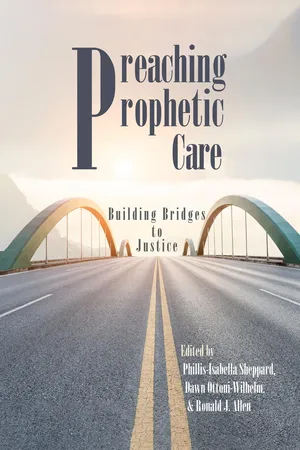
Preaching Prophetic Care
Building Bridges to Justice
- 340 pages
- English
- ePUB (mobile friendly)
- Available on iOS & Android
eBook - ePub
Preaching Prophetic Care
Building Bridges to Justice
About this book
Preachers often think of prophetic preaching in the caricature of the prophet as the lonely outsider confronting the congregation, often angrily, with the congregation's complicity in social injustice and with a bracing call for repentance. The twenty-seven essays and sermons in this book offer a different perspective by viewing prophetic preaching specifically--and ministry, practical theology, and theological education more broadly--as pastoral care for the community in prophetic perspective. Such preaching does indeed bring a critical theological analysis of justice concerns to the center of the sermon, but in such a way as to invite the congregation to consider how the move toward justice is a pastoral move-- that is, a move that seeks to build up community. Rather than contributing to the polarization so rampant in today's social world, the preacher seeks to help the congregation build bridges along which concern for justice can travel. The contributions honor the work of the late Dale Andrews, a scholar of preaching and practical theology at the Divinity School, Vanderbilt University, whose seminal work inspires the notions of prophetic care and building bridges to justice.
Information
Topic
Theology & ReligionSubtopic
Biblical StudiesPart 1
Preaching and Practical Theology
1
Bridges
Strong, Purposeful, and Vulnerable
I knew Dale Andrews as a bridge-builder and this volume is dedicated to his passion for creating connections. When Dale was a faculty member at Boston University School of Theology, he was a quintessential connector. He built friendships among people, relationships between the school and churches, and vigorous dialogue across diverse fields of interest, especially attending to his own fields of pastoral care and preaching. Intellectually, Dale was also a connector, linking ideas from church practice and family life to theological and political constructs, and analyzing the connection-breaking practices in social organizations that hurt people who are most vulnerable. He continually sought ways to analyze issues and then to address and transform them into new possibilities. He has been sorely missed since he departed BU School of Theology, but he left a legacy that continues. For this, we are abundantly grateful.
The focus of this chapter is on the practice of bridging, apropos to the legacy of Dale Andrews. I begin, however, with the recognition that bridging is itself a complicated phenomenon. Bridges bring people together and open new possibilities for travel and relationships, but they can also lead into the unknown and affect people and lands in unexpected ways. Thus, I begin with a meditation on bridges and bridging.
Bridges—pathways between
One place and another
One people or nation and another
One culture, one perspective, one value and another-
One and another!
Bridges—strong and beautiful
Places to cross as you travel
Places to stand as you gaze at the world
Places to feel the textures of life—
People passing, wind blowing, rain falling, sun shining.
Bridges—structures of purpose for travelers
As they journey toward basic life needs
As they work, trade, and play
As they reach toward others
To reshape the clay of a world gone astray.
Bridges—vulnerable to powers of change
To the natural elements of wind, sun, and rain
To travelers’ trodding through eons of time
To political maneuvers and competitive forces
To changes that erode, destroy, and refine.
Bridges—pathways to hope
Hope for human meeting
Hope for ecological care
Hope for justice and reconciliation
In a world longing for life-giving connection!
Bridges come in many forms—land bridges between continents, natural stone bridges across ravines, human-built bridges across waterways, and paths between animals’ natural habitats. One could name others. In all of these forms, bridges have three persisting qualities: they are strong, purposeful, and vulnerable. In this chapter, I focus particularly on bridges in practical theology—Dale’s home field of study and a field that is desperately in need of bridges.
Strong Bridging
Bridges have to be strong to support movement from one place to another and communication across geographical distance or differences in race, culture, gender identity, sexual orientation, ability, age, language, life experience, or worldview. In practical theology, the bridges have to be strong to link people concerned with diverse theological and existential issues, “sub-fields” of practical theology, methodologies, religious traditions, human communities, social patterns, and ecological systems. One major challenge facing practical theology worldwide is to cultivate communication links that enrich the field, encouraging vast diversity while providing common ground for mutual learning and shared work. This is challenging for a newly recovered field in which competition for correctness is wide-spread, complicated by the domination of some intellectual, religious, and cultural traditions over others.
I propose that practical theology—a field of analytic reflection, poetics, and practice—needs strong bridges to foster life-giving relationships in and across religious communities and in the larger society. Practical theology is a field marked by fragmentation—valuing some scholars more than others, some fields (or subfields) more than others, and some regions of the world over others. Our guild has also tilted toward some ethnic scholars and ethnic communities and some genders more than others. I remember sitting with two African American colleagues in 2001 when Fred Smith, also African American, gave a plenary address in the International Academy of Practical Theology. When the address ended, they jumped to their feet with vigorous applause and said to me, “At last, we hear an address that really matters.” Dr. Smith had described practical theology that was engaged with the church and with young people in a challenging culture. The incident represents a continuing pattern, leading many Black scholars to find organizations and conferences that are more relevant to them. Bonnie Miller-McLemore tracks similar gendered patterns in the International Academy of Practical Theology.1
Dale Andrews was himself a bridge within the field, bridging predominantly European and European-American scholarship with African American scholarship, bridging theoretical developments with African American church life, bridging practical theology with other areas of theology, and bridging homiletics and pastoral theology. Each of these bridging efforts has been significant, building a very strong matrix of bridges that will endure.
Early in Dale’s academic career, he was concerned about the disconnection between developments in Black theology and the life of Black churches, describing “the actual situation between the academy of black theology and black churches as a chasm.”2 He described his own work as bridging “the theological axioms of black theology and the faith claims operating in African American folk religion.”3 In excavating the chasm, Dale recognized the wisdom that emerged on both sides of the bridge and the urgency to build deeper relationships. He identified a paradigm of “the church as refuge,” which could draw upon the wisdom of black churches and scholarship, while holding the deep spiritual traditions and liberative movements of African American peoples.4 Dale’s work also drew from deep biblical veins of tradition, featuring especially covenant and prophecy.5 His passion for bridging was already born in that first book.
Dale also worked to connect church life and homiletic theory through his specialized work in preaching. One impressive example appears in print. Joining with five colleagues, he produced a collection of homiletical case studies.6 The purpose was to “listen to listeners” of sermons, interviewing people in congregations to discern their experience of hearing sermons. The interviewees included 260 African American and Caucasian congregants of diverse ages and genders from urban, rural, and suburban churches of many sizes and denominations. The team analyzed listeners’ perceptions in Aristotelian rhetorical categories, and presented five representative interviews and one small group interview as case studies. The purpose was to invite preachers and scholars to ponder the wisdom of listeners via cases, then to reflect on insights from the interviews and consider approaches that preachers can use to listen to their congregations. The book reveals many forms of bridging-bridging homileticians with the book’s six authors, bridging preachers and listeners, and bridging research with practices of preaching and listening.
Dale’s most recent book involved multiple forms of bridging as well. In Black Practical Theology, he and Robert London Smith Jr. created a comprehensive hermeneutical conversation that spans many topics: youth, intergenerational relations and ageism; education, class and poverty; gender, sexual orientation and race; and mass incarceration and the justice system. Further, each part includes a conversation with a practical theologian, church leader, and scholar in constructive theological, biblical, and ethical disciplines. Thus, the book is a series of dialogues among people who are diverse in professional roles and yet all concerned with faith in life. Dale often used the term “trialogues” to note the multiple partners in these conversations. The conversations represent “praxiological response criticism,” focusing on the experiences and perspectives of people in faith communities in dialogue with theological traditions, which allow all participants to probe complexities and seek guidance for the future.7
The kind of bridging work represented by these several publications is testimony to the freshness of Dale Andrews’ contributions and his love for complicating dominant assumptions. I recently studied Black Practical Theology with a class and I witnessed its generativity for students of many backgrounds—African American, Latinx, Asian, and European American. The specificity of the conversations that focused on the Black church and Black theology touched a chord in readers, as did the conversations themselves. What makes all of Dale’s bridging strong is that he built bridge upon bridge for more than 20 years, with publications, lectures, classes, workshops, and interpersonal relationships. With his characteristic vision and persistence, he built bridges of understanding, questioning, and passion on which others will continue to build.
What is needed in practical theology is similar vision and persistence in building bridges. Many have directed themselves to this kind of work in recent years to beneficial effect.8 The work has only just begun, however, and much more is needed, hopefully led by persons of color and people whose fields and interests have been underrepresented thus far in practical theology. The efforts of many scholars are an important beginning, but scholars such as Courtney Goto remind us of the endemic problems in tokenizing people of color to represent their ethnic communities in a single chapter and not considering white cultures at the same time.9 What is needed is a reshaping of practical theology with strong bridges for the ongoing work of sharing, listening, questioning and transforming.
Purposeful Bridging
Strong bridges are not sufficient in themselves. What is also n...
Table of contents
- Title Page
- Contributors
- Preface
- Foreword
- Introduction: Brief Biographical Sketch of Dale P. Andrews
- Part 1: Preaching and Practical Theology
- Part 2: The Pastoral and Prophetic in Preaching
- Part 3: Prophetic Care, Preaching, and Wider Community
- Part 4: Learning to Preach in the Mode of Prophetic Care
- Part 5: Prophetic Care: Particular Topics
- Part 6: Sermons that Embody Prophetic Care
- Appendix A
- Appendix B
- Bibliography
Trusted by 375,005 students
Access to over 1.5 million titles for a fair monthly price.
Study more efficiently using our study tools.
Frequently asked questions
Yes, you can cancel anytime from the Subscription tab in your account settings on the Perlego website. Your subscription will stay active until the end of your current billing period. Learn how to cancel your subscription
No, books cannot be downloaded as external files, such as PDFs, for use outside of Perlego. However, you can download books within the Perlego app for offline reading on mobile or tablet. Learn how to download books offline
Perlego offers two plans: Essential and Complete
- Essential is ideal for learners and professionals who enjoy exploring a wide range of subjects. Access the Essential Library with 800,000+ trusted titles and best-sellers across business, personal growth, and the humanities. Includes unlimited reading time and Standard Read Aloud voice.
- Complete: Perfect for advanced learners and researchers needing full, unrestricted access. Unlock 1.5M+ books across hundreds of subjects, including academic and specialized titles. The Complete Plan also includes advanced features like Premium Read Aloud and Research Assistant.
We are an online textbook subscription service, where you can get access to an entire online library for less than the price of a single book per month. With over 1.5 million books across 990+ topics, we’ve got you covered! Learn about our mission
Look out for the read-aloud symbol on your next book to see if you can listen to it. The read-aloud tool reads text aloud for you, highlighting the text as it is being read. You can pause it, speed it up and slow it down. Learn more about Read Aloud
Yes! You can use the Perlego app on both iOS and Android devices to read anytime, anywhere — even offline. Perfect for commutes or when you’re on the go.
Please note we cannot support devices running on iOS 13 and Android 7 or earlier. Learn more about using the app
Please note we cannot support devices running on iOS 13 and Android 7 or earlier. Learn more about using the app
Yes, you can access Preaching Prophetic Care by Phillis Isabella Sheppard, Dawn Ottoni-Wilhelm, Ronald J. Allen, Phillis Isabella Sheppard,Dawn Ottoni-Wilhelm,Ronald J. Allen, Sheppard, Ottoni-Wilhelm in PDF and/or ePUB format, as well as other popular books in Theology & Religion & Biblical Studies. We have over 1.5 million books available in our catalogue for you to explore.