- 148 pages
- English
- ePUB (mobile friendly)
- Available on iOS & Android
eBook - ePub
About this book
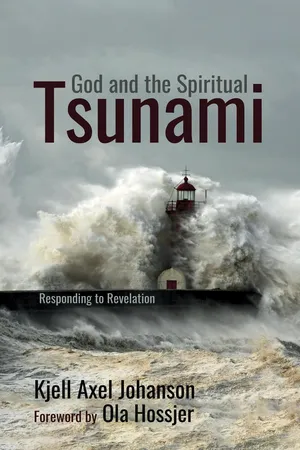
God is clearly at work today. There is a cultural, political, and religious metaphorical tsunami gathering power under the surface of ordinary world events, and when it is fully released, it will turn the world as we now know it upside down.
Thousands upon thousands of Muslims, Buddhists, Hindus, and nominal Christians become followers of Jesus Christ every day and the effects are enormous.
The premises of this book are:
There is a God and the belief in God is a moral and not an intellectual question.
God created mankind out of his goodness as his representatives on Earth.
Since God is by nature good and generous, the essence of sin is to doubt this goodness and walk away from him.
God nonetheless continues to seek man in order to bless him, and he has an encompassing plan to accomplish that purpose. He began this purpose through his covenant with Abraham and is fulfilling it through Jesus Christ.
Contemporary evidence of this purpose can be seen clearly in what he is doing right before us: We see it in the nation of Israel, through the growth of the church, and the persecution of the church.
Information
Topic
Theology & ReligionSubtopic
Christian TheologyChapter 1
Premise 1: God—We Can Know that He is Here
In this chapter I aim to show that:
1. Belief in God is a moral, not intellectual issue
2. God must, per definition be good
3. God has not hidden Himself—He is revealing His presence so clearly that it is beyond doubt
4. Man does not seek God, so God will seek man
5. Faith can be placed in a fact or a relationship; for instance, ‘I believe that the Earth is round’ but it can also mean to have faith in a person: trust in God or a neighbor
My own beginning
I grew up in one of the most secular cultures in the world, but I was, of course, not aware of that at the time. Despite this, I became a Christian when I was seven years old. I was on my own in my bedroom as it was past my bedtime. Before I went to sleep I asked God to make me a Christian. He did. I jumped out of bed, went downstairs and shared my newly found faith with everybody in my family. Their reaction was less than enthusiastic. I was reminded, in no uncertain terms, that it was bed time, so back to bed I went. It was not the glorious start of the Christian life that many others describe, but despite this humble beginning, I never forgot my prayer and I never needed to say it again.
None of my close friends were believers, but they were very nice guys. We had a lot of fun, spending every week-end out in the amazing Nordic forests, discussing every part of life that we were aware of. In my experience, nothing (besides knowing God and our family relationships) can be compared to spending midsummer nights in the forest—encountering moose, fox, all kinds of birds and armed only with cameras and fishing gear. Those experiences shaped us all, and to this day I, for one, feel that unless I sleep outside under a bare sky at least once a year, it’s a lost year.
Growing up, I realized there was one significant idea that almost everyone seemed to take for granted: one cannot be sure that there is a God, and, if there is a God He is far away, and too busy running the universe to be interested in a cosmically insignificant me. Most religious people who had adopted this mindset seemed really to only expect psychological comfort from their faith, more than tangible reality. So most of my life I was told that I could never be absolutely certain that God exists. To believe in God’s existence was purely a matter of blind faith. This ingrained cultural falsehood has profound implications in today’s world.
Most people saw faith not as faith in God as He has revealed Himself in the Bible and throughout history, but rather faith in a religious system whose values made the world a better place. Adhering to the values was the only acceptable (albeit a very narrow) definition of faith. Faith, understood as trusting in a personal God that you with intellectual certainty know is there, sounded to many like a contradiction. It was not even on the radar of most people’s horizons. Relational faith had been wiped out by years of muddled intellectual work at theological faculties. This uncertainty spread to the largest denominations and from there on to the general population throughout Europe and America. I vividly remember one of my favorite teachers tellingly correcting a friend of mine who tried to guess the right answer in geography class: “You may believe when you are in church. In class, we’re only interested in facts.”
People seemed to think that if God existed He must have withdrawn, and may not really want to be found. My favorite author when I was young, Per Lagerkvist, the Nobel laureate, who had an uncanny ability to speak right into me and many in my generation, worked from that assumption.
I was engrossed in his stories, absorbing some of Lagerkvist’s feelings, while not wholly convinced by his world view which seemed to communicate that if there was a God, he was far away, mysterious and unpredictable. While I would never have gone that far, as most teenagers do, I often felt that as humans we were on a lonely and senseless cosmic trip going nowhere. But this hopeless scenario was often overridden by a stirring conviction that there must be more to reality than this.
Lagerkvist grew up in a believing, pietistic home. That particular Christian context was characterized by deep faith, while in its Scandinavian context, it could also be legalistic and a-rational. Within this context, the way to find God was through spiritual and often emotional experiences, and once you had these there was no need for further thought.
Lagerkvist, as well as thousands of others with him, felt alienated by this approach. I suspect Lagerkvist was actually a reluctant rejector of faith in Christ, but it probably seemed to him that existential emptiness and anxiety was the only honest alternative to faith within this scenario. In this way, he became the Existentialist spokesperson for a whole generation of Scandinavians.
The pietistic revivals in the seventeen and eighteen-hundreds swept powerfully over northern Europe and filled the intense longing for God that had been left unanswered by the state churches, but the revivals did not lay a foundation for the continued, healthy growth of the whole church. The consequences of that particular combination—on one hand, a church that was seen as primarily a protector of existing culture and on the other, a renewal movement that was not at all interested in answering the fundamental and honest questions it raised—created, if not the perfect storm, at least the perfect recipe for spiritual apathy.
After a few generations, many now felt that there was no church that seemed interested in giving credible answers, showing the power reality of the early church or with a vision, like the early missionary movements, that brought Christianity to Europe. So the Christian faith came to be looked upon as a crutch for weak people, and secularization logically became a way to prove one’s freedom from the spiritually irrelevant ideas of cultural preservation and the religious oppression of legalism.
That was a part of my cultural heritage. I still love and have a deep respect for the revivalist believers I grew up under. Without them—their example, intercession and love—I would probably not be a believer today, and it is out of respect for them that I try to share why it is not only possible, but absolutely necessary, to believe in God.
At the same time, I also have respect for the type of agnosticism and respectful atheism that I have lived alongside all of my life. I don’t mean the arrogant and irrational atheism we find in today’s best-selling authors trying to dispute the existence of God: authors who come across more like high school bullies than the sensitive analytical minds of men like Lagerkvist or Jürgen Habermas who asked decent and honest questions and who dared to deal with the existential consequences of a life without God. I have met many, thoughtful, but often frustrated persons who are sorely disappointed with religious language without substance and who like one famous philosopher quipped: “Why should I believe in what the church says, when the theologians themselves don’t believe it?” I have had the same question myself, so I can appreciate their position. But I have come to see that there are other and better answers—not new answers, by any stretch of the imagination, but old, ageless and clear answers beyond doubt.
Scandinavia is not the only place we find this disillusionment. All across the Western world we find similar issues. While there are many and complex reasons that led to decades of empty, substance-less religiosity, it is a fact that the last two generations have not encountered Christ in a meaningful way. These are the people who now rule the media world and the political machinery. Their pay-check depends on how well they defend the values and lifestyle of their constituency: a constituency that has no idea of who God is and that would rebel against any concept of a supreme Someone who has the final say over their actions. We get a form of closed loop, where everyone reinforces the message and beliefs and becomes more entrenched.
Faith and Personal Responsibility
But before we look at those old, ageless answers, there is one more aspect that we need to bring up: personal responsibility. You are not destined to become an agnostic or atheist because of the direction taken by your own culture. However little we know, it is our personal responsibility to seek God, and through that relationship with Him to seek to be a blessing to others. That it would be our responsibility might sound like a contradiction to the Western mind, but not in the Semitic worldview—Biblical thinking’s original context. The influence of spiritual leaders, cultural direction, personal choices and our response to God’s active work in our hearts, are all a part of what makes up the human spiritual journey. Even if all those elements point in conflicting directions, God has left enough revelation around to help us find Him. No one is excused from personal responsibility.
The Folly of Dodging Science Artfully
It is neither the will of the majority nor trends in society that decide what is truth, even if the pressure to think like society around us comes from both pundits of the political right and left. The idea of truth is highly controversial today. We cannot live with it, but neither can we live without it. The Bible anchors truth beyond us. It is not found in the majority will of the people or in those who shout the loudest. To extract ourselves from this quagmire we must begin by asking the right questions as honestly and openly as we can. As I have wrestled with the Christian faith as presented in the Bible, I have personally asked a couple of simple questions.
One of the most challenging statements in the Bible is this: “The fool says in his heart, ‘There is no God’.” How can the Bible say that, if it is so hard to know that God is here? How can God hold people responsible for not believing what they cannot know for certain?
Assuming that the Bible’s assertion here is correct, could it be that, in the West, we have actually unlearned the knowledge of the obvious? That we even suppress the thought of the obvious, like the Bible says we do—a form of what present-day psychologists might describe as perceptual defense? Could it be that even the first verses in the Bible tell us something so obvious that we would kick ourselves for not seeing it earlier?
The beginning is often the best place to start. The first words in the Bible are:
“In the beginning, God created the heavens and the earth.” That might sound simple, or even simplistic, but it is the most important piece of concrete information that we have ever given about who He is and who we are.
The first verse in the Bible tells us that there was a beginning of everything in the entire Cosmos. From subatomic particles and galaxies to you and me, we all have our roots in this beginning that happened a long time ago, and this has consequences for us.
If the entire universe had a beginning (a widely accepted scientific view) there must have been a state where there was nothing. No matter, no space, no time, no potentiality. Nothing. Most of us can’t imagine that, so we think of nothing as a vast empty space, but there was no space because there would have been no boundaries for that space. Instead, there literally was nothing. Zero.
If we refuse to consider God as the Creator, we are forced to suggest other alternatives to where matter arose from, generating a number of theories about how the universe began out of nothing. These theories are in fact based on the assumption that the universe began out of something, but they cannot explain what that ‘something’ is. All those alternative theories have one thing in common—they are based on a particular leap of faith, i.e. the ill-founded assumption that there is no God. It is certainly possible to suggest other alternatives to God, all of which work on a ‘what if’ assumption. However, I would maintain that those assumptions are not based on scientific evidence, but are motivated by the common cultural pressure to avoid the God-issue.
Let me illustrate this by taking the idea of the “Big Bang” as the beginning of the universe. Until the early nineteen-hundreds, most physicists believed that the universe was an eternal entity that was renewed because new hydrogen atoms were being made all the time. Because it was discovered that the universe is expanding, a Belgian priest and astronomer, Georges Lemaître suggested that it actually must have had a beginning as a single point billions of years ago. A lot of colleagues criticized the idea, now prevalent, because Lemaître was a Christian and the idea of a beginning of the universe sounded too much like the Genesis creation. The very words “Big Bang” was coined by a British astronomer, Fred Hoyle, who believed in a static universe and who thought the concept of a beginning as in a “Big Bang” was ludicrous. (There was no bang in the beginning, by the way, as there would not have been space enough for sound waves).
Scientific research is a God-given ability and is a deeply Christian pursuit, but the discoveries scientists make do not always sit comfortably with us.
A fe...
Table of contents
- Title Page
- Foreword
- Thank you
- Introduction
- Chapter 1: Premise 1: God—We Can Know that He is Here
- Chapter 1b: Follow-up: A Look at Paul’s Letter to the Romans
- Chapter 2: Premise 2: Sin is Our Problem but God Does Not Leave Us
- Chapter 3: Follow the Signs—Israel
- Chapter 4: Follow the Signs—The Church
- Chapter 5: Follow the Signs: Turning Persecution to Victory
- Chapter 6: Follow the Signs: The Bible —A Reliable Record
- Chapter 7: The Tsunami and What to Expect: Change
- Chapter 8: The Tsunami and What to Expect: Revival in the Muslim World
- Chapter 9: The Tsunami and What to Expect: Israel’s Conversion and Our Response
Trusted by 375,005 students
Access to over 1.5 million titles for a fair monthly price.
Study more efficiently using our study tools.
Frequently asked questions
Yes, you can cancel anytime from the Subscription tab in your account settings on the Perlego website. Your subscription will stay active until the end of your current billing period. Learn how to cancel your subscription
No, books cannot be downloaded as external files, such as PDFs, for use outside of Perlego. However, you can download books within the Perlego app for offline reading on mobile or tablet. Learn how to download books offline
Perlego offers two plans: Essential and Complete
- Essential is ideal for learners and professionals who enjoy exploring a wide range of subjects. Access the Essential Library with 800,000+ trusted titles and best-sellers across business, personal growth, and the humanities. Includes unlimited reading time and Standard Read Aloud voice.
- Complete: Perfect for advanced learners and researchers needing full, unrestricted access. Unlock 1.5M+ books across hundreds of subjects, including academic and specialized titles. The Complete Plan also includes advanced features like Premium Read Aloud and Research Assistant.
We are an online textbook subscription service, where you can get access to an entire online library for less than the price of a single book per month. With over 1.5 million books across 990+ topics, we’ve got you covered! Learn about our mission
Look out for the read-aloud symbol on your next book to see if you can listen to it. The read-aloud tool reads text aloud for you, highlighting the text as it is being read. You can pause it, speed it up and slow it down. Learn more about Read Aloud
Yes! You can use the Perlego app on both iOS and Android devices to read anytime, anywhere — even offline. Perfect for commutes or when you’re on the go.
Please note we cannot support devices running on iOS 13 and Android 7 or earlier. Learn more about using the app
Please note we cannot support devices running on iOS 13 and Android 7 or earlier. Learn more about using the app
Yes, you can access God and the Spiritual Tsunami by Kjell Axel Johanson in PDF and/or ePUB format, as well as other popular books in Theology & Religion & Christian Theology. We have over 1.5 million books available in our catalogue for you to explore.