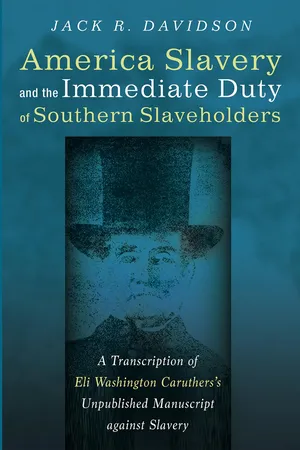
eBook - ePub
American Slavery and the Immediate Duty of Southern Slaveholders
A Transcription of Eli Washington Caruthers’s Unpublished Manuscript against Slavery
- 196 pages
- English
- ePUB (mobile friendly)
- Available on iOS & Android
eBook - ePub
American Slavery and the Immediate Duty of Southern Slaveholders
A Transcription of Eli Washington Caruthers’s Unpublished Manuscript against Slavery
About this book
Eli Washington Caruthers's unpublished manuscript, American Slavery and the Immediate Duty of Southern Slaveholders, is the arresting and authentic alternative to the nineteenth-century hermeneutics that supported slavery. On the basis of Exodus 10:3--"Let my people go that they may serve me"--Caruthers argued that God was acting in history against all slavery. Unlike arguments guided largely by the New Testament, Caruthers believed the Exodus text was a privileged passage to which all thinking on slavery must conform. As the most extensive development of the Exodus text within the field of antislavery literature, Caruthers's manuscript is an invaluable primary source. It is especially relevant to historians' current appraisal of the biblical sanction for slavery in nineteenth-century America because it does not correspond to characterizations of antislavery literature as biblically weak. To the contrary, Caruthers's manuscript is a thoroughly reasoned biblical argument unlike any other produced during the nineteenth century against the hermeneutics supporting slavery.
Information
Topic
Theology & ReligionSubtopic
Biblical Studies257
III. The reason for the demand or the purpose for which it is made.
Let my people go that they may serve me; which implies that their service is indispensable to the accomplishment of his merciful designs for them and for the world, and that they cannot render such a service as he requires while in a state of servitude or absolute and perpetual bondage. This all important truth will be made plain we imagine, by the statement of a few facts and by such observations as they naturally suggest.
Their powers can never be developed while in condition of slavery.
The service which he requires consists in such a voluntary exercise of all their powers, mental, moral and physical, as will result in their increasing enjoyment and as will reflect increasing honor upon his wisdom, power and goodness in their creation. It belongs to the nature of all rational, finite, and dependent beings to be progressive and he had made ample provision, in nature and grace, for an everlasting progression in whatever is conducive to their well being. As such an employment of their powers is perfect freedom. The opposite of such employment, whether forced or voluntary, must be bondage and hence according to the teachings of
258
inspiration, all who have become reconciled with God through Jesus Christ are free indeed, , children of the household, sons and daughters of the Lord Almighty; but the unconverted and and unrenewed are represented as under bondage to the law and the servants of sin. Those who Christ has redeemed and disenthralled are in a condition to serve him with a perfect heart and a willing mind; and they are brought under such influences that their powers may be forever expanding in knowledge, purity, and love to the glory of his free and sovereign grace. No man has the shadow of a right to lay an arrest on this progress and to say that their whole time and bodily strength shall be devoted to his interests or his pleasures. Such an enslavement of those whom he has purchased with his own blood, whether actually converted or not, is a daring encroachment on his rights and a most unjust and cruel outrage on their privileges and enjoyments. The soul and body constitute only one person or percipient, intelligent, and accountable being; both were included in the great redemptive act on Calvary; both will share in the final results of that redemption and no man can prevent them without great guilt from sharing in the benefits here to the full extent of their capacity.
259
A mere glance at the condition of our slaves as it appears in the ordinary occupations and business transactions of every day life might satisfy any reflecting man that a regular cultivation of their minds, or any considerable progress in civilization is altogether impracticable. It was said on a former page that, in spite of all the prohibitory laws which had been passed, some thousands of them have learned to read and have acquired as much intelligence and refinement as a very large portion of our white population but a few thousands are no more to the whole mass than a drop from the bucket to the ocean. The comparatively few who have learned to read have lived in favored localities, having been kept as household servants in the towns, or in part of the country where they were few in number and belonged to Christian masters who encouraged if they did not assist them in learning; but the great mass of them are either entirely neglected or watched and guarded and effectually excluded from all the means and facilities by the free use of which they might rise above their conditions. If any man will notice the houses or dirty log cabins in which they are crowded together and the kind of bedding and other furniture which
260
is allowed them, if he will observe the manner in which they are driven about late and early, and bought and sold without any regard to their social attachments or affections, he will se that they have neither time nor means nor inducements to learn.
But people have grown up with this institution among them and have become so familiar with all its horrid details that it makes very little impression on their minds. The thought hardly occurs to four fifths that their negroes deserve much better treatment than their horses or that they are not as much their property and may be bought and sold like any other property as suits their interests or their convenience. To understand the institution of slavery as it now exists and has long existed in the Southern states it is necessary to notice some of the laws that have been passed and are now in force on this subject. It was my design to give all our slave laws as they are found in the Revised Code of North Carolina, ed., 1855, chapter 107; but it soon become apparent that they would occupy entirely too much space. I must therefore limit myself with giving the substance of the most objectionable and refer the reader to the Code itself.
261
19. Slave Code of the South
Before we enter on the Code of North Carolina we will, partly as a matter of curiosity and partly as a proof of the cruelty which the slaves have been subjected ever since their first introduction into the country quote an act passed by the Colonial legislature of Maryland, which is in these words. “All negroes or other slaves within the province and all negroes and other slaves to be hereafter imported into the province, shall serve durante vita; and all children born of any negro or other slave, shall be slaves as their fathers were for the term of their lives” Sec. 1. “And forasmuch as divers free born English women, forgetful of their free condition and to the disgrace of our nation, do intermarry with negro slaves, by which also, divers suits may arise, touching the issue of such women, and a great damage doth befall the master of such negroes, for the prevention whereof, for deterring such freeborn women such shameful matches, be it enacted so that whatsoever freeborn women shall intermarry with any slave, from and after the last day of the present Assembly, shall serve the master of such slave during life of her husband; and that all the issue of such free born women so married, shall be slaves as their fathers were.”
262
This act was passed in 1663, and is the earliest of the Colonial enactments respecting slavery that has come under my notice. It was repealed in 1681, but as the repealing act contained an express saving of the rights acquired under the Act of 1663, before the date of the repealing act, so far as concerned the enslavement of the woman and her issue, it is not improbable that some of their descendants are in bondage to this day (see Stroud’s Sketch).
In the above enactment, however, there are two things which are vary remarkable and to which we call the reader’s attention.
1st the adoption of the Common law doctrine, partus sequitur pabrem that the offspring follows the condition of the father.
2nd The slavery to which it subjected the white freeborn English woman This law was repealed about 1700 and there was no law on the subject in that state until 1715 when the following act was passed, “All negroes and other slaves already imported or hereafter to be imported into this province, and all children now born or hereafter to be born of such negroes and slaves shall be slaves during their natural lives.”
263
Here the legislature adopted the maxim of civil law, “partus sequitor ventrum” and from that day to the present the condition of the mother has determined the fate of the child. This maxim, which the advocates of universal freedom regard as “the genuine most degrading principle of slavery” was soon after adopted wherever slavery existed and we believe it has been enacted by all the slave states that the offspring shall follow the condition of the mother.
Before proceeding to the laws now in force in North Carolina, we feel tempted to give another act or two, in the “Olden Time” partly to gratify the curiosity of the reader but mainly to show the uneasiness of conscience and the crude notions which serious thinking people of that day had respecting the lawfulness of slavery, or of holding Christians in bondage. In 1715, the Colonial legislature of Maryland made the following enactment “For asmuch as many people have neglected to baptize their negroes, or suffer them to be baptized, on a vain apprehension that negroes , by receiving the sacrament of baptism, are manumitted and set free, Be it enacted so that no negroe or negress by receiving the holy sacrament of baptism, is thereby manumitted or set free, nor hath any right
264
or title to freedom or manumission more than he or they had before any law, usage, or custom to the contrary notwithstanding.” In 1711 the legislature of South Carolina passed the following act: “Since charity and the Christian religion which we profess oblige us to wish well to the souls of all men; and that religion may not be made a pretext to alter any man’s property and right, and that no persons may neglect to baptize their negroes or slaves, or suffer them to be baptized; for fear that thereby they should be manumitted and set free, Be it enacted that it shall be, and is hereby declared lawful, for any negro or Indian slave, or any other slave or slaves whatsoever, to receive and profess the Christian religion and be thereunto baptized.” The section then provides that such profession of religion and submission to baptism shall not be construed so as to entitle them to emancipation. At that time the impression seems to have been pretty generally on the minds of Christians that members of the Christian church, like those of the Jewish church could not be lawfully held in bondage and there was a conflict between their interest and their conscience.
265
Probably they had an idea that the negroes, before their conversion, were heathen and might be enslaved; but that, like the bondsmen of the Jews from among the heathen nations around, when they became proselytes to the Christian faith and were admitted to membership in the church, they were as free as any other members of the household of faith. In the notion that no members of the church have a right to hold other members in bondage they were not mistaken; but they did not recollect that they as well as the Africans were gentiles by nature and that all nations having been redeemed by Jesus Christ are entitled to the same rights and privileges. Christians in this state had to a great extent, the same notion and masters often presented the children of their slaves for baptism as they presented their own children and this had not ceased here entirely at the commencement of the present century; for although I never saw a case of the kind, I recollect to have heard in my early boyhood, of several such instances. They took it for granted that Abraham’s servants were slaves and that as he had all his circumcised, so every Christian master ought to have all his household baptized.
266
But interest triumphed over conscience, as has been too often the case and the members of Christ’s body were continued in bondage. It might and no doubt would have been alleged that if they were to be emancipated on their submission to baptism it would be too great a temptation to hypocrisy; but as their qualifications for the ordinance had to be judged of by ministers of the gospel, the extent to which false professions of religion might be carried, would depend upon their fidelity. In the Act of Assembly above quoted, the main and, in fact, the only reason assigned for continuing them in a state of bondage and degradation was the interest of their masters; and to that chiefly are to be ascribed all the atrocities and horrors of slavery and the slave trade. With a supreme desire for gain all the laws in all the slave codes of the southern states have been made and, unless Providence interfere in some effectual way, we fear that the god of this world will continue to hold dominion in this matter even over the c...
Table of contents
- Title Page
- Introduction
- Preface
- Let My People Go That They May Serve Me.
- I. The claim: My people. They are mine and not yours: for you have no right to them.
- II. The demand: Let my people go.
- III. The reason for the demand or the purpose for which it is made.
- Bibliography
Trusted by 375,005 students
Access to over 1.5 million titles for a fair monthly price.
Study more efficiently using our study tools.
Frequently asked questions
Yes, you can cancel anytime from the Subscription tab in your account settings on the Perlego website. Your subscription will stay active until the end of your current billing period. Learn how to cancel your subscription
No, books cannot be downloaded as external files, such as PDFs, for use outside of Perlego. However, you can download books within the Perlego app for offline reading on mobile or tablet. Learn how to download books offline
Perlego offers two plans: Essential and Complete
- Essential is ideal for learners and professionals who enjoy exploring a wide range of subjects. Access the Essential Library with 800,000+ trusted titles and best-sellers across business, personal growth, and the humanities. Includes unlimited reading time and Standard Read Aloud voice.
- Complete: Perfect for advanced learners and researchers needing full, unrestricted access. Unlock 1.5M+ books across hundreds of subjects, including academic and specialized titles. The Complete Plan also includes advanced features like Premium Read Aloud and Research Assistant.
We are an online textbook subscription service, where you can get access to an entire online library for less than the price of a single book per month. With over 1.5 million books across 990+ topics, we’ve got you covered! Learn about our mission
Look out for the read-aloud symbol on your next book to see if you can listen to it. The read-aloud tool reads text aloud for you, highlighting the text as it is being read. You can pause it, speed it up and slow it down. Learn more about Read Aloud
Yes! You can use the Perlego app on both iOS and Android devices to read anytime, anywhere — even offline. Perfect for commutes or when you’re on the go.
Please note we cannot support devices running on iOS 13 and Android 7 or earlier. Learn more about using the app
Please note we cannot support devices running on iOS 13 and Android 7 or earlier. Learn more about using the app
Yes, you can access American Slavery and the Immediate Duty of Southern Slaveholders by Jack R. Davidson in PDF and/or ePUB format, as well as other popular books in Theology & Religion & Biblical Studies. We have over 1.5 million books available in our catalogue for you to explore.