- 178 pages
- English
- ePUB (mobile friendly)
- Available on iOS & Android
eBook - ePub
About this book
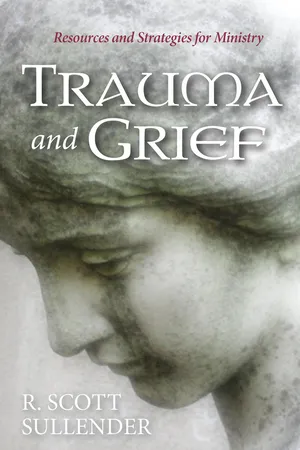
In today's world, trauma and traumatic loss are increasingly common. This book surveys the important constructs, concepts, and dynamics of trauma, loss, grief, and growth, offering resources and strategies that ministers and other spiritual caregivers can use as they support and facilitate people in their journey from trauma recovery to grief work to spiritual growth.
The book presents a framework for understanding the interrelationship between trauma recovery work, grief work, and spiritual growth. The author argues that each of these components is essential for a full and complete healing from trauma and traumatic losses and that they work together in the ongoing process of healing.
Traumas and traumatic losses are times of "crisis" in the sense that they are turning points in people's lives; people can either grow through the experience or decline under the weight of their unbearable sorrow and anxiety. How people handle traumas and significant losses may be the most important variable in their psychological, relational, and spiritual health. The author gives special attention to describing ways in which God might draw close to the traumatized and bereaved in their process of recovery and healing.
Information
Topic
Theology & ReligionSubtopic
Christian Ministry1
Trauma
Trauma seems to be everywhere these days. Trauma is not new, but it seems to be more obvious, frequent, and intense than ever before. The new term “trauma creep” describes this sense that trauma is everywhere, that the terms “trauma,” “traumatic,” and “PTSD” are being overused these days, particularly in the news media and social media. Setting aside the overuse of these terms in the media, it is a fair question to raise: Is trauma actually more common these days than ever before? The answer may be a partial “yes.” After all, there are more people on planet earth, so the likelihood of a natural disaster impacting population centers is higher than ever before. And climate change is triggering more weather-related disasters than ever before. Terrorism is not new, but technology makes the stakes higher. Terrorists can do more damage than ever before. Are there also more wars, violent crimes, and accidents than ever before? Maybe there is not more in proportion to the population, but the ever-increasing population does lead to more of these traumas. And certainly, as I said at the start, trauma seems to dominate the airwaves, creating a climate of drama and terror.
Trauma has been around since the dawn of human civilization. The Bible contains some vivid examples of trauma, such as the destruction of Jerusalem, the Massacre of the Innocents, and the persecution of early Christians. War has been a source of trauma for centuries. Trauma among soldiers was called “shell shock” in the mid-twentieth century. Post-traumatic stress disorder (PTSD) first received recognition as an identifiable disorder affecting Vietnam veterans in the United States in the 1970s. Americans are also aware that violent crime can be a source of trauma, crimes such as assault and battery, sexual assault, kidnapping, and murder. Moreover, we have become more aware of the previously hidden traumas caused by domestic violence and child abuse. All of these kinds of traumas are not new in the course of human history, but they do appear to be more common, more visible, these days. Their visibility is a good thing, however, and we do have the media to thank for making us more aware of trauma.
So, given the rising incidence of trauma and the pervasive influence of trauma in our culture, how should ministers and other Christian caregivers be equipped to respond to those suffering from trauma with compassionate and knowledgeable pastoral care? In this first chapter, I touch on the various concepts, issues, and constructs associated with the emerging discipline of trauma studies, noting a few implications for those who minister to people in trauma.
What Is Trauma?
Many different kinds of events and issues are presented to the public as traumatic, so let’s define trauma carefully. First, trauma is a life-threatening event or series of events. It is an event that is outside of the usual realm of human experience. It is an event that involves people directly in a life-threatening situation. That involvement may be as a victim or even as a witness or first responder. But more than a life-threatening event, which is bad enough, a trauma is also
a. sudden, unexpected, and unpredictable;
b. stressful, causing intense fear and subsequent anxiety;
c. horrific and repulsive to the senses of most people;
d. overwhelming, rendering people powerless at least momentarily.
Here are some examples:
a. Imagine walking into your regular bank and suddenly masked gunmen pull out their guns, shoot into the air, and order everyone down on the floor. It is frightening! You do not know what to expect. Several hostages are crying. The gunmen are shouting orders. One hostage tries to escape and is shot and then pistol whipped. Blood collects on the floor. It makes you sick to your stomach. After five to seven minutes, apparently collecting enough money, the robbers shoot again in the air above the hostages, ordering them not to move, and then flee out of the back door. No one moves. Soon you hear sirens and the police arrive.
b. Imagine a Sunday afternoon when you and your family are returning from a weekend visit with relatives. You are driving fifty to sixty miles per hour down the state highway, but suddenly a car in the oncoming lane bangs into another car, pushing the second one across the median barrier into your lane of traffic. You stretch for the brakes, but it happens in a spilt second. You go blank. The last thing you remember is crushing pain to your head and neck. Your car spins around and then rolls, coming to a stop in the ditch. You are semiconscious just long enough to ask if everyone is okay, but no one answers. Then you see an arm severed at the shoulder, dripping blood—whose arm is it? . . . and then you lose consciousness.
c. Imagine you are a young mother with four children. Your husband, the father of two of the children, has a terrible drinking problem as well as an anger problem. He has a hard time keeping a job. There is rarely enough food at home. Sometimes, when he is unhappy and has been drinking, he starts berating José, his eight-year-old stepson. You get in between them, and he starts beating you. He throws you against the wall. He breaks your favorite lamp. He screams all kinds of accusations and vulgarities at you and then drives off in the family car. You fear the worst, but the worst part really is that this is not unique. It is almost routine. You think it is not going to happen again, at least that is what he promises, but then it does.
d. Imagine living in a small town, surrounded by mountains, with a narrow highway running through it that was the only way in or out. After a week of rain, in the middle of the night, you are wakened by a rumble that grows to a roar. Within seconds, mud and rocks sweep through your yard, burying your garden, barn, and the first floor of your small house. The power goes off. Your children are awake and crying, but they are safe. You are safe. But you fear for your neighbors who live more directly in the path of this avalanche. When morning light arrives, the devastation is clearly horrific. Nothing much is left of your little town, just a sea of mud and debris. After your family is evacuated to a Red Cross center, you help direct rescue workers to the sites of your neighbors’ homes. A few survivors are found, but more often, as the hours and days pass, the first responders are pulling corpses from the mud. In total, thirty-seven people die in the avalanche.
Each of these horrific examples illustrates the essential features of trauma: a life-threatening event or events that is unexpected, creates intense fear, is often horrific or gruesome in nature, and renders participants powerless to control or stop it. That’s trauma!
Major Types of Trauma
Generally speaking, trauma events are classified into one of three broad categories based on whether they were caused by a natural disaster, an unintentional human act (i.e., an accident), or an intentional human act.
• Natural disasters include earthquakes, tsunamis, floods, fires, and volcanoes, like the avalanche described in the above vignette.
• Motor vehicle crashes like the one described above are the most common type of accident in the United States, followed by house fires. There are also occasional large-scale transportation accidents, such as train derailments or airplane crashes.
• Violent crime is the major source of intentional human trauma, and it includes muggings, beatings, stabbings, shootings, and rapes. Violent crimes can also occur within intimate relationships and families in the form of spousal battering and child abuse, as described in the above vignette.
• War is another arena in which humans inflict trauma upon one another. Both soldiers and civilians can be victims of trauma by being threatened, by observing, or by being in close proximity to horrific violence and destruction. Torture and human slavery are other examples of prolonged human-caused traumas.
The distinctions between these three categories of trauma are not always clear but are surprisingly important to people. Was hurricane Katrina really a natural disaster or was it a human-caused disaster? Is a particular airplane crash an accident or a terrorist act or the result of human error? Much of the news reporting around trauma events is focused on determining which category a particular trauma belongs in. This debate is not just a theoretical discussion. There are certain legal implications, but the issue also affects the recovery process of the survivors. Generally speaking, the recovery process for people caught in trauma’s wake is easier if the trauma is understood to be a natural disaster or an accident rather than an intentional act by another person.
How many Americans experience trauma? It is difficult to generalize about all Americans because exposure to trauma varies according to living environment and each individual’s psychosocial history. However, surveys of the general population often estimate that about one-half of Americans have experienced or will experience a major trauma in their lifetime.1 Maybe trauma is more common than we might realize. There are a myriad of ways that people can be traumatized.
Trauma Spectrum
Robert Scaer, in his book The Trauma Spectrum, argues that trauma is best understood as on a continuum.2 There are full-scale traumas and there are “little traumas.” The latter are “little” in the sense that not all four of the essential defining features of a trauma noted above are operative. A trauma may be unexpected but not horrific. It may be life-threatening but not overwhelming. And so on. Or, a “little” trauma could have elements of all four features but at a relatively mild level of intensity. Among these hidden, unrecognized little traumas are many medical procedures, which, Scaer suggests, are more traumatic than most physicians or patients realize.3 Chief among medical procedures that need to be understood in a trauma framework are the procedures and treatments associated with cancer. Cancer treatment can be traumatic on many levels. First, the word cancer can itself be terrifying and rather overwhelming. Second, the language of warfare that surrounds cancer treatment can be upsetting, making patients feel that they are powerless and that their bodies are the collateral damage in a larger, epic struggle. Then, there are the actual procedures, the major surgeries or chemotherapy treatments that are traumatic to the body as well as the psyche.
“Little traumas” may actually be an oxymoron. Trauma is by definition something big, something out of the ordinary. Many events might be traumatic but not a trauma event. This is reflected in the distinction between “trauma,” the noun, and “traumatic,” the adjective. The concept of trauma as being on a spectrum might contribute to what was earlier called trauma creep, the increasing use of the word trauma to describe experiences that do not meet the full criteria of the concept. Nevertheless, Scaer’s point is noted, and I will come back to it again in this book; trauma is more common than we might realize, and thus its impact is not always recognized. Another corollary of this insight is that trauma is both an objective reality and a subjective perception.
A Single Event vs. a Prolonged Trauma
Some traumas are single events. Other traumas are a series of events or a continuous “event” or situation. The traditional definition of trauma is that it is an event or a series of events. Some scholars, notably Judith Herman in her 1992 classic Trauma and Recovery, have also drawn the world’s attention to situations of prolonged trauma, such as being tortured or being a victim of domestic violence or being repeatedly abu...
Table of contents
- Title Page
- Acknowledgments
- Introduction
- Chapter 1: Trauma
- Chapter 2: Recovery
- Chapter 3: Losses
- Chapter 4: Grief
- Chapter 5: Growth
- Chapter 6: Spirituality
- Chapter 7: Theological Postscript
- Appendix 1: Discussion Questions and Activities for Classroom Use
- Bibliography
Trusted by 375,005 students
Access to over 1.5 million titles for a fair monthly price.
Study more efficiently using our study tools.
Frequently asked questions
Yes, you can cancel anytime from the Subscription tab in your account settings on the Perlego website. Your subscription will stay active until the end of your current billing period. Learn how to cancel your subscription
No, books cannot be downloaded as external files, such as PDFs, for use outside of Perlego. However, you can download books within the Perlego app for offline reading on mobile or tablet. Learn how to download books offline
Perlego offers two plans: Essential and Complete
- Essential is ideal for learners and professionals who enjoy exploring a wide range of subjects. Access the Essential Library with 800,000+ trusted titles and best-sellers across business, personal growth, and the humanities. Includes unlimited reading time and Standard Read Aloud voice.
- Complete: Perfect for advanced learners and researchers needing full, unrestricted access. Unlock 1.5M+ books across hundreds of subjects, including academic and specialized titles. The Complete Plan also includes advanced features like Premium Read Aloud and Research Assistant.
We are an online textbook subscription service, where you can get access to an entire online library for less than the price of a single book per month. With over 1.5 million books across 990+ topics, we’ve got you covered! Learn about our mission
Look out for the read-aloud symbol on your next book to see if you can listen to it. The read-aloud tool reads text aloud for you, highlighting the text as it is being read. You can pause it, speed it up and slow it down. Learn more about Read Aloud
Yes! You can use the Perlego app on both iOS and Android devices to read anytime, anywhere — even offline. Perfect for commutes or when you’re on the go.
Please note we cannot support devices running on iOS 13 and Android 7 or earlier. Learn more about using the app
Please note we cannot support devices running on iOS 13 and Android 7 or earlier. Learn more about using the app
Yes, you can access Trauma and Grief by R. Scott Sullender in PDF and/or ePUB format, as well as other popular books in Theology & Religion & Christian Ministry. We have over 1.5 million books available in our catalogue for you to explore.