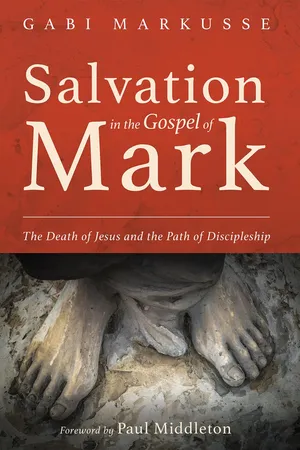
eBook - ePub
Salvation in the Gospel of Mark
The Death of Jesus and the Path of Discipleship
- 218 pages
- English
- ePUB (mobile friendly)
- Available on iOS & Android
eBook - ePub
About this book
The Gospel of Mark portrays Jesus making impossible demands on his disciples. They must follow him even if it costs them their lives. And, unsurprisingly, this proves to be impossible for them to do. They fail drastically in Mark's narrative and run from the scene as Jesus is arrested. Peter had been determined to stay by him unto death, but even he was not able to admit to knowing Jesus at that crucial moment. The strange thing is that Jesus made it clear that it is impossible to enter the Kingdom of God without this sort of radical discipleship. In this narrative study of salvation in the Gospel of Mark, this conundrum is studied closely with surprising results. An investigation of various socio-historical aspects of Mark's background elucidate the connection that Mark makes between the death of Jesus and the following of the disciples. And a study of Mark's narrative as a whole shows that Mark provides hope for those without courage to follow. If they continue to look and listen carefully, the mystery will be unveiled to them.
Information
1
Introduction
The Gospel of Mark portrays a striking connection between the passion predictions concerning Jesus’s fate and Jesus’s teaching to his followers. Examining this connection, I discover that Mark approaches salvation not solely as something that Jesus has accomplished for us, but as something that is incomplete without the human response of giving up the rights to one’s own life. While Mark portrays the initial failure of the disciples, he stresses the notion of dying to one’s self and becoming the servant and slave of all as a necessary component to salvation. This extent of discipleship proves impossible to attain, humanly speaking. Mark’s Good News is that through the Holy Spirit even this is possible.
The Death of Jesus and the Path of Discipleship
The writer of the Gospel of Mark makes a fascinating connection between the death of Jesus and the path of discipleship. Right in the middle of the narrative, Jesus takes his disciples aside to go on a journey designed specifically to teach them some important things. He doesn’t want anyone to know where they are. Experience has taught that when word is out that Jesus is in town, the crowds make it nearly impossible for him to give attention to his own disciples. And right now, he needs to make sure his disciples listen and learn. They tell him that they know he is the Messiah. And then he tells them that he must suffer and die and if they want to continue to follow him, this is also the road that they must take.
In three clearly defined scenes during this journey in the center of the Gospel, Mark combines a prediction of Jesus’s passion with teaching about what it means to follow Jesus. In the first of these three discipleship teachings (8:34—9:1), the Markan Jesus insists that whoever would follow him must pick up their cross and come after him. They must deny themselves and give up their life. For whoever wants to save their life will lose it; only those who are willing to let go of their life will save it. In the second teaching moment (9:35–50), the Markan Jesus speaks of letting go of rights and privileges and of serving the least at whatever cost it might bring to oneself. In the third teaching moment (10:35–45), Jesus combines both of these aspects of discipleship. He implies that being a disciple will entail great suffering in the same way that Jesus himself would suffer. He insists that to be great they must serve and even be a slave to all, using himself as an example of the extent to which this service reaches (10:45). Each of these three teaching moments is attached to a prediction of his own passion and resurrection. According to Mark, the cross of the Messiah Jesus is not sold separately.
Mark introduces and concludes this teaching journey in the same way: with Jesus healing a man’s blind eyes. There is a lot to say about this; blind eyes learning to see form a red thread throughout the narrative, indicating an understanding that will lead to salvation. I will pick up on this below.1 Suffice it for now to say that the eyes of the disciples did not open easily. Jesus was teaching something that was very difficult for them to understand.
The Gospel of Mark is well known for its emphasis on discipleship. It is often referred to as “the Way,” echoing “the Way of the LORD” imagery from Isaiah.2 Mark indeed arranges the teaching material described above in such a way to suggest that this way of suffering and service has everything to do with the salvation described in Isaiah as the way of the LORD. He also places his entire narrative squarely in the context of God’s salvation history with Israel when he begins with the conflated quotation of Exod 23:20, Mal 3:1, and Isa 40:3. And he leads this narrative of God’s salvation ultimately to the crucifixion of Jesus. But if Mark presents the cross of Jesus as being God’s work of salvation and connects the suffering of the disciples narratively to the suffering of Jesus, would that indicate that Mark intends the suffering of the disciples to be understood as also being part of God’s work of salvation? This has been the guiding question of this research.
Mark’s narrative shows the disciples failing drastically at following Jesus. This forms an interpretive conundrum—for how can this be if their following is so essential to the Kingdom of God? A narrative reading of the Gospel will highlight the promise that is worded by John the Baptist in the prologue: “One is coming after me who is stronger than I; I am not worthy to stoop down to untie the chords of his sandals. I baptize you with water; he will baptize you in the Holy Spirit” (1:7–8).3 Commentators generally agree that this provides an intertextual allusion to the eschatological promise of the Holy Spirit.4 However, this promise has largely been ignored by scholars in their studies of the disciples’ failure; I propose that it holds the solution to their problem.
Mark’s Story of Salvation as the Coming of the Kingdom of God
The message of the Markan Jesus is the nearness of the Kingdom of God (1:15). A basic working assumption in this study is that the essence of salvation is to Mark the coming of the Kingdom of God. This is what God is moving towards as narrated in Scripture. A related assumption is that salvation is accomplished by God, and cannot be attained without him (see 10:23–27). This is reflected in the background texts that we will look at in Part Three below. In Isaiah, God continually states that he is the one who will redeem his people, even when he uses servants to accomplish this. In Daniel 7, only God is able to finally bring a halt to the cruel persecution of his people by the beasts (Dan 7:9–12, 26). All nations are then brought under the umbrella of his Kingdom which will be ruled by his people (Dan 7:14, 18, 27). Psalm 22 also reflects a faith in God as the only one who can help the sufferer, and as the one who ultimately brings relief and vindication.
This Kingdom of God is understood as the realm in which God’s ways are lived out, where God is obeyed.5 To make this obedience possible, the Holy Spirit was promised to God’s people. This is apparent in such texts as Ezekiel 36:27 (“And I will put my spirit in you, and move you to follow my decrees and be careful to keep my laws”) which lie at the background of the statement of John the Baptist in Mark’s prologue (1:7–8). Mark’s use of the term baptism in conjunction with the Holy Spirit indicates the connection between John’s ministry and that of Jesus, while he focuses on the intensity of the difference. John’s baptism in water indicates repentance but Jesus’s baptism in the Spirit would actually enable a life of obedience. This connection between the Holy Spirit and the ability to obey God, and thus please him, is embodied in the scene immediately following the record of John’s message. Jesus is baptized by John and as he arises from the water, the Holy Spirit descends upon him and a voice proclaims to him that he is his beloved Son in whom he is well pleased (1:10–11). As the ensuing narrative unfolds, Jesus is portrayed as living out God’s will to the utmost. The first activity portrayed after the baptism is the Holy Spirit thrusting Jesus into the wilderness where he undergoes testing by Satan (1:12–13). While Mark does not mention the outcome explicitly as Matthew (Matt 4:1–11) and Luke (Luke 4:1–13) do, it is understood that Jesus passes the testing and remains obedient to God. Mark makes vivid to his audience through the words of John the Baptist that this Holy Spirit will be available to people through Jesus, enabling and even moving them to live a life of pleasing and obeying God even when faced with the testing of the opponent Satan.6 The background against which my research has been underta...
Table of contents
- Title Page
- Foreword
- Preface
- Abbreviations
- Chapter 1: Introduction
- Part One: Mark’s Theology Highlighted by Narrative Structure
- Part Two: Relevant Socio-Historical Background to Mark 8:22—10:52
- Part Three: Relevant Intertextual Background to Mark 8:22—10:52
- Chapter 10: Conclusions
- Bibliography
Trusted by 375,005 students
Access to over 1.5 million titles for a fair monthly price.
Study more efficiently using our study tools.
Frequently asked questions
Yes, you can cancel anytime from the Subscription tab in your account settings on the Perlego website. Your subscription will stay active until the end of your current billing period. Learn how to cancel your subscription
No, books cannot be downloaded as external files, such as PDFs, for use outside of Perlego. However, you can download books within the Perlego app for offline reading on mobile or tablet. Learn how to download books offline
Perlego offers two plans: Essential and Complete
- Essential is ideal for learners and professionals who enjoy exploring a wide range of subjects. Access the Essential Library with 800,000+ trusted titles and best-sellers across business, personal growth, and the humanities. Includes unlimited reading time and Standard Read Aloud voice.
- Complete: Perfect for advanced learners and researchers needing full, unrestricted access. Unlock 1.5M+ books across hundreds of subjects, including academic and specialized titles. The Complete Plan also includes advanced features like Premium Read Aloud and Research Assistant.
We are an online textbook subscription service, where you can get access to an entire online library for less than the price of a single book per month. With over 1.5 million books across 990+ topics, we’ve got you covered! Learn about our mission
Look out for the read-aloud symbol on your next book to see if you can listen to it. The read-aloud tool reads text aloud for you, highlighting the text as it is being read. You can pause it, speed it up and slow it down. Learn more about Read Aloud
Yes! You can use the Perlego app on both iOS and Android devices to read anytime, anywhere — even offline. Perfect for commutes or when you’re on the go.
Please note we cannot support devices running on iOS 13 and Android 7 or earlier. Learn more about using the app
Please note we cannot support devices running on iOS 13 and Android 7 or earlier. Learn more about using the app
Yes, you can access Salvation in the Gospel of Mark by Gabi Markusse in PDF and/or ePUB format, as well as other popular books in Theology & Religion & Biblical Criticism & Interpretation. We have over 1.5 million books available in our catalogue for you to explore.