eBook - ePub
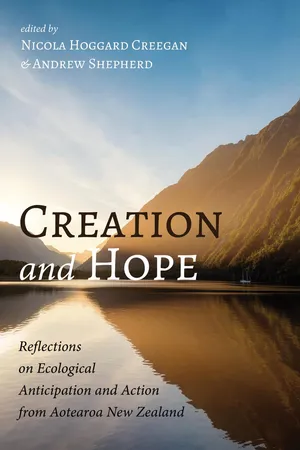
Creation and Hope
Reflections on Ecological Anticipation and Action from Aotearoa New Zealand
- 230 pages
- English
- ePUB (mobile friendly)
- Available on iOS & Android
eBook - ePub
Creation and Hope
Reflections on Ecological Anticipation and Action from Aotearoa New Zealand
About this book
We live in an ecological age. Science in the last few hundred years has given us a picture of nature as blind to the future and mechanical in its workings, even while ecology and physics have made us aware of our interconnectedness and dependency upon the web of life. As we witness a possible sixth great mass-extinction, there is increasing awareness too of the fragility of life on this planet. In such a context, what is the nature of Christian hope? St Paul declares that all of creation "will be set free from its bondage to decay and will obtain the freedom of the glory of the children of God." How are we to imagine this "freedom" when death and decay are essential to biological life as we currently experience it, and when the scientific predictions for life are bleak at best? This book explores these questions, reflecting on how our traditions shape our imagination of the future, and considering how a theology of hope may sustain Christians engaged in conservation initiatives. The essays in this volume are partly in dialogue with the ground-breaking work of Celia Deane-Drummond, and are set in the context of global and local (Aotearoa New Zealand) ecological challenges.
Information
Topic
Theology & ReligionSubtopic
Christian TheologyText
6
The Animal in Derrida’s Bible
If the animal moving toward us
so securely in a different direction
had our kind of consciousness
it would wrench us round.
But it feels its life as boundless, unfathomable
and without regard to its own condition:
pure like its outward gaze.
And where we see the future
it sees all the time
and itself within all time, forever healed.
—Rainer Maria Rilke, The Eighth Duino Elegy159
Genesis 2/Gilgamesh I:110
I came awake in the dirt, in the mud, as if thrown down. Lips upon my nose. My body was alive with sensation. All around was green and new. The air, the sensation of toes and feet on the dry ground. I was as shaky and wide-eyed as a new born foal. I waded into cool waters, the very source of the Pishon river, to wash the stain of clay from my skin and hair. A herd of gazelle lined the bank, drinking in the twilight. I placed my hand on a warm furred flank and drank too.
As in the extract from Rilke’s ‘Eighth Elegy’ that begins this essay, the other-than-human in the world is an object of curiosity, mystery and denigration. Derrida’s 1997 Cerisy lectures “L’animal que donc je suis [à suivre]” aligns itself with Rilke’s mood in its desire to be with or for rather than in spite of the animal.160 In his first lecture, Derrida speaks of the difference between nudity and animal non-nudity. He speaks of the beginnings of the civilized world. The beginnings of literature and of language. He reveals his shame. He speaks of cats in literature; and of poetry and passion. He speaks of sacrifice.
Derrida’s survey of the question of the animal in Genesis penetrates into the heart of animal theology. Much of the Western theological tradition has interpreted the hierarchical distinction between the animal and the human as ratified and limned with divine authority in the first pages of the Judeo-Christian sacred text. Thus in Derrida’s rewriting and re-interpretation of Genesis, he is firstly recognizing the power of these texts that are lodged at the heart of the question of the animal and then offers an “other” reading that deconstructs this dominating theological narrative and the ways in which it is made manifest. Likewise, in the Western philosophical tradition the animal has been an invisible and mute companion—easily set aside—and, as Derrida will claim, the historic span of this consequential monologue about the animal has done little except to further underline the false dichotomy of the human-animal relation. In this situation Derrida offers a reading of hope: a new relation, and this means looking into the face of l’animal as a divine moment.
Initially, the question of the animal is one of difference, insurmountable distinction. The animal is considered as one not: “capable of consciousness, of language, of a relation to death . . . incapable of the phenomenological . . . a relation to the other as other”.161 Humanity is defined over and against the animal. Derrida’s return to Genesis and to the first animal is a search for the animal face.162 It is a search for the animal subject denied in philosophy and that has shaped animal lore/law:
That would be the law of an unperturbable logic, both Promethan and Adamic, both Greek and Abrahamic . . . Its invariance hasn’t stopped being verified all the way to our modernity.163
Like Rilke, Derrida seeks to encounter the animal, and to look it squarely in the face, and to do this naked, removing the clothing that blinds western philosophy. He plays in the possibility of humanimality and divinanimality. He searches for a place where human and animal share a border.
This engagement of the question of the animal is not an obscure cause for Derrida. He made a life’s work of deconstructing phallocentric or anthropocentric othering or silencing such as that that silences woman and of injustices endemic in sexual difference.164 For Caputo, Derrida’s theological offering is one of justice: “for a justice to come that will count our every tear”165 from a God whose name constitutes a call “for the other, that calls from the other, the name that the other calls, that calls upon us like Elijah at the door, and that calls for something new.”166 In animality studies, Derrida sounds this call for a new relation by making a “turn toward the animal gaze”167 in the most surprising of ways.
I often ask myself, just to see, who I am—and who I am (following) at the moment when, caught naked, in silence, by the gaze of the animal, for example the eyes of a cat, I have trouble, yes, a bad time overcoming my embarrassment.168
This beginning of Derrida’s lecture recalls the words of Rilke’s Eighth Duino Elegy, “Oder daß ein Tier, ein stummes, aufschaut, ruhig durch ...
Table of contents
- Title Page
- Acknowledgments
- Abbreviations
- Introduction
- Phenomenology
- Text
- Theology
- Conclusion
- Author Biographies
Trusted by 375,005 students
Access to over 1.5 million titles for a fair monthly price.
Study more efficiently using our study tools.
Frequently asked questions
Yes, you can cancel anytime from the Subscription tab in your account settings on the Perlego website. Your subscription will stay active until the end of your current billing period. Learn how to cancel your subscription
No, books cannot be downloaded as external files, such as PDFs, for use outside of Perlego. However, you can download books within the Perlego app for offline reading on mobile or tablet. Learn how to download books offline
Perlego offers two plans: Essential and Complete
- Essential is ideal for learners and professionals who enjoy exploring a wide range of subjects. Access the Essential Library with 800,000+ trusted titles and best-sellers across business, personal growth, and the humanities. Includes unlimited reading time and Standard Read Aloud voice.
- Complete: Perfect for advanced learners and researchers needing full, unrestricted access. Unlock 1.5M+ books across hundreds of subjects, including academic and specialized titles. The Complete Plan also includes advanced features like Premium Read Aloud and Research Assistant.
We are an online textbook subscription service, where you can get access to an entire online library for less than the price of a single book per month. With over 1.5 million books across 990+ topics, we’ve got you covered! Learn about our mission
Look out for the read-aloud symbol on your next book to see if you can listen to it. The read-aloud tool reads text aloud for you, highlighting the text as it is being read. You can pause it, speed it up and slow it down. Learn more about Read Aloud
Yes! You can use the Perlego app on both iOS and Android devices to read anytime, anywhere — even offline. Perfect for commutes or when you’re on the go.
Please note we cannot support devices running on iOS 13 and Android 7 or earlier. Learn more about using the app
Please note we cannot support devices running on iOS 13 and Android 7 or earlier. Learn more about using the app
Yes, you can access Creation and Hope by Nicola Hoggard Creegan,Andrew Shepherd, Hoggard Creegan, Shepherd in PDF and/or ePUB format, as well as other popular books in Theology & Religion & Christian Theology. We have over 1.5 million books available in our catalogue for you to explore.