- 304 pages
- English
- ePUB (mobile friendly)
- Available on iOS & Android
eBook - ePub
About this book
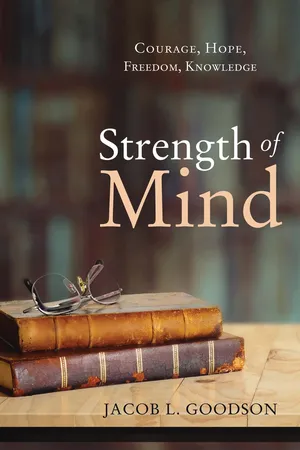
Higher education in the twenty-first century should bring together freedom and knowledge with courage and hope. Why these four concepts? As Goodson argues in Strength of Mind, higher education in the twenty-first century offers preparation for ordinary life. Freedom and knowledge serve as the conditions for cultivating courage and hope within one's ordinary life. More specifically, courage and hope ought to be understood as the virtues required for enjoying ordinary life. If college-educated citizens wish to hold onto the concepts of courage and hope, however, then both courage and hope need to be understood as intellectual virtues. As a moral virtue, courage has become outdated. As a theological virtue, hope violates the logic of the golden mean. Focusing on intellectual virtues also requires shifting from moral perfectionism to rational perfectionism. Rational perfectionism involves keeping impossible demands in view for oneself while constantly and continually striving for one's "unattained but attainable self." Goodson defends these arguments by learning from the bits of wisdom found within American Transcendentalism (Emerson, Cavell), German Idealism (Kant, Hegel), Jewish philosophy (Maimonides, Spinoza, Putnam), neo-pragmatism (Putnam, Rorty, West), post-modern theories about pedagogy (Nietzsche, Foucault, Rorty), and secular accounts of perfectionism (Murdoch, Cavell).
Information
Topic
PhilosophySubtopic
Pragmatism in PhilosophyPart 1. FREEDOM AND KNOWLEDGE IN THE TWENTY-FIRST CENTURY
In Part 1, I introduce readers to several versions of perfectionism. I explain and evaluate a variety of defenses of moral perfectionism, and I defend my own account of rational perfectionism. In chapter 1, I work through pertinent arguments found in Iris Murdoch’s The Sovereignty of Good; I tease out Murdoch’s account of moral perfectionism in relation to the concepts of courage, hope, freedom, and knowledge.
After establishing how Murdoch’s philosophy gives us compelling ways to understand these four concepts, I challenge Murdoch’s account of moral perfectionism in order to set up my claim that courage and hope are best understood as intellectual virtues within the twenty-first-century context. Murdoch’s moral perfectionism seems unrealistic, but I demonstrate that rational perfectionism—which relies on an account of intellectual virtues—becomes more realistic for us today. In chapter 2, I explicate Ralph Waldo Emerson’s Transcendentalist philosophy in order to develop an understanding of freedom in the language of coming to terms with one’s autonomy and an understanding of knowledge in the language of learning how to balance Nature, Tradition, and Human Activity as sources of knowledge. In chapter 3, I turn to the work of the medieval Jewish philosopher Maimonides to distinguish between moral and rational perfectionism. I demonstrate that rational perfectionism becomes, perhaps paradoxically, a higher form of perfectionism yet much more realistic to achieve than moral perfectionism. Also, in chapter 3, I remain within the tradition of Jewish philosophy—shifting to the arguments of the American philosopher Hilary Putnam—to consider what it means for rational perfectionism to be relational. The pattern of this section involves: from a secularized version of moral perfectionism, through a medieval Jewish account of rational perfectionism, to a recent defense of perfectionism defined in terms of describing our commitments “in ways that seem impossibly demanding” yet requires realism in the sense “it is only by keeping an ‘impossible’ demand in view that one can strive for one’s ‘unattained but attainable self’.”31 My preference for the final version of perfectionism presented in this section becomes twofold: (1) unlike Murdoch’s account of moral perfectionism, this final version allows for a positive role for the individual self, and (2) unlike Maimonides’s account of rational perfectionism, the final version encourages relationships with other people—which helps us think through the role of rational perfectionism in ordinary life (indeed, we tend to have very personal relationships in ordinary life!). I conclude chapter 3 by describing the connections between perfectionism within American Transcendentalism and Jewish philosophy—the tradition of Jewish philosophy highlighted and reconstructed in the contours of this chapter: perfectionism in the thinking of Maimonides, Rosenzweig, Buber, Levinas, and Putnam.
In chapter 4, I turn to toward an early writing from Friedrich Nietzsche in order to describe the professorial task in relation to rational perfectionism. Nietzsche’s argument has been labeled as both “aesthetic perfectionism” and “moral perfectionism,” and I demonstrate why it more accurate to think of Nietzsche’s argument in terms of rational perfectionism. I conclude the section by contrasting Murdoch’s and Nietzsche’s versions of perfectionism, and I distance my defense of rational perfectionism a bit from Nietzsche’s account of perfectionism.
31. Putnam, JPGL, 59 & 72. Putnam argues that this definition of perfectionism fits both twentieth-century Jewish philosophy (Franz Rosenzweig, Martin Buber, Emmanuel Levinas) and the tradition of American Transcendentalism (Ralph Waldo Emerson and Stanley Cavell).
Chapter 1
From Moral Perfectionism to Rational Perfectionism
That human beings are naturally selfish seems true on the evidence, whenever and wherever we look at them, in spite of a very small number of apparent exceptions. About the quality of this selfishness modern psychology has had something to tell us. The psyche is a historically determined individual relentlessly looking after itself. In some ways, it resembles a machine; in order to operate it needs sources of energy, and it is predisposed to certain patterns of activity. The area of its vaunted freedom of choice is not usually very great. One of its main pastimes is daydreaming. It is reluctant to face unpleasant realities. Its consciousness is not normally a transparent glass through which it views the world, but a cloud of more or less fantastic reverie designed to protect the psyche from pain. It constantly seeks consolation, either through imagined inflation of self or through fictions of a theological nature. Even its loving is more often than not an assertion of self. I think we can . . . recognize ourselves in this rather depressing description.
Iris Murdoch, The Sovereignty of Good
Iris Murdoch’s Moral Perfectionism
Iris Murdoch, a twentieth-century British philosopher, wrote The Sovereignty of Goodness and Metaphysics as a Guide to Morals. She was born July 15th, 1919, in Ireland and died on February 8th, 1999, in Oxfordshire (England). As a student, she studied Philosophy at Cambridge University and English Literature at Oxford University. While at Cambridge University, she studied under/with the famous philosopher Ludwig Wittgenstein but never attended any of his lectures. She wrote more than twenty-five novels in her lifetime, and the recent film Iris (2001) depicts the complexities of her everyday life and philosophical thinking. She served as Professor of Philosophy at Oxford University from 1948 to 1963, Professor of Aesthetics and Art History at the Royal College of Art from 1963 to 1967, and the Warton Professor of English at Oxford University from 1974 to 1992. She died from Alzheimer’s Disease in the early part of 1999.32 Her philosophical legacy includes her recovery of Platonism, her claim that moral reasoning needs a strong metaphysical foundation, and her account of moral perfectionism. Although these three positions are closely intertwined in her thinking, I focus on her account of moral perfectionism and mention the other two positions only on an ad hoc basis.
Murdoch defends the notion of moral perfectionism against (what she considers) the perversity of existentialist philosophies. The task of philosophy, according to Murdoch, concerns moving “towards the building of elaborate theories and mov[ing] back again towards the consideration of simple and obvious facts.”33 While existentialism certainly builds elaborate theories concerning authenticity and freedom, Murdoch makes the judgment that existentialism fails to “move back again towards the consideration of simple and obvious facts.”
While Murdoch agrees with existentialist philosophy that freedom becomes a necessary component for modern moral life, she disagrees that freedom stands on its own. According to Murdoch, existentialism makes three claims: (1) freedom is all that is needed for individual actions; (2) authenticity is all that is needed for individual identity; and (3) authenticity and freedom negate the metaphysical foundations found within the world and/or for the world. Murdoch argues that (3) does not follow from (1) and (2), and she thinks that we need a metaphysical foundation of the Good to make sense of our modern moral lives and to understand the world. In Murdoch’s words, “Existentialism . . . is an attempt to solve the problem [of modern life] without really facing it: to solve it by attributing to the individual an empty lonely freedom, a freedom [that] flies ‘in the face of the facts’.”34 Against existentialism, Murdoch claims that moral “concepts do not move about within a hard world . . . . They set up, for different purposes, a different world.”35 In other words, clarifying concepts help us to imagine the world on different terms. I agree with Murdoch on this point, but I find that we need to narrow and specify her claim. When is it best for moral concepts to “set up . . . a different world” for us? I believe that setting up “a different world,” through moral concepts, ought to be considered one of the goals of undergraduate life within an institution of Christian higher education.
Murdoch’s account of moral perfectionism serves as a legitimate alternative to existentialist philosophy. Existentialists claim that the great achievement of modern life is absolute freedom, and this freedom provides the only condition for morality. Murdoch claims that freedom, itself, must be understood within moral contexts along with other words such as justice, love, obligation, and responsibility. We learn to become ethical beings; we learn how to live ethical lives; we learn what it means to live a moral life by being around other people (social interactions) and reading great stories about people (literature). Moral perfectionism needs a setting for these social interactions to occur in a healthy environment and for studying litera...
Table of contents
- Title Page
- Acknowledgments
- Abbreviations
- Preface: Writing as Teaching, Teaching as Writing
- Introduction: The Pillars Project
- Part 1: Freedom and Knowledge in the Twenty-First Century
- Part 2: Courage as an Intellectual Virtue
- Part 3: Hope as an Intellectual Virtue
- Conclusion: From Freedom and Knowledge to Courage and Hope
- Appendix: Beauty and the Purpose of Higher Education
- Bibliography
Trusted by 375,005 students
Access to over 1.5 million titles for a fair monthly price.
Study more efficiently using our study tools.
Frequently asked questions
Yes, you can cancel anytime from the Subscription tab in your account settings on the Perlego website. Your subscription will stay active until the end of your current billing period. Learn how to cancel your subscription
No, books cannot be downloaded as external files, such as PDFs, for use outside of Perlego. However, you can download books within the Perlego app for offline reading on mobile or tablet. Learn how to download books offline
Perlego offers two plans: Essential and Complete
- Essential is ideal for learners and professionals who enjoy exploring a wide range of subjects. Access the Essential Library with 800,000+ trusted titles and best-sellers across business, personal growth, and the humanities. Includes unlimited reading time and Standard Read Aloud voice.
- Complete: Perfect for advanced learners and researchers needing full, unrestricted access. Unlock 1.5M+ books across hundreds of subjects, including academic and specialized titles. The Complete Plan also includes advanced features like Premium Read Aloud and Research Assistant.
We are an online textbook subscription service, where you can get access to an entire online library for less than the price of a single book per month. With over 1.5 million books across 990+ topics, we’ve got you covered! Learn about our mission
Look out for the read-aloud symbol on your next book to see if you can listen to it. The read-aloud tool reads text aloud for you, highlighting the text as it is being read. You can pause it, speed it up and slow it down. Learn more about Read Aloud
Yes! You can use the Perlego app on both iOS and Android devices to read anytime, anywhere — even offline. Perfect for commutes or when you’re on the go.
Please note we cannot support devices running on iOS 13 and Android 7 or earlier. Learn more about using the app
Please note we cannot support devices running on iOS 13 and Android 7 or earlier. Learn more about using the app
Yes, you can access Strength of Mind by Jacob L. Goodson in PDF and/or ePUB format, as well as other popular books in Philosophy & Pragmatism in Philosophy. We have over 1.5 million books available in our catalogue for you to explore.