- 90 pages
- English
- ePUB (mobile friendly)
- Available on iOS & Android
eBook - ePub
About this book
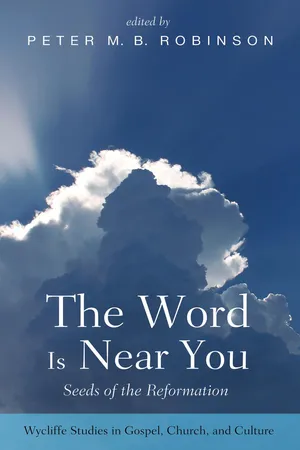
Beginning with the desires of our hearts and ending with the priesthood of all believers, this series of meditations traces a path through some central concerns of the Reformation. Along this path, the authors, all faculty at Wycliffe College, engage with biblical passages which were important at that time and remain just as vital today in working out what it means to be a Christian, what it means to be the people of God. It seems appropriate, given the central place Scripture had for the reformers, that we should follow their lead in looking to the Bible in the context of the life of the church. While some church communities enthusiastically proclaim their Reformation roots, others look askance at particular reformers and seek to distance themselves from the whole of the Reformation. Yet the Reformation is not an era we in the West can simply ignore; it is bred in our bones, runs through our veins, and shapes our life together in myriad ways. These meditations are not simply historical explorations or an exercise in documenting past events. Rather, the authors grapple with questions which we continue to struggle with today--questions of faith and grace, sin and salvation, work and worship. These meditations will provoke discussion and broaden our theological understanding while guiding us into a deeper understanding of the faith.
Trusted by 375,005 students
Access to over 1.5 million titles for a fair monthly price.
Study more efficiently using our study tools.
Information
Topic
Theology & ReligionSubtopic
Christian Denominations1
The Heart Wants What It Wants
“The heart wants what it wants. There’s no logic to these things. You meet someone and you fall in love and that’s that.”
That’s the great comedian and filmmaker Woody Allen, explaining how it was that he abandoned his wife Mia Farrow to take up with Farrow’s adoptive daughter Soon-Yi Previn, whom he married in 1997. Allen is a very well-read man, so it’s possible that when he said that, he was consciously or unconsciously channeling Emily Dickinson. In a letter to a friend written in 1862, Dickinson wrote, “The heart wants what it wants, or else it does not care.”
“The heart wants what it wants.” On the lips of Woody Allen, the words sound like a justification: human desire is mysterious, we are its helpless playthings. Don’t blame me, blame my heart. From the pen of Emily Dickinson the words sound more like a comment on how the heart, desire, eros, is close to the animating principle of what it means to be human. The heart wants what it wants, or else it does not care. The heart desires, or else we die. Human beings are lovers down to the very core. It is a deeply Augustinian insight: “You have made us for yourself,” writes Augustine on the very first page of the Confessions, “and our hearts are restless until they find their rest in you.” So likewise Pascal tells us that “the heart has its reasons, of which reason knows nothing.”
The problem, of course, is that the heart often wants the wrong things. The heart wants what it wants. Not what is good, or courageous, or true, or of assistance to the neighbor, but that which feeds the fantasies of our desires. So we read in Genesis: “And God saw that the wickedness of man was great in the earth, and that every imagination of the thoughts of his heart was only evil continually” (Gen 6:5, KJV). The twentieth-century novelist and philosopher Iris Murdoch spoke of the “fat, relentless ego” and showed the human wreckage it causes in her dark, funny, and weird novels. The fat relentless ego: a good description of the human condition. We Christians have another name for the heart’s evil imagining. We call it sin.
The Old Testament is ruthlessly honest about sin’s empire, the way it plants its flag not just in the Gentile nations with their idols and abominable practices—that is only to be expected—but in the midst of the covenant between God and Israel. Israel, God’s own beloved people, have sinned. They have dishonored the Torah and broken the covenant. They have answered God’s love with malice and injustice. The situation is dire. What is needed is not good intentions or promises to do better next time, or any other sort of halfway measure, but a radical new beginning: a new love, a new affection, a new obedience. We encounter this vision of the future in many parts of the Old Testament, but perhaps nowhere more powerfully than in Jeremiah 31:33–34:
But this is the covenant that I will make with the house of Israel after those days, says the LORD: I will put my law within them, and I will write it on their hearts; and I will be their God, and they shall be my people. No longer shall they teach one another, or say to each other, “Know the LORD,” for they shall all know me, from the least of them to the greatest, says the LORD; for I will forgive their iniquity, and remember their sin no more.
The covenant established on Sinai pointed the way, offered a vision of human life as it should be, showed what it might look like to live in peace with God and one’s neighbor, to be one of the “quiet in the land.” This Godward shaping of human existence is what the Ten Commandments are all about. But in the new covenant of which Jeremiah speaks, obedience will come from within; it will be written on the human heart. The heart will indeed want what it wants, and what it wants will be good.
This series is about the Reformation of the sixteenth century, and maybe you were wondering when I would get around to talking about that. But you see, I already have. For notice something about the Jeremiah passage: it is in the form of a promise. There is no more reformational category than that. Protestant theologians from Luther to Barth to Robert Jenson have read Scripture as one long record of God’s promise-making and promise-keeping. Jeremiah’s words were addressed to the Israel of his own day, teetering on the brink of exile. But they gesture forward to the day when God’s promises to Israel, to the nations, and to the whole world would be fulfilled in the sending of God’s own Son and the pouring out of the Spirit upon all flesh. The new covenant envisioned by Jeremiah is none other than the New Testament of our Lord and Savior Jesus Christ. It is simply the gospel—the glad tidings that God has visited his people, not just to forgive sin or usher in the kingdom but to transform our hearts. There is no more profoundly reformational theme than that. The law in its unity with the gospel, the gospel as the true meaning of the law, the Spirit as the divine person who writes that law in our hearts so that we may love the Lord our God with all our heart, and with all our soul, and with all our strength; and our neighbors as ourselves. This is the gift God has given us in Jesus, who is—as Hebrews tells us—the mediator of a new covenant, sealed with his own sprinkled blood.
If we had more time, we could play with this theme as it is discussed by John Calvin in his Institutes. Calvin wrote eloquently about the unity between the old and new covenants, despite their very real differences. Or we might explore how Karl Barth, in his doctrine of election, saw Jesus Christ himself as the eternal covenant of grace uniting God and humankind. But we do not have time in this brief reflection. So I will instead leave you with an image, drawn not from Calvin but from Luther. Luther’s personal seal consisted of a black cross on a red heart, resting on a white rose, the whole set against a field of blue and surrounded by a golden ring. The cross is black (Luther explains) because it puts to death our sin; the heart is red—its natural color—because the cross does not kill us but makes us alive; it perfects rather than destroys our nature. The white rose is the peace that comes to us through the gospel, while the blue field represents the joy that awaits us in heaven. The gold ring, finally, is the heavenly blessedness that lasts forever and has no end.
The heart wants what it wants. And in Christ our Lord, God has given us our heart’s desire. May we take this gospel message out into the world that God has made, loved, and reconciled in the person of his beloved Son—to whom, with the Father and the Holy Spirit, be glory forever and ever.

Scripture: Jeremiah 31:31–34
Questions
1. What does it mean to say that the heart “is close to the animating principle of what it is to be human,” or that human beings are “lovers down to the very core”? How much control do we have over what we love?
2. What is meant here by “old covenant” and “new covenant”? How are these covenants similar, and how are they different?
3. Why is the category of promise so important to our reading of the Bible? Why was it especially attractive to the Protestant reformers of the sixteenth century?
2
By Faith Alone
But What Exactly is Faith?
This year, around the world and across many denominations, the 500th anniversary of the Reformation is being recognized. For those of us studying or teaching theology, this is significant because we know how profoundly the Reformation affected the church. But how would you explain what was at the heart of the Reformation to someone who hadn’t studied it?
One approach might be to start with what are sometimes called the “five solas”: five short Latin phrases that emerged to summarize the reformers’ theological convictions about the essentials of Christianity.
1. Sola Scriptura (“Scripture alone”): The Scriptures alone are our highest authority.
2. Sola Gratia (“grace alone”): We are saved by the grace of God alone.
3. Solus Christus (“Christ alone”): Jesus Christ alone is our Lord, Savior, and King.
4. Soli Deo Gloria (“to the glory of God alone”): We live for the glory of God alone.
5. Sola Fide (“faith alone”): We are saved through faith alone in Jesus Christ.
The third chapter of Romans, like so much of Paul’s letter to the Romans, speaks about faith. What exactly is this thing called faith and what difference does it make? We live in a culture in which “faith” means to many people something between dogged positivity and wishful thinking. It is often seen as a feeling: rooted in the self, manufactured by the self, and useful (or harmful) to the self. Faith as it is described in Scripture, and so as understood by the reformers, is something far more substantive.
In the letter to the Romans alone faith is described as the root of obedience (Rom 1:5), an instrument of justification (Rom 3:30), and the pathway to righteousness (Rom 4:13).
Luther described faith this way:
Faith is a work of God in us, which changes us and brings us to birth anew from God (cf. John 1). It kills the old Adam, makes us completely different people in heart, mind, senses, and all our powers, and brings the Holy Spirit with it. What a living, creative, active pow...
Table of contents
- Title Page
- Introduction
- Chapter 1: The Heart Wants What It Wants
- Chapter 2: By Faith Alone
- Chapter 3: The Devil and the Details
- Chapter 4: The Law Too Is Gracious
- Chapter 5: I Am Not Ashamed
- Chapter 6: He Even Milks the Cows through You
- Chapter 7: On the Mountain with Jesus
- Chapter 8: Come Back to Me with All Your Heart
- Chapter 9: The Reformation Principle We Might Want to Forget
- Chapter 10: Real Worship
- Chapter 11: Power to the Priesthood (of All Believers)
- Bibliography
- Contributors
Frequently asked questions
Yes, you can cancel anytime from the Subscription tab in your account settings on the Perlego website. Your subscription will stay active until the end of your current billing period. Learn how to cancel your subscription
No, books cannot be downloaded as external files, such as PDFs, for use outside of Perlego. However, you can download books within the Perlego app for offline reading on mobile or tablet. Learn how to download books offline
Perlego offers two plans: Essential and Complete
- Essential is ideal for learners and professionals who enjoy exploring a wide range of subjects. Access the Essential Library with 800,000+ trusted titles and best-sellers across business, personal growth, and the humanities. Includes unlimited reading time and Standard Read Aloud voice.
- Complete: Perfect for advanced learners and researchers needing full, unrestricted access. Unlock 1.5M+ books across hundreds of subjects, including academic and specialized titles. The Complete Plan also includes advanced features like Premium Read Aloud and Research Assistant.
We are an online textbook subscription service, where you can get access to an entire online library for less than the price of a single book per month. With over 1.5 million books across 990+ topics, we’ve got you covered! Learn about our mission
Look out for the read-aloud symbol on your next book to see if you can listen to it. The read-aloud tool reads text aloud for you, highlighting the text as it is being read. You can pause it, speed it up and slow it down. Learn more about Read Aloud
Yes! You can use the Perlego app on both iOS and Android devices to read anytime, anywhere — even offline. Perfect for commutes or when you’re on the go.
Please note we cannot support devices running on iOS 13 and Android 7 or earlier. Learn more about using the app
Please note we cannot support devices running on iOS 13 and Android 7 or earlier. Learn more about using the app
Yes, you can access The Word Is Near You by Peter M. B. Robinson, Robinson in PDF and/or ePUB format, as well as other popular books in Theology & Religion & Christian Denominations. We have over 1.5 million books available in our catalogue for you to explore.