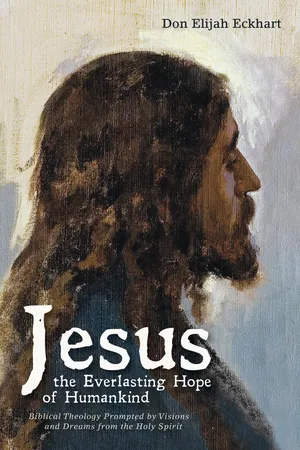
Jesus the Everlasting Hope of Humankind: Biblical Theology Prompted by Visions and Dreams from the Holy Spirit begins with a vision that came to Don Eckhart of two persons: one a Spirit-filled Christian and the other in the lake of fire. The vision depicts Jesus saving the desperate one crying out for mercy. Eckhart enrolled in seminary where he studied the Bible and the history of Christian theology, especially eternal punishment, a topic seldom examined since Augustine in the fifth century. Uniquely unfolding in the book are visions and dreams prompting an insightful study of Scripture and a biblical theology developed as the hope of Christ-mediated salvation for all. The effects are far-reaching but not complicated. This coherent theology includes afterlife correction and purification for nonbelievers, as well as for believers who never fully devoted to Jesus Christ. This purification compares to Catherine of Genoa's vision in the early sixteenth century. The book demonstrates how God's desire that all be saved can be accomplished according to Scripture. God's sovereignty and human free will coalesce, as every tongue joyfully confesses that Jesus Christ is Lord. The Good News may be even better than we thought!
eBook - ePub
Jesus the Everlasting Hope of Humankind
Biblical Theology Prompted by Visions and Dreams from the Holy Spirit
- 148 pages
- English
- ePUB (mobile friendly)
- Available on iOS & Android
eBook - ePub
Jesus the Everlasting Hope of Humankind
Biblical Theology Prompted by Visions and Dreams from the Holy Spirit
About this book
Information
Topic
Theology & ReligionSubtopic
Biblical Studies1
Revelation of Purification in Life and Afterlife
I was not disobedient to the heavenly vision. . . . (Acts 26:19 New Revised Standard Version)
Introduction
I enrolled in seminary because of a song—but not just any song. With the tune of the old hymn “Beneath the Cross of Jesus” playing in my head,1 new words came to my mind in the early morning of Holy Saturday, April 3, 1999. I arose from my bed and wrote down those words. That morning, I heard them for the first time, and I knew they came from God, not me. The Lord called me and led me to examine the biblical basis for the ideas in this revelation:
Beyond the cross of Jesus, I cannot bear to see,
The sight of that dear dying man Who gave His life for me;
And when the picture quickly fades, I see the risen Christ,
The One for Whom I’ll die myself, greets me saying “Arise!”
(Verse 1)
Upon the cross of Jesus, for sin His blood was poured;
His love a sacrifice for all, Christ is my Living Lord;
So as my life has grown with Him, the story to be told;
The One for Whom I’ve died myself, the first for me to hold.
(Verse 2)
What if I’d never known Him, what would “eternal” be?
Would I be drowning deep inside, within a fiery sea?
If I could gasp for one last breath, to utter one last word,
From deep within my soul I’d cry to God just for “mercy.”
(Verse 3)
If God could hear me calling, I know He’d grant my plea;
But how much longer would it be until He rescues me?
And then a figure comes in view—who could this savior be?
He’s Jesus Christ, my Servant King—the God I long to see!!!
(Verse 4)
I gave a title to the new revelatory song: “Beyond the Cross of Jesus—Christ Greets Me.” The song divides into two parts. Verses 1 and 2 reflect a life devoted to Jesus Christ and eternal life which flows naturally from earthly life—unbroken by death. I will call this person Adjoined. The name reflects an individual who is aligned with Jesus; that is, the person believes and obeys Christ. Verses 3 and 4 represent a person who is lost and experiencing eternal punishment. I will call this individual Alone because of the solitary state in which the person exists. Totally helpless, this person is in despair until calling to God for “mercy.” Then, Jesus saves the wretched soul from the fiery sea.
The title “Beyond the Cross of Jesus—Christ Greets Me” applies to both the first two verses (salvation during this lifetime) and the last two verses (showing how salvation could be possible through Christ after this life). In verses 1 and 2, followers of Christ are beyond the cross historically yet walk with Jesus and are guided by the Holy Spirit every day. In verses 3 and 4, lost persons are oftentimes thought to be beyond the redemption of Jesus’ sacrifice. A weighty question is asked: “What if I’d never known Him, what would ‘eternal’ be?” It essentially asks: If I had never come to faith in Jesus Christ, what would be my eternal fate? It also asks about the eternal destiny of all people of all times and all places. Eternal is a key word; I did not know its full significance at the time I wrote down these verses. However, as I have found in my studies, its meaning helps to demonstrate that no one is beyond the salvation made possible by Jesus Christ.
Have misgivings? I did. That is not how the Bible is generally read—that is, according to how most Christians understand it or have been told what the Bible means. “Once someone dies, that’s the end—heaven or hell,” most preachers say. “No one gets a ‘second chance,’” they say to emphasize the point. “Hell is everlasting conscious torment,” asserts the evangelist; “say a prayer while you can still be saved.” I relate to these concerns. Before Holy Saturday 1999, I would never have considered the possibility that Jesus saves in eternity and that God wants to save everyone. Even after the revelation of the song, I did not know what to do with it.
At that point, I was a lifelong Christian who experienced a personal spiritual awakening in the spring 1972 during my senior year of college. Sue Ellen and I married on August 19, 1972. Then, I completed a Master of Public Administration at the University of Pennsylvania; began a career in budgeting and policy analysis for local governments and later a state government; became a father of two sons; and volunteered with local church ministries before God gave me a revelation in 1985. Then, I received more revelations starting in 1996 and the revelation on Holy Saturday 1999.
I contemplated the revelatory song for several years. After I retired from my thirty-year career in government budgeting, I enrolled in seminary and completed a master’s degree in Christian theology. The classes and thesis focused on biblical studies, theology, and church history. Since there was no specific curriculum on the possibility of salvation after death, I did research papers and special projects on particular aspects of this scarcely studied subject. I diligently prayed and studied whether my revelation is biblical and true. Let us return to the song in order to understand it more fully before proceeding.
Faith Demonstrated in the Revelation
The first two verses of the song depict a person who has devoted their life to the Lord Jesus Christ, but not all at once. The person envisions Jesus dying on the cross, and the person believes that Jesus “gave His life for me.” Then, the person envisions the risen Christ and believes that Jesus is the way to eternal life. At the end of verse 1, the person makes a commitment to Christ, “The One for Whom I’ll die myself.” The now devout follower of Christ figuratively dies by giving up their self-centered life and living in obedience to Jesus. For example, Jesus said, “Those who want to save their life will lose it, and those who lose their life for my sake, and for the sake of the gospel, will save it” (Mark 8:34–35 NRSV, emphasis added). By giving up our self-centered life, we find true life in Christ.
Similarly, Jesus said, “If any want to become my followers, let them deny themselves and take up their cross daily and follow me” (Luke 9:23 NRSV). The concept of taking up one’s cross is also figurative for dying to a self-centered life. Jesus in this verse emphasized that death-to-self is ongoing, and so is life in Christ. A sacrificial life serves a purpose beyond oneself. For example, Paul wrote: “For while we live, we are always being given up to death for Jesus’ sake, so that the life of Jesus may be made visible in our mortal flesh. So death is at work in us, but life in you” (2 Cor 4:11–12 NRSV).
In verse 2, the person gains a better understanding of Jesus’ sacrifice of himself on the cross—“His love a sacrifice for all.” Such great, selfless love brings a response, “Christ is my Living Lord.” To be Lord means to be Master—a relationship that is often lost in contemporary Christianity which thrives on grace. For Jesus to be Lord means that the person will obey Jesus’ commands. Indeed, we see that in the song: “So as my life has grown with Him, the story to be told.” Now we can see why this person is called Adjoined. He or she has joined Christ in the abundant life (John 10:10), fulfilling God-given purposes and serving others for Christ, “The One for Whom I’ve died myself.” The story points to the gracious work of Jesus Christ.
On the other side is Alone, described in verses 3 and 4 of the song. This person either did not believe in Jesus or did not even know who Jesus is. To a certain branch of traditional theology called restrictivism and the traditional Western Christian doctrine of hell, it makes no difference if Alone rejected belief in Christ or never heard of Christ because all people in either situation are damned forever. That is not at all the position of this revelatory song and book. In verse 3, it is apparent that Alone is struggling within himself or herself—the struggle may be with sins against God and against people—sins now seen for the harm caused. A battle between self-will (perhaps self-righteousness) and a new attitude is now waging within Alone. It feels like the old self is drowning out any possibility of a fresh start. Yet the fire in that sea is purifying Alone. No excuses, no blaming others will do. The sins are to be borne alone—at least that is what Alone now feels. However, the burden becomes too much! Alone cries out to God for “mercy.” Sud...
Table of contents
- Title Page
- Acknowledgements
- Chapter 1: Revelation of Purification in Life and Afterlife
- Chapter 2: God Wants All to Be Saved
- Chapter 3: Various Christian Views on Salvation in the Afterlife
- Chapter 4: Christ-Mediated Salvation in Life and Afterlife Resolves the Dilemma
- Chapter 5: Summary and Conclusion
- Bibliography
Trusted by 375,005 students
Access to over 1.5 million titles for a fair monthly price.
Study more efficiently using our study tools.
Frequently asked questions
Yes, you can cancel anytime from the Subscription tab in your account settings on the Perlego website. Your subscription will stay active until the end of your current billing period. Learn how to cancel your subscription
No, books cannot be downloaded as external files, such as PDFs, for use outside of Perlego. However, you can download books within the Perlego app for offline reading on mobile or tablet. Learn how to download books offline
Perlego offers two plans: Essential and Complete
- Essential is ideal for learners and professionals who enjoy exploring a wide range of subjects. Access the Essential Library with 800,000+ trusted titles and best-sellers across business, personal growth, and the humanities. Includes unlimited reading time and Standard Read Aloud voice.
- Complete: Perfect for advanced learners and researchers needing full, unrestricted access. Unlock 1.5M+ books across hundreds of subjects, including academic and specialized titles. The Complete Plan also includes advanced features like Premium Read Aloud and Research Assistant.
We are an online textbook subscription service, where you can get access to an entire online library for less than the price of a single book per month. With over 1.5 million books across 990+ topics, we’ve got you covered! Learn about our mission
Look out for the read-aloud symbol on your next book to see if you can listen to it. The read-aloud tool reads text aloud for you, highlighting the text as it is being read. You can pause it, speed it up and slow it down. Learn more about Read Aloud
Yes! You can use the Perlego app on both iOS and Android devices to read anytime, anywhere — even offline. Perfect for commutes or when you’re on the go.
Please note we cannot support devices running on iOS 13 and Android 7 or earlier. Learn more about using the app
Please note we cannot support devices running on iOS 13 and Android 7 or earlier. Learn more about using the app
Yes, you can access Jesus the Everlasting Hope of Humankind by Don Elijah Eckhart in PDF and/or ePUB format, as well as other popular books in Theology & Religion & Biblical Studies. We have over 1.5 million books available in our catalogue for you to explore.