- 160 pages
- English
- ePUB (mobile friendly)
- Available on iOS & Android
eBook - ePub
About this book
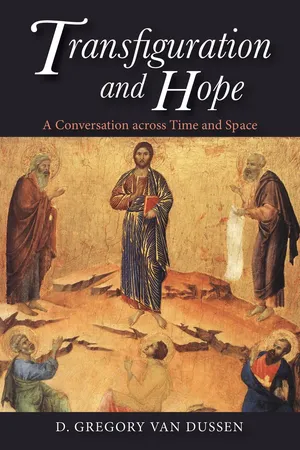
To read and visualize the transfiguration of Christ is to enter its mystery and encounter its hope. Like the Gospel writers and the disciples who climbed the mountain with Jesus, we struggle to tell the story and explain its meaning. Yet this astounding event reveals God's ultimate purpose in sending his Son--the complete restoration of humanity and all creation--our transfiguration in Christ. The light and glory of that moment reveal a destiny that is infinite and eternal, made possible by the power of grace. Transfiguration is the trajectory and goal of our spiritual journey.
Across time and space, Christians have reflected on the mystery and hope epitomized in the transfiguration, yet their voices have been heard primarily within their own cultural and ecclesiastical contexts. This study gathers many of those voices from the panorama of Scripture and church history and finds in them the common theme of radical transformation in Christ.
The point of this theological conversation is spiritual transfiguration and hope for each of us as we reach toward the future Christ has shown us in himself.
Information
Topic
Theology & ReligionSubtopic
Biblical StudiesChapter 1
God’s Purpose and Human Destiny: “Too Heavenly Minded?”
May God himself, the God of peace, sanctify you through and through. May your whole spirit, soul and body be kept blameless at the coming of our Lord Jesus Christ. The one who calls you is faithful, and he will do it.
—1 Thess 5:23–24 NIV
Following the luminous Christ, we hope to fulfill our future in the transfiguring light of God.
—Andreas Andreopoulos, Beloved Son
Lord, what am I becoming? I know I’m becoming older, but am I becoming wiser, more loving, more forgiving, more gracious, more understanding, in a word, more like You? More God-like?
Am I striving to become by grace what you created me to be, or am I denying and covering over Your restored image in me through selfishness and greed?
Help me to aspire to the highest and the best and to use the power you offer me to become truly Your child as I partake more and more of Your love. Amen.
—Anthony Coniaris, Achieving Your Potential
You are to be a free and true person, going on to the destiny and freedom of the sons and daughters of God. Such people stand above present things and look toward eternal ones.
—Thomas à Kempis, The Imitation of Christ
Only a heavenly minded Christian faith will do us any earthly good.
—Hans Boersma, Heavenly Participation
It would be difficult to overstate the distance between our own time and the nineteenth century, especially when it comes to attitudes about death and resurrection, heaven and hell, and the importance of dying well. However, there is a common expression that conveys a nearly complete misunderstanding of that earlier period, the saying that someone is “so heavenly minded they’re no earthly good.”
While this expression may fit some Christians and groups, it fails to represent the reality of Christianity in that century of amazing accomplishments. For Evangelicals and others, the nineteenth century was a time for building churches, colleges, and hospitals. There was a deep conviction that Christian faith could shape society and overcome social ills. Methodists and other Evangelicals believed they could accomplish anything by the power of God’s Spirit. Motivated by a very activist faith, they shared the optimism of their time.
People were indeed heavenly minded, but far from distracting them from practical concerns, their vision of heaven propelled them into movements designed to do a great deal of earthly good. Timothy Smith’s classic, Revivalism and Social Reform, documents the way this worked for Evangelicals before the Civil War. Among those who exemplify the connection between faith and action was James Finley, the Ohio circuit rider who devoted much of his energy to prison reform and to justice for Wyandot Indians.1 The same spiritually fed activism typifies other groups of that time.
Later, as Evangelicalism in particular divided into Fundamentalist and Modernist camps, the connection weakened as those who emphasized “the old-time religion” grew pessimistic about the possibilities for change and devoted themselves to an increasingly disconnected, otherworldly spirituality.2 Other traditions have their own histories of social involvement, of making a difference in this world while journeying beyond it.
The Coptic Orthodox monk Matthew the Poor once made a powerful connection between God’s work within us and our participation in the world—our moral transformation: “What is left for us to do is to set the Holy Spirit free to work within us by opening up new possibilities in our behavior and actions—offering love to everyone, especially our enemies who curse us, abuse us, persecute us and plunder our property.”3 Given the long perseverance of Coptic Christianity in a precarious and often dangerous social context, he could hardly have made a stronger statement.
John Wesley’s ministry offers a further example of spiritual religion “renew[ing] the face of the earth” (Ps 104:30 NIV). His mandate for the early Methodist preachers “to reform the continent, and spread scripture-holiness over these lands,” was taken seriously by his movement, on both sides of the Atlantic.4 Among those Wesley applauded and encouraged was William Wilberforce, whose tireless work eventually brought an end to the British slave trade.
Anyone who experiences genuine transfiguration will not leave the world unchanged. His or her participation in the world becomes different because it flows from what Leslie Weatherhead called “the transforming friendship.”5
As Matthew the Poor wrote, “A person who is transformed in Jesus Christ is converted to the love, life, and light of God. And it is by the conversion of individuals that the world itself is transformed.”6 When we fail to provide each other with the vision of God’s heavenly kingdom, we deprive ourselves of the inspiration and destination required for Christian discipleship. Lacking both the fuel and the hope to serve, we lose clarity as to our identity and purpose, and thus limited, we become little more than a mirror to the society around us. The message and experience of transfiguration restores meaning and direction for our lives, molding us and empowering us for today’s work and for our ultimate destiny. The transforming connection with God offers a place to stand, a vantage point from which to evaluate and act upon the powerful currents of our own culture.
Could it be that today we are so earthly minded we don’t think enough about heaven? While there remains a fascination that surfaces with books and films about near-death experiences and visions of heaven, Western churches are focused almost exclusively on this life and this world. There has been a relentless growth of secularism and materialism across our culture, but there is more. No doubt our turning away from thought about heaven is also a reaction against a shallow, self-centered, transactional view of salvation. There’s something wrong with viewing heaven as merely an exchange for accepting Christ, a reward for good behavior (someone has called it a “get out of hell free” card) or the endless continuation of life as we know it here, for example. In this context, Wesley’s words ring loud and clear:
By salvation I mean, not barely (according to the vulgar notion) deliverance from hell, or going to heaven, but a present deliverance from sin, a restoration of the soul to its primitive health, its original purity; a recovery of the divine nature; the renewal of our souls after the image of God in righteousness and holiness, in justice, mercy, and truth.7
Turning away from heaven, or viewing it mythologically, or in ways that are crudely self-serving has created a devaluing of older people, even as medical science extends longevity. Too often people who reach a certain age in our society are regarded as less important, not to be taken seriously. After all, how much do ag...
Table of contents
- Title Page
- Foreword
- Acknowledgments
- Introduction
- Chapter 1: God’s Purpose and Human Destiny: “Too Heavenly Minded?”
- Chapter 2: What Actually Happened at the Transfiguration?
- Chapter 3: God with Us: Incarnation and Transfiguration
- Chapter 4: Like the Sun: Visions of Destiny in Christ
- Chapter 5: “Glory Into Glory”: Transfiguration and Sanctification in the Theology of John and Charles Wesley
- Chapter 6: Participate in the Divine Nature? Necessary Disclaimers
- Chapter 7: Transfiguration and Christian Unity
- Chapter 8: Transfiguration and Worship
- Chapter 9: Transfigured Character
- Chapter 10: Life and Eternity in Light of the Transfiguration
- Bibliography
Trusted by 375,005 students
Access to over 1.5 million titles for a fair monthly price.
Study more efficiently using our study tools.
Frequently asked questions
Yes, you can cancel anytime from the Subscription tab in your account settings on the Perlego website. Your subscription will stay active until the end of your current billing period. Learn how to cancel your subscription
No, books cannot be downloaded as external files, such as PDFs, for use outside of Perlego. However, you can download books within the Perlego app for offline reading on mobile or tablet. Learn how to download books offline
Perlego offers two plans: Essential and Complete
- Essential is ideal for learners and professionals who enjoy exploring a wide range of subjects. Access the Essential Library with 800,000+ trusted titles and best-sellers across business, personal growth, and the humanities. Includes unlimited reading time and Standard Read Aloud voice.
- Complete: Perfect for advanced learners and researchers needing full, unrestricted access. Unlock 1.5M+ books across hundreds of subjects, including academic and specialized titles. The Complete Plan also includes advanced features like Premium Read Aloud and Research Assistant.
We are an online textbook subscription service, where you can get access to an entire online library for less than the price of a single book per month. With over 1.5 million books across 990+ topics, we’ve got you covered! Learn about our mission
Look out for the read-aloud symbol on your next book to see if you can listen to it. The read-aloud tool reads text aloud for you, highlighting the text as it is being read. You can pause it, speed it up and slow it down. Learn more about Read Aloud
Yes! You can use the Perlego app on both iOS and Android devices to read anytime, anywhere — even offline. Perfect for commutes or when you’re on the go.
Please note we cannot support devices running on iOS 13 and Android 7 or earlier. Learn more about using the app
Please note we cannot support devices running on iOS 13 and Android 7 or earlier. Learn more about using the app
Yes, you can access Transfiguration and Hope by D. Gregory Van Dussen in PDF and/or ePUB format, as well as other popular books in Theology & Religion & Biblical Studies. We have over 1.5 million books available in our catalogue for you to explore.