- 428 pages
- English
- ePUB (mobile friendly)
- Available on iOS & Android
eBook - ePub
About this book
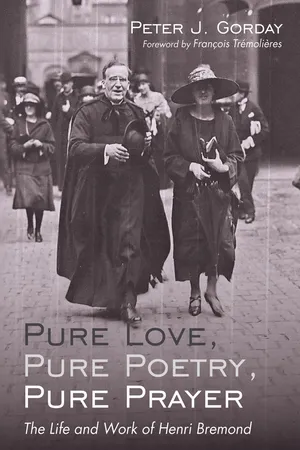
By the time of his death in 1933 Henri Bremond, priest and member of the elite Academie francaise, had established himself in France, and increasingly in England and the United States, as a distinguished historian of Christian spirituality and as a Catholic modernist who helped to shake the church out of its dogmatic slumbers by embracing "pure love," artistic-poetic expression, and mystical prayer as the privileged manifestations of spiritual truth. Drawing on substantial new scholarship in France, that has resuscitated and reinterpreted Bremond's work for our own times, and that sees Bremond as an important precursor of current trends in literary interpretation as well as spirituality, Gorday surveys the entirety of Bremond's corpus of writing, setting his work in its context of his personal struggles, as well as the wider setting of French historical and cultural development.
Information
Topic
Theology & ReligionSubtopic
Christian Theology1
Introduction
High Honors
In the spring of 1924 the abbé Henri Bremond received the greatest public honor his country could bestow on a historian and writer. Having completed to popular acclaim, but mixed scholarly reviews—even outrage in some quarters—the first six volumes of his Histoire littéraire, his projected Literary History of the Religious Sentiment in France from the Wars of Religion down to the Present Time,1 he was elected to membership in that revered bastion of elite French culture, the Académie française. He had made it to the top.
The journey, however, had been a rocky one, and he had been an unlikely candidate. His Provençal roots marked him as a regional and provincial character; his early career as a Catholic priest had been turbulent with departure from the Jesuit order; his involvement with Modernist writers and thinkers had led at one point to ecclesiastical censure; his 1912 biography of Ste. Jeanne de Chantal had landed on the Index of Prohibited Books. He was not a product of the prestigious Parisian Écoles normales, and he had not secured a university position. Further, the principal focus of his best-known historical work—Catholic spirituality in the seventeenth century—might easily have ensured permanent oblivion for all but a handful of readers in a secular society increasingly alienated from traditional churchly discourse.
But, just the opposite happened. Enthusiastically devouring long passages from the often obscure spiritual writers that Bremond cited in abundance, a diverse constituency had been enthralled by the liveliness and sparkle of his presentation, especially by his ability to capture the energy of the inner struggle to secure a place with God as something literary and artful, as poetry and autobiographical remembrance and journalistic intimacy and lyrical prayer. In a long tradition hearkening back at least to Saint-Simon’s famous memoirs from the time of Louis XIV, Bremond had mastered techniques of literary portraiture, of word-painting, in order to make religious affections, specifically the inner life of prayer, aesthetically compelling, not only for people who do pray, but also for those who might. And the fact that these affections were distinctively French only heightened his readership’s pride and pleasure in a wartime of desperate patriotic struggle for survival.
The occasion of his induction to the Académie thus marked a moment of extraordinary success for Henri Bremond, a moment whose peculiar significance resided in the kind of historical work that he was attempting to do and in the tenor of his “message,” as well as in the validation that membership as an académicien français entails.2
Though partial imitations exist in other countries, the Académie is an institution unique to France and French society. One of the five learned “companies” that since the Revolution of 1789 and its aftermath make up the Institut de France, chartered originally by Louis XIII in 1637 with precise and strict statutes, it has a peculiar national mandate: to oversee the production of the definitive dictionary of the French language, and, second, to award prizes for distinction in the arts. The Académie functions in effect as an instrument of national unity by means of linguistic unity, with “the office not to create, but to register, words approved by the authority of the best writers and by good society.”3 France being a composite land of quite distinct regional dialects and traditions, with today’s multiculturalism adding to the complexity, there is in the work of the Académie the reflecting, and then reinforcing, of an aesthetically-derived social cohesion. Moreover, the work is done not by a group of professors from the universities, but by savants and successful professionals from every walk of life, including generals, diplomats and politicians, as well as artists. As the “arbiters of elegance,” the mandarins of excellence, the members of the Académie are not primarily erudite specialists, but figures representative of popular standing and general culture.4
For French thinkers of every sort, moreover, election to membership in the Académie can justly be described as the ultimate and official act of recognition of one’s “voice,” of one’s popular impact, in a society where the role of the “public intellectual” remains very strong. That kind of presence of intellectuals in the public mind, whereby they constitute an “intelligentsia,” is a very European thing, an acknowledgment that ideas emanating from well-trained thinkers matter in the formation of national purpose and the setting of tone for national life.5 Dubbed the “Immortels” by long custom (because presumably their ideas and contributions will live on after them), and limited by statute to a membership of forty, the Académie meets regularly in closed sessions to present and discuss issues of scholarship, public interest, and cultural definition. Members are elected for life by their peers, each member occupying a specific seat in direct intellectual succession to the deceased predecessor.
And so it is no wonder that the early afternoon of May 22, 1924, found Henri Bremond, then fifty-nine years old, both exhilarated and nervous as he prepared to complete his induction into the Académie with a substantive address. Standing on Paris’s quai Conti close by the meeting place of the Académie sous la Coupule, “under the cupola,” of the Palais de l’Institut, he greeted friends and pondered his upcoming “discours de réception.” In the traditional green-embroidered coat of an académicien for the first time, he would be officially welcomed to the podium by the Perpetual Secretary, and then begin his initiatory presentation, while new peers and specially invited guests gauged his performance. The purpose of this ritually enacted “discours” is twofold: appreciative commemoration of the work of the esteemed predecessor in the seat in question (the fauteuil), and then a sketch of the direction of the inductee’s own ongoing work. Continuity and discontinuity are in play, therefore, at the same time, a prolongation of the past and a creative anticipation of the future. Build on your forebear, but improve on him as well!
The relationship of a new member to his/her predecessor can be, thus, a subtle matter. When a sitting member dies, the first step for replacement is a formal nomination, declared by a member in writing to the Secretary of the Académie, of a suitable candidate for the vacated seat. Campaigning then begins with a round of social visits to members by the candidate in order to (gently and by implication) solicit their support,6 since there will have been other candidates nominated as well for the same seat, and because it is these same, presently sitting members who will cast the decisive yea or nay votes. One of the questions in the minds of the electors will be: is this candidate a suitable/worthy/sufficiently accomplished replacement for our departed and esteemed colleague?
For Bremond, the nominator was the well-known, indeed notorious for many, nationalistic novelist and propagandist Maurice Barrès, and the seat to be filled would be that of the distinguished, though massively controversial, church historian Mgr Louis Duchesne, deceased on April 21, 1922. Complications abounded. Barrès was scorned for his type of hyper-patriotic French chauvinism, including his association with the anti-Semitic, monarchist Action Française, seen by many as fascist. Duchesne was despised by many Catholics as a liberal proto-Modernist, a historical-critical debunker of saints’s legends and an irreverent, Voltaire-like wit in relation to the unspiritual foibles of church history. His landmark history of the church, critically sophisticated but deemed irreverent by traditionalists, went on the Index in 1912. With two such polarizing figures as Barrès and Duchesne to be acknowledged and honored through his candidacy, Bremond in his canvassing, and later in his induction, needed to affirm what he saw as the best in these two, while steering clear of their excesses or blind spots. It would prove to be a delicate balancing act.
What he had the cold comfort of knowing in his nervousness on that afternoon of May 22 was that, as things turned out, he had been elected by a respectable majority of votes on the s...
Table of contents
- Title Page
- Foreword
- Preface
- Acknowledgments
- Abbreviations and Short Titles of Frequently Cited Works
- Chapter 1: Introduction
- Chapter 2: Aixois Roots and Politics
- Chapter 3: The English Desert
- Chapter 4: Newman and Blondel
- Chapter 5: Bremond and Blondel
- Chapter 6: Returning to Roots
- Chapter 7: Pure Love
- Chapter 8: Under the Shadow of Sainte-Beuve
- Chapter 9: Formulations in Time of War
- Chapter 10: Port-Royal I
- Chapter 11: Port-Royal II
- Chapter 12: Ignatian Mysticism
- Chapter 13: 1922–23: First Signs of Integration
- Chapter 14: Interlude and Assessment
- Chapter 15: Pure Poetry and Pure Prayer
- Chapter 16: The “Metaphysic of the Saints” I
- Chapter 17: The “Metaphysic of the Saints” II
- Chapter 18: Bremond’s Mysticism
- Chapter 19: If We Die with Christ, then We Shall Sing with Him
- Chapter 20: Histoire, XI
- Chapter 21: Conclusions
- Bibliography
Trusted by 375,005 students
Access to over 1.5 million titles for a fair monthly price.
Study more efficiently using our study tools.
Frequently asked questions
Yes, you can cancel anytime from the Subscription tab in your account settings on the Perlego website. Your subscription will stay active until the end of your current billing period. Learn how to cancel your subscription
No, books cannot be downloaded as external files, such as PDFs, for use outside of Perlego. However, you can download books within the Perlego app for offline reading on mobile or tablet. Learn how to download books offline
Perlego offers two plans: Essential and Complete
- Essential is ideal for learners and professionals who enjoy exploring a wide range of subjects. Access the Essential Library with 800,000+ trusted titles and best-sellers across business, personal growth, and the humanities. Includes unlimited reading time and Standard Read Aloud voice.
- Complete: Perfect for advanced learners and researchers needing full, unrestricted access. Unlock 1.5M+ books across hundreds of subjects, including academic and specialized titles. The Complete Plan also includes advanced features like Premium Read Aloud and Research Assistant.
We are an online textbook subscription service, where you can get access to an entire online library for less than the price of a single book per month. With over 1.5 million books across 990+ topics, we’ve got you covered! Learn about our mission
Look out for the read-aloud symbol on your next book to see if you can listen to it. The read-aloud tool reads text aloud for you, highlighting the text as it is being read. You can pause it, speed it up and slow it down. Learn more about Read Aloud
Yes! You can use the Perlego app on both iOS and Android devices to read anytime, anywhere — even offline. Perfect for commutes or when you’re on the go.
Please note we cannot support devices running on iOS 13 and Android 7 or earlier. Learn more about using the app
Please note we cannot support devices running on iOS 13 and Android 7 or earlier. Learn more about using the app
Yes, you can access Pure Love, Pure Poetry, Pure Prayer by Peter J. Gorday in PDF and/or ePUB format, as well as other popular books in Theology & Religion & Christian Theology. We have over 1.5 million books available in our catalogue for you to explore.