eBook - ePub
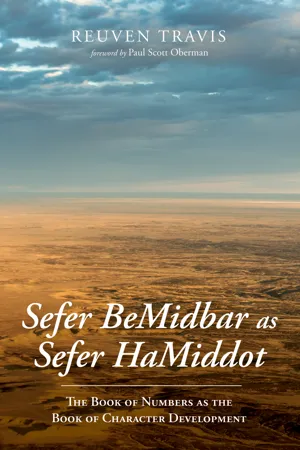
Sefer BeMidbar as Sefer HaMiddot
The Book of Numbers as the Book of Character Development
- 380 pages
- English
- ePUB (mobile friendly)
- Available on iOS & Android
eBook - ePub
Sefer BeMidbar as Sefer HaMiddot
The Book of Numbers as the Book of Character Development
About this book
While it is true the Bible does relate important episodes in the history of the Jewish people, it is thought of as being much more than a history book. This is why many question the Bible's rationale for including a book such as Numbers, one that seems to be little more than a history book. In comparison, Genesis as a history book makes sense. It tells of the creation of the heavens and earth and the foundational stories of the Jewish people. Even Exodus, which relates the departure of the Jewish people from Egypt, has many legal sections. This thus begs the question: what exactly is the Book of Numbers, and what role does it play in the overall narrative of the Bible? Presenting Numbers as the book of character development is the major guiding principle of the pedagogical approach set forth in this book for teaching Numbers. This approach can also be used for teaching Genesis. However, the characters in Genesis are portrayed as either "very good" or "evil." Not so in Numbers, whose main personalities can and should be viewed in hues of grey, making it a very appropriate vehicle for teaching character development to high school students.
Information
Part One
A Complex Text
Chapter 1
The Challenges of Teaching Sefer BeMidbar
The book of Numbers, or Sefer BeMidbar as it is known in Hebrew, is a complex text, one whose narrative has been explicated in a variety of ways. An obvious but arguably simplistic approach to looking at this text is to see it as a story of a sinful people and a wrathful God. The God of this book certainly seems to see it this way.
Nevertheless, as I live and as the Lord’s Presence fills the whole world, none of the men who have seen My Presence and the signs that I have performed in Egypt and in the wilderness, and who have tried Me these many times [literally, ten times] and have disobeyed Me, shall see the land that I promised on oath to their fathers; none of those who spurn Me shall see it. (Numbers 14:21–23)1
What were these many times that the people disobeyed and provoked the Lord during their forty-year sojourn in the wilderness? Starting with chapter 14 of the book of Exodus and continuing through chapter 14 of the book of Numbers, the following ten incidents listed in the Babylonian Talmud, Erchin 15a seem to underscore the rebellious nature of the Jewish people in the Sinai desert.2
• The children of Israel, pinned against the Red Sea with the Egyptians in close pursuit, complained to Moses: “Was it for a lack of graves in Egypt that you took us to die in the wilderness?” (Exodus 14:11)
• After safely crossing the sea, Israel suspected that the Egyptians ascended on the opposite bank until God had the water spit them out: “Thus the Lord delivered Israel that day from the Egyptians. Israel saw the Egyptians dead on the shore of the sea.” (Exodus 14:30)
• Complaining about the lack of water at Marah: “And the people grumbled against Moses, saying, ‘What shall we drink?’” (Exodus 15:24)
• Complaining about the lack of food in the wilderness of Sin: “In the wilderness, the whole Israelite community grumbled against Moses and Aaron. The Israelites said to them, ‘If only we had died by the hand of the Lord in the land of Egypt, when we sat by the fleshpots, when we ate our fill of bread! For you have brought us out into this wilderness to starve this whole congregation to death.’” (Exodus 16:2–3)
• Leaving over manna in defiance of the command not to leave the manna overnight: “But they paid no attention to Moses; some of them left of it until morning, and it became infested with maggots and stank. And Moses was angry with them.” (Exodus 16:20)
• Searching for manna on the morning of the Sabbath: “Yet some of the people went out on the seventh day to gather, but they found nothing.” (Exodus 16:27)
• Complaining about the lack of water at Rephidim: “From the wilderness of Sin the whole Israelite community continued by stages as the Lord would command. They encamped at Rephidim, and there was no water for the people to drink. The people quarreled with Moses. ‘Give us water to drink,’ they said; and Moses replied to them, ‘Why do you quarrel with me? Why do you try the Lord?’ But the people thirsted there for water; and the people grumbled against Moses and said, ‘Why did you bring us up from Egypt, to kill us and our children and livestock with thirst’?” (Exodus 17:1–3)
• The sin of the golden calf: “When the people saw that Moses was so long in coming down from the mountain, the people gathered against Aaron and said to him, ‘Come, make us a god who shall go before us, for that man Moses, who brought us from the land of Egypt—we do not know what has happened to him.’ Aaron said to them, ‘Take off the gold rings that are on the ears of your wives, your sons, and your daughters, and bring them to me.’ And all the people took off the gold rings that were in their ears and brought them to Aaron. This he took from them and cast in a mold, and made it into a molten calf. And they exclaimed, ‘This is your god, O Israel, who brought you out of the land of Egypt!’ When Aaron saw this, he built an altar before it; and Aaron announced: ‘Tomorrow shall be a festival of the Lord!’ Early next day, the people offered up burnt offerings and brought sacrifices of well-being; they sat down to eat and drink, and then rose to dance.” (Exodus 32:1–6)
• The “mixed multitude” of nations which accompanied Israel complaining about the lack of meat, precipitating Israel’s complaining as well: “The riffraff in their midst felt a gluttonous craving; and then the Israelites wept and said, ‘If only we had meat to eat! We remember the fish that we used to eat free in Egypt, the cucumbers, the melons, the leeks, the onions, and the garlic. Now our gullets are shriveled. There is nothing at all! Nothing but this manna to look to!’” (Numbers 11:4–6)
• The sin of the ten spies, who gave a negative report about the land of Israel when they returned from spying it out, after which God refers to Israel as “having tested Me these ten times” (Numbers 13–14)
Given these, it is not surprising that many Christian preachers and teachers view the God of the Old Testament as a God of wrath compared to the God of the New Testament, who is seen as a God of love. Carl Olson, editor of Catholic World Report and Ignatius Insight, sums it up quite succinctly when he states that there is a “widespread and deeply ingrained” view among some Christians “that the God described in the Old Testament is, on the whole, quite angry and judgmental.”3
Chuck Swindoll expresses a similar view. Swindoll is an evangelical Christian pastor, author, educator, and radio preacher who founded the publication Insight for Living and a radio program of the same name which airs on more than two thousand stations around the world. In his words, “More than just a history lesson, the Book of Numbers reveals how God reminded Israel that He does not tolerate rebellion, complaining, and disbelief without invoking consequences.”4
As a last example, consider the views of David Lamb, author of God Behaving Badly: Is the God of the Old Testament Angry, Sexist and Racist? In a 2013 interview, Lamb was asked why he wrote this book. He responded in part:
I was on a date with my wife Shannon recently, and we ended up chatting with my server. He says to me, “So what do you do?” I replied, “I teach the Bible, mainly the Old Testament.” My response prompted him to ask, “The Old Testament—isn’t that where God is always getting angry, smiting people, and destroying cities all the time?” I tell him, “Well, not exactly, but I get that question a lot because the God of the Old Testament has a bad reputation.” I wrote God Behaving Badly for this server and for anyone who wonders about God’s behavior in the OT (which is pretty much everyone). One of the biggest obstacles to moving atheists, agnostics, and skeptics toward God is the problematic passages of the Old Testament. I talk to people about the problem of God of the Old Testament all the time: my cardiologist, my postman, my son’s soccer coach, my Sunday school class, and literally hundreds of college students. I wrote the book for them.5
In fairness, these people for whom Lamb wrote his book, as we have already seen, base their views about the God of the Old Testament upon large portions of the Torah narrative. To their credit, teachers and authors such as Olson, Swindoll, and Lamb work to disabuse the masses of this image of a wrathful and unforgiving God. Their efforts make great sense if one sees in the Old Testament theological underpinnings to the New Testament, and even a cursory perusal ...
Table of contents
- Title Page
- Foreword
- Preface
- Part One: A Complex Text
- Part Two: The Narrative of Sefer BeMidbar
- Part Three: The Legal Positings of Sefer BeMidbar
- Final Thoughts
- Appendix: Sample Rubric for Middot Essays
- About the Author
- Bibliography
Trusted by 375,005 students
Access to over 1.5 million titles for a fair monthly price.
Study more efficiently using our study tools.
Frequently asked questions
Yes, you can cancel anytime from the Subscription tab in your account settings on the Perlego website. Your subscription will stay active until the end of your current billing period. Learn how to cancel your subscription
No, books cannot be downloaded as external files, such as PDFs, for use outside of Perlego. However, you can download books within the Perlego app for offline reading on mobile or tablet. Learn how to download books offline
Perlego offers two plans: Essential and Complete
- Essential is ideal for learners and professionals who enjoy exploring a wide range of subjects. Access the Essential Library with 800,000+ trusted titles and best-sellers across business, personal growth, and the humanities. Includes unlimited reading time and Standard Read Aloud voice.
- Complete: Perfect for advanced learners and researchers needing full, unrestricted access. Unlock 1.5M+ books across hundreds of subjects, including academic and specialized titles. The Complete Plan also includes advanced features like Premium Read Aloud and Research Assistant.
We are an online textbook subscription service, where you can get access to an entire online library for less than the price of a single book per month. With over 1.5 million books across 990+ topics, we’ve got you covered! Learn about our mission
Look out for the read-aloud symbol on your next book to see if you can listen to it. The read-aloud tool reads text aloud for you, highlighting the text as it is being read. You can pause it, speed it up and slow it down. Learn more about Read Aloud
Yes! You can use the Perlego app on both iOS and Android devices to read anytime, anywhere — even offline. Perfect for commutes or when you’re on the go.
Please note we cannot support devices running on iOS 13 and Android 7 or earlier. Learn more about using the app
Please note we cannot support devices running on iOS 13 and Android 7 or earlier. Learn more about using the app
Yes, you can access Sefer BeMidbar as Sefer HaMiddot by Reuven Travis in PDF and/or ePUB format, as well as other popular books in Theology & Religion & Biblical Criticism & Interpretation. We have over 1.5 million books available in our catalogue for you to explore.