eBook - ePub
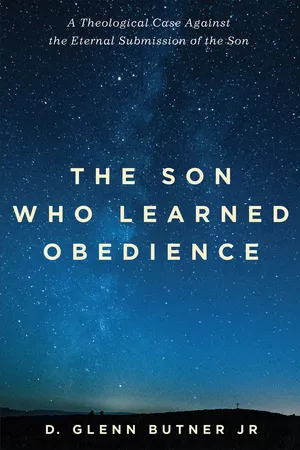
The Son Who Learned Obedience
A Theological Case Against the Eternal Submission of the Son
- 234 pages
- English
- ePUB (mobile friendly)
- Available on iOS & Android
eBook - ePub
The Son Who Learned Obedience
A Theological Case Against the Eternal Submission of the Son
About this book
This book offers a fresh perspective on the ongoing evangelical debate concerning whether the Son eternally submits to the Father. Beginning with the pro-Nicene account of will being a property of the single divine nature, Glenn Butner explores how language of eternal submission requires a modification of the classical theology of the divine will. This modification has problematic consequences for Christology, various atonement theories, and the doctrine of God, because as historically developed these doctrines shared the pro-Nicene assumption of a single divine will. This new angle on an old debate challenges the reader to move beyond the inaccurate characterization of views on eternal submission as "Arian" or "feminist" toward a more accurate understanding of the real theological issues at stake.
Information
Topic
Theology & ReligionSubtopic
Biblical Studies1
The Father’s Will Set Forth in Christ
The Evangelical Trinitarian Debate
“In him we have redemption through his blood, the forgiveness of our trespasses, according to the riches of his grace, which he lavished upon us, in all wisdom and insight, making known to us the mystery of his will, according to his purpose, which he set forth in Christ.” (Eph 1:7–9)
“The will of the Father and the Son is one, and their operation is inseparable.”16
—Augustine of Hippo
Descriptions of the intimate relation between the Father and the Son fill the New Testament, particularly in depictions of the will and actions of God that contribute to trinitarian thought about God. This is clear in the Gospel of John when Jesus debates with a group of Jews over Sabbath observance. John 5:19–30 serves as an immediate response to what may have initially represented a juridical controversy over Sabbath observance (John 5:3–16),17 something common in Jewish theological debates of the first several centuries AD as various Jewish groups sought clarity on how much work if any could be done on the Sabbath.18 The exchange quickly escalated when Jesus defends his actions by identifying his work with the work of the Father (5:17), something his accusers view as “making himself equal with God” (5:18). Here, Jesus could have easily corrected the misconception if he did not intend to equate himself with God; instead, he reinforces his equality with God by claiming for himself two actions that are shared with his Father.
Jesus’s response to his Jewish opponents is to claim, “The Son can do nothing of his own accord, but only what he sees the Father doing. For whatever the Father does, the Son does likewise” (John 5:19). Jesus explains his equality with the Father by pointing to two paradigmatic divine actions: judgment and giving life. In 5:21 Jesus claims for himself the authority to give life (zōopoiei), a word often used of God in the Septuagint.19 Similar terminology is used to describe God in other Jewish texts preserved in Greek,20 so when Jesus claims the authority to give life, he is clearly accepting the charge of his opponents that he is equal to God. God is the one who breathed life into Adam and Eve, who created the world and everything in it, and likewise “the Son gives life to whom he will.” Jesus also claims for himself the right to judge on the last day (5:27). Here again, we encounter a paradigmatic divine action. Claims that God will raise the dead to execute judgment are found throughout the Old Testament and Apocrypha (Isa 26:19, Dan 12:2, 2 Macc 7, 1 En. 22, 2 Esd 7, Bar 42:7, 15:2).21 The implications of Jesus’s words is that his acts are the acts of the Father.
Initially, Jesus’s response defends his healing on the Sabbath by appealing to a common Jewish notion that God still does the work of bringing life and death on the Sabbath.22 Christ does this same work of the Father because he does what the Father does. Besides serving as a response to his accusers, Jesus’s words in John 5:20 also serve as something of a thesis for the festival cycle, that portion of John’s gospel that focuses on Christ’s actions and teachings during various Jewish festivals (John 5–11). The initially discussed acts of judging and giving life only begin to illustrate the fact that Jesus and his Father do the same works. Jesus clearly states that the Father “shows [the Son] all that he himself is doing” (5:20). The present active indicative (deiknusin) has an undefined aspect, suggesting the possibility that the Father is continuously showing the Son all that he does, such that the Father will do nothing new that the Son will not be aware of; there is a temporal exhaustiveness to the Son’s knowledge. Moreover, the Father shows all (panta) that he is doing, leaving nothing hidden; there is a missional exhaustiveness to the Son’s knowledge. In short, whatever the Father is doing or will do to elect, save, preserve, or sanctify his people is shown to the Son, and “whatever the Father does, that the Son does likewise” (John 5:19).
Throughout the festival cycle Jesus performs miracles and makes claims that identify his works with the work of the Father. Passover primarily commemorates the deliverance of Israel from Egypt (Deut 16:1–8).23 During Passover in the festival cycle, Jesus feeds the 5,000 (6:1–15) and walks on water (6:16–24), recreating the two miraculous works of God by which he preserved Israel between Egypt and Canaan: miraculously providing means of crossing the Red Sea,24 and miraculously providing manna from heaven. Jesus explicitly claims to be the “bread of life” (6:35) and the “bread that came down from heaven” (6:41), connecting his person with the Father’s life-sustaining works of provision in the Exodus account. Similarly, Jesus is the one like the paschal lamb whose flesh must be eaten (6:53). In this teaching, Jesus claims that the festivals are pointing to the Son as much as they point to the works of the Father seen in salvation history, thereby identifying himself with the work of the Father. The Feast of Tabernacles emphasizes the light of God’s glory.25 A water libation pointing to an eschatological hope for God to renew the world is the feast’s signature ritual.26 During this festival, Jesus claims to be the “light of the world” (8:12), an allusion to divine glory.27 When in John 7:37 Jesus stands up on the last day of Tabernacles and tells the thirsty to come to him for living water, he is identifying himself with the Father’s historic provision of water to the Israelites in the wilderness (Exod 17:1–7). In each of these festivals, Jesus is associating himself with the redemptive historical work of the Father, continuing to illustrate the point made in John 5:19–20: the Son works as his Father works in history, even on the Sabbath.
This Johannine pattern of shared works between the Father and Son during the Sabbath debate and festival cycle is one of many scriptural patterns that can serve as a starting point for introducing the doctrine of the Trinity, which develops such scriptural tropes through use of philosophy to establish doctrinal statements that offer conceptual clarity. I choose this location to introduce the doctrine of the Trinity because it raises an important set of questions. Does Jesus do the same works as his Father because he shares in the actions of his Father inseparably? Or is there a division in this shared work such that the Son does the sam...
Table of contents
- Title Page
- Acknowledgements
- Introduction
- Chapter 1: The Father’s Will Set Forth in Christ
- Excursus 1
- Chapter 2: The Obedience of One Man
- Chapter 3: Obedient to the Point of Death
- Chapter 4: God’s Good, Pleasing, and Perfect Will
- Excursus 2
- Chapter 5: His Counsel Revealed to the Prophets
- Conclusion
- Bibliography
Trusted by 375,005 students
Access to over 1.5 million titles for a fair monthly price.
Study more efficiently using our study tools.
Frequently asked questions
Yes, you can cancel anytime from the Subscription tab in your account settings on the Perlego website. Your subscription will stay active until the end of your current billing period. Learn how to cancel your subscription
No, books cannot be downloaded as external files, such as PDFs, for use outside of Perlego. However, you can download books within the Perlego app for offline reading on mobile or tablet. Learn how to download books offline
Perlego offers two plans: Essential and Complete
- Essential is ideal for learners and professionals who enjoy exploring a wide range of subjects. Access the Essential Library with 800,000+ trusted titles and best-sellers across business, personal growth, and the humanities. Includes unlimited reading time and Standard Read Aloud voice.
- Complete: Perfect for advanced learners and researchers needing full, unrestricted access. Unlock 1.5M+ books across hundreds of subjects, including academic and specialized titles. The Complete Plan also includes advanced features like Premium Read Aloud and Research Assistant.
We are an online textbook subscription service, where you can get access to an entire online library for less than the price of a single book per month. With over 1.5 million books across 990+ topics, we’ve got you covered! Learn about our mission
Look out for the read-aloud symbol on your next book to see if you can listen to it. The read-aloud tool reads text aloud for you, highlighting the text as it is being read. You can pause it, speed it up and slow it down. Learn more about Read Aloud
Yes! You can use the Perlego app on both iOS and Android devices to read anytime, anywhere — even offline. Perfect for commutes or when you’re on the go.
Please note we cannot support devices running on iOS 13 and Android 7 or earlier. Learn more about using the app
Please note we cannot support devices running on iOS 13 and Android 7 or earlier. Learn more about using the app
Yes, you can access The Son Who Learned Obedience by D. Glenn Butner Jr. in PDF and/or ePUB format, as well as other popular books in Theology & Religion & Biblical Studies. We have over 1.5 million books available in our catalogue for you to explore.