eBook - ePub
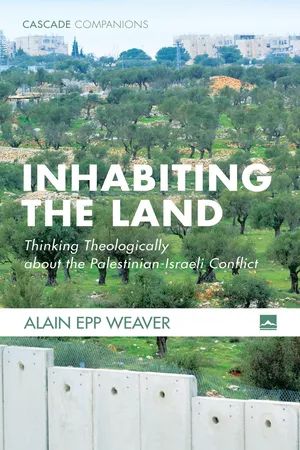
Inhabiting the Land
Thinking Theologically about the Palestinian-Israeli Conflict
- 148 pages
- English
- ePUB (mobile friendly)
- Available on iOS & Android
eBook - ePub
About this book
What does it mean to inhabit the land of Palestine and Israel justly? How should Christians understand the Palestinian-Israeli conflict? Alain Epp Weaver examines answers to these questions, paying particular attention to the theologies of sumud, or steadfastness, advanced by Palestinian Christian theologians, while also presenting other Christian, Jewish, and Muslim responses. Contextualizing these theologies within Palestinian and Israeli Jewish histories, Epp Weaver introduces readers to the intertwined histories of Zionism (as a movement to establish a Jewish state and renew Jewish life in the biblical land of Israel) and Palestinian nationalism. He also situates Palestinian Christian theologies within broader Christian conversations about election, God's enduring covenant with the Jewish people, and Zionism. In the face of a politics of separation and dispossession, Epp Weaver contends, Palestinian Christian theologies testify to the possibility of a shared polity and geography for Palestinians and Israeli Jews not defined by walls, militarized fences, checkpoints, and roadblocks, but rather by mutuality and reconciliation.
Information
Topic
Theology & ReligionSubtopic
Middle Eastern Politics1
Zionism and Palestinian Nationalism: Intertwined Histories
This chapter traces the roots of the Palestinian-Israeli conflict by examining the histories of Zionism and Palestinian nationalism. In the course of narrating these intertwined histories, the chapter provides a mostly chronological account of the Palestinian-Israeli conflict from the late nineteenth century up to the present. This historical narrative is supplemented by the timeline in Appendix 1. Readers interested in exploring the history of the Palestinian-Israeli conflict in greater depth should consult the studies listed in the Further Reading section at the end of this book.
Zionism and European Nationalism
Zionism is a modern nationalist movement originating in the late nineteenth century. Most versions of Zionism aimed at securing Jewish sovereignty and reviving Jewish life within Palestine in what was then part of the Ottoman Empire. Zionism thus emerged late within the rise of European nationalism in the 1800s, during which time questions of national identity and roots became increasingly pronounced. As states became focused on answering these questions of identity (What does it mean to be French? to be German? etc.), the place of Jews within European society became a point of debate and contention. Traditionally confined primarily to ghettos, some European Jews started becoming assimilated into broader national contexts. Yet even as this assimilation process unfolded, some European Jews had become convinced that Jewish assimilation into their broader societies within contexts of rising nationalist sentiment was an illusory dream. In 1862, Jewish philosopher Moshe Hess published Rome and Jerusalem, in which he envisioned the establishment of a Jewish socialist commonwealth in the land. Anti-Jewish pogroms, or riots, in 1881 in Tsarist Russia set off an initial wave of Zionist migration (aliyah, or ascent) to Palestine. In 1882, Judah Pinsker penned one of the first Zionist tracts, Auto-Emancipation, in which he argued that the Jewish people were a distinctive element among the European nations who could not be assimilated. Therefore, he continued, Jews needed to take responsibility for their own future and find a place where they could exercise self-determination free from other nations.
Alongside other languages, most Eastern European Jews at this time spoke Yiddish, a Germanic dialect with borrowings from biblical Hebrew and from various European languages. The linguist Eliezer Ben-Yehuda, who immigrated to Palestine in 1881, argued that the Zionist vision required the revival of Hebrew as a spoken, instead of solely liturgical, language. Ben-Yehuda and fellow collaborators simplified Hebrew grammar, invented new Hebrew words, and created the first Hebrew dictionary. The Modern Hebrew spoken in Israel today has its origins in the efforts of this group.
By the late nineteenth century, Zionist energies had begun to coalesce. The Dreyfus Affair, in which Albert Dreyfus, a French military officer of Jewish descent, was accused in 1894 of spying for Germany, exposed a strong current of anti-Semitism running through French society (and through Europe more broadly). By 1896, Theodor Herzl, one of the leading intellectual visionaries of Zionism, had shifted from staunch advocacy of assimilation into European societies to a firmly pro-Zionist position, a shift represented in Herzl’s influential tome, Der Judenstaat (The Jewish State). In 1897, Herzl convened the First Zionist Congress in Basel, Switzerland, joined by other early Zionist luminaries like Max Nordau. The meeting produced the pioneering Basel Program, which articulated the vision of establishing a national home of the Jewish people in eretz yisrael (the biblical “land of Israel”) and a program of encouraging the settlement of Jewish farmers, manufacturers, and artisans in the land. While Herzl and other early Zionists sometimes entertained ideas of the Zionist project unfolding in other locations, such as Uganda, the primary focus of Zionist territorial aspirations was the land of Israel. A phrase from Herzl’s writings—“If you will it, it is no dream”—captured Zionism’s Romantic and visionary spirit, becoming a widely used Zionist slogan.
The next two decades witnessed accelerated developments in the Zionist project. The period between 1904 and 1914 witnessed a second wave of aliyah, with around 35,000 Jews, mostly from Eastern Europe, immigrating to Palestine. Two key events then transpired during World War I that proved momentous. In 1916, as it became clear that the Ottoman Empire, led from Istanbul, was on the brink of defeat, British and French officials, led by Mark Sykes and François Georges-Picot, met in secret to agree on the division of the Arab Middle East into respective French and British spheres of control. Then, in 1917, the United Kingdom’s Foreign Secretary Arthur Balfour wrote a letter to a leading Zionist in Britain, Walter Rothschild, in which he committed the United Kingdom to a policy of support for Zionist aspirations. The pertinent section of the letter, which came popularly to be known as the Balfour Declaration, expressed the United Kingdom’s support for “the establishment in Palestine of a national home for the Jewish people,” so long as it does not “prejudice the civil and religious rights of existing non-Jewish communities in Palestine, or the rights and political status enjoyed by Jews in any other country.”1
In the wake of World War I, a third wave of approximately 40,000 Jewish immigrants moved to Palestine. The vast majority of these immigrants came from Eastern Europe following the October Revolution of 1917–1918 in Russia. Then, in 1922, the newly formed League of Nations granted Britain a Mandate over the parts of the dissolved Ottoman Empire called Palestine and Transjordan (today’s Jordan). The League of Nations also granted Britain a Mandate over Iraq and France a Mandate over Lebanon and Syria. As Mandate powers, Britain and France were tasked with administering these former Ottoman territories for a transitional period towards national independence and self-determination. The Mandate system reflected colonial assumptions that Western powers had a “civilizing mission” to prepare non-Western peoples for self-determination. British authorities ruled Palestine for more than a quarter century, with the Mandate ending in 1948.
Diversities of Zionism
From its inception, Zionism was an internally diverse movement, with different visions for Jewish settlement in eretz yisrael. Key streams within Zionism included:
Labor Zionism
One major current of Zionist thought sought to merge socialist ideals with the Zionist project of establishing a Jewish state. Key leaders included Nachman Syrkin, Haim Orlosoroff, and Berl Katznelson. The State of Israel’s first Prime Minister, David Ben-Gurion, emerged from this socialist stream of Zionism—as did Israel’s Labor Party.
Labor Zionists held that worldwide socialist revolutions would not solve the question of the place of Jews within their broader nation-states—an independent Jewish state was still needed. “Hebrew Labor” (avodah ivrit) would be essential to the establishment of such a state, Labor Zionists insisted. The iconic Israeli institution of the kibbutzim—collective communities—emerged from this movement.
Revisionist Zionism
Led by Ze’ev Jabotinsky, Revisionist Zionists chafed at what they viewed as compromising tactics of Zionist leaders like Chaim Weizmann and David Ben-Gurion, who argued that the Zionist movement should take a practical approach and accept sovereignty in whatever parts of eretz yisrael would be granted by the ruling authorities. Revisionists like Jabotinsky, in contrast, advanced a maximalist approach, pressing British authorities for Jewish settlement not only in Palestine, but also in Transjordan (east of the Jordan River), where the British Mandate rulers had prevented Zionist settlement.
Revisionist Zionists were staunch anti-communists and regularly came into conflict with Labor Zionists. Future Israeli Prime Ministers Menachem Begin and Yitzhak Shamir emerged from within the Revisionist movement, leading paramilitary organizations (Irgun and Lehi, respectively) that attacked British authorities and Palestinian Arabs. Today’s Likud party is a descendant of Revisionist Zionism.
Religious Zionism
Jewish life in Palestine during the Ottoman era was concentrated in what came to be known as the four holy cities of Jerusalem, Hebron, Safed, and Tiberias. Yet while these Jewish communities lived and prayed in eretz yisrael, they viewed themselves, like other religious Jews, as being in a state of exile, awaiting the coming of the mashiach, or messiah, and the ingathering of the exiles and the establishment of the messianic kingdom. Attempts to establish a Jewish state prior to the messiah’s coming, from this perspective, were blasphemous.
The religious Zionism propounded by Rabbi Abraham Isaac Kook (1865–1935) broke from this traditional understanding of Jewish return to the land. For Kook, Zionism, even as a secular movement, was part of a divine plan to bring God’s chosen people back to the land, where they would be able to follow laws of the Torah and observe halakhic precepts (rabbinic law as identified in the Talmud) specific to life in eretz yisrael. Kook and his followers maintained that Zionist settlement, rather than expressing a blasphemous repudiation of divine will, represented a faithful anticipation of and preparation for the messiah’s return. Abraham Isaac Kook’s son, Rabbi Zvi Yehuda Kook, further developed his father’s religious nationalist ideas, but with a greater emphasis on militarism and political action. In the 1970s, groups like Gush Emunim (Bloc of the Faithful) that pressed for Israeli settlement and even annexation of the Occupied Territories took inspiration from Zvi Yehuda Kook’s ideas. The younger Kook’s ideas in turn paved the way for figures such as Rabbi Meir Kahane, an outspoken advocate for the expulsion of Palestinians from eretz yisrael. The legacy of Kook lives on today among religious West Bank settlers and the right-wing HaBayit HaYehudi (Our Jewish Home) party.
Cultural Zionism
For the cultural Zionism espoused by Ahad Ha’am, a leader in the World Zionist Organization in the early twentieth century, the Zionist project’s focus was to be on the revival of Jewish culture and the Hebrew language as a living language (rather than solely a language of worship and prayer) within eretz yisrael. Contrary to Herzl’s flexibility about the location of the envisioned Jewish state, Ha’am insisted on Palestine as the only option for the Zionist project, while also stressing the importance of Jewish self-reliance in reviving Jewish life in the land.
Cultural Zionists like Ha’am were not necessarily opposed to the eventual establishment of a Jewish state—but they wanted to ensure that such a state would truly be a Jewish state in terms of culture and values, rather than simply a state of the Jews, and so emphasized the primary importance of Jewish spiritual revival in the land.
Brit Shalom and Proponents of Binationalism
Ha’am’s ideas were taken up by a small group of intellectuals in Mandate Palestine who banded together in 1925 to found Brit Shalom (Covenant o...
Table of contents
- Title Page
- Acknowledgments
- Introduction
- Chapter 1: Zionism and Palestinian Nationalism: Intertwined Histories
- Chapter 2: Palestinian Christian Theologies of Land and Liberation
- Chapter 3: Christian Theologies of Judaism and Assessments of Zionism
- Chapter 4: A Shared Palestinian-Israeli Future?
- Appendix 1: Timeline
- Appendix 2: Maps
- Works Cited and Further Reading
Trusted by 375,005 students
Access to over 1.5 million titles for a fair monthly price.
Study more efficiently using our study tools.
Frequently asked questions
Yes, you can cancel anytime from the Subscription tab in your account settings on the Perlego website. Your subscription will stay active until the end of your current billing period. Learn how to cancel your subscription
No, books cannot be downloaded as external files, such as PDFs, for use outside of Perlego. However, you can download books within the Perlego app for offline reading on mobile or tablet. Learn how to download books offline
Perlego offers two plans: Essential and Complete
- Essential is ideal for learners and professionals who enjoy exploring a wide range of subjects. Access the Essential Library with 800,000+ trusted titles and best-sellers across business, personal growth, and the humanities. Includes unlimited reading time and Standard Read Aloud voice.
- Complete: Perfect for advanced learners and researchers needing full, unrestricted access. Unlock 1.5M+ books across hundreds of subjects, including academic and specialized titles. The Complete Plan also includes advanced features like Premium Read Aloud and Research Assistant.
We are an online textbook subscription service, where you can get access to an entire online library for less than the price of a single book per month. With over 1.5 million books across 990+ topics, we’ve got you covered! Learn about our mission
Look out for the read-aloud symbol on your next book to see if you can listen to it. The read-aloud tool reads text aloud for you, highlighting the text as it is being read. You can pause it, speed it up and slow it down. Learn more about Read Aloud
Yes! You can use the Perlego app on both iOS and Android devices to read anytime, anywhere — even offline. Perfect for commutes or when you’re on the go.
Please note we cannot support devices running on iOS 13 and Android 7 or earlier. Learn more about using the app
Please note we cannot support devices running on iOS 13 and Android 7 or earlier. Learn more about using the app
Yes, you can access Inhabiting the Land by Alain Epp Weaver in PDF and/or ePUB format, as well as other popular books in Theology & Religion & Middle Eastern Politics. We have over 1.5 million books available in our catalogue for you to explore.